The 8 Steps
1. Know your sunset, and finish the last stop before it. Calculated with NOAA's solar equations, sunset on Monday, November 2, 2026 is 4:36 PM in Boston, 4:43 PM in Chicago, 4:57 PM in Denver, 4:59 PM in Minneapolis, 5:28 PM in Columbus, 5:35 PM in Dallas, and 5:44 PM in Atlanta. Look up yours, and move any last stop that cannot be finished by then. For more on what the change does to routes, see The Clocks Fall Back November 1.
2. Walk every trailer's lights, hooked up. Federal rules require that "all lamps required by this subpart shall be capable of being operated at all times" on commercial motor vehicles (49 CFR 393.9(a)). Lights that nobody checked all summer are about to be needed on the drive home. Hook each trailer to its truck and check brake lights, turn signals, tail lights, and marker lights.
3. Clean the lenses and reflectors. No commercial motor vehicle may be driven when required lamps or reflectors are obscured "by any part of the load or its covering, by dirt, or other added vehicle or work equipment or otherwise" (49 CFR 392.33). In leaf season, that includes the leaves, mud, and debris packed around trailer lights.
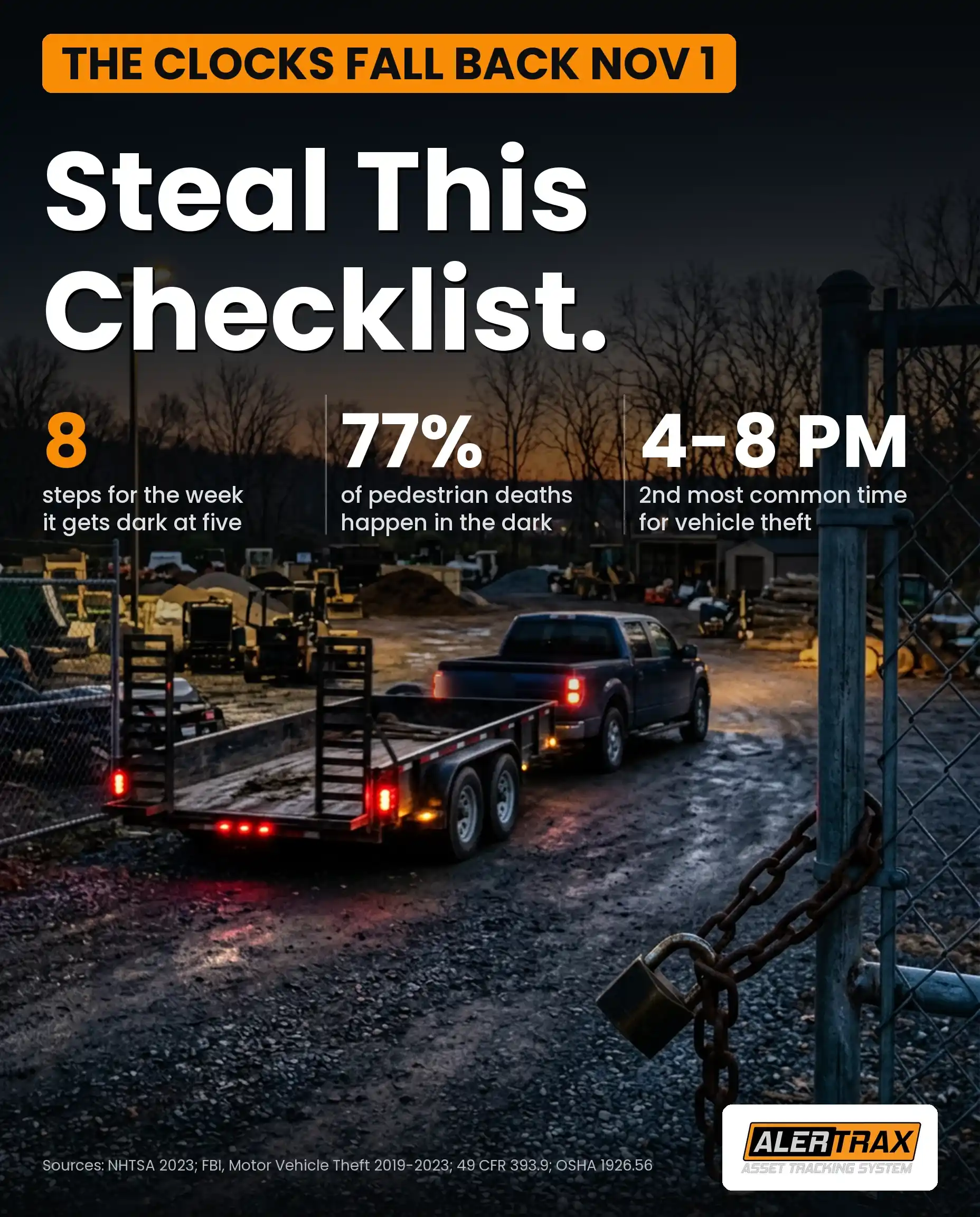
4. Get everybody at the curb into high visibility. In 2023, 77 percent of pedestrian deaths in the U.S. happened in the dark, and in the fall, the deadliest window was 6:00 to 8:59 PM, with 32 percent of pedestrian deaths (NHTSA, Pedestrians: 2023 Data). After November 1, crews loading a trailer at the curb at 5 PM are working in that light. Reflective vests or shirts on everyone, and a light on the trailer. More in The Dark Hour Just Moved Up.
5. Light the place where crews unload. For construction work, OSHA sets minimum lighting while work is in progress, including 3 foot-candles for "active storage areas, loading platforms, refueling, and field maintenance areas" (29 CFR 1926.56, Table D-3). Whether or not that standard covers your yard, it is a useful benchmark: if the crew cannot see the ramp, the hitch, or the fuel can at 5:30, fix the lights now.
6. Everything home before the evening theft window. FBI data from 2019 to 2023 show 4 PM to 7:59 PM is the second most common time of day for reported motor vehicle thefts, after 8 PM to 11:59 PM (FBI, Motor Vehicle Theft, 2019 to 2023). The equipment theft report says equipment "should also never be left on trailers," and work sites usually have lower security than your yard (NER/NICB 2016 Equipment Theft Report). Nothing stays at a job site overnight. See It's Dark by 5. Your Trailer Is Still at the Job.
7. Move your evening alerts earlier. If your trackers have parked hours or after-hours alerts, they were probably set for summer. Crews are back an hour earlier now, and it is dark an hour earlier. Move the start time to match.
8. Tell the crews and the customers, and put one name on lock-up. Send the new start and end times to every crew and any customer who expects you at a set time. Assign one person to lock the gate each night, because lock-up in the dark gets rushed. Only about 21 percent of stolen equipment is recovered (NER/NICB 2016 Equipment Theft Report), so the lock-up is worth the five minutes.
Sources
United States Code, 15 U.S.C. 260a, "Advancement of time or changeover dates," retrieved October 2026: daylight saving time ends at 2 AM on the first Sunday of November
NOAA Global Monitoring Laboratory, solar position equations used in the NOAA Solar Calculator: sunset times in this article were calculated by Alertrax for city-center coordinates in October 2026 and may differ by a minute or so from other published tables
Electronic Code of Federal Regulations (eCFR), 49 CFR 393.9, "Lamps operable, prohibition of obstructions of lamps and reflectors," retrieved October 2026
eCFR, 49 CFR 392.33, "Obscured lamps or reflective devices/material," retrieved October 2026
National Highway Traffic Safety Administration (NHTSA), "Pedestrians: 2023 Data," Traffic Safety Facts, DOT HS 813 727, June 2025, retrieved October 2026: 77 percent of pedestrian fatalities in the dark; fall peak of 6:00 to 8:59 PM at 32 percent
Occupational Safety and Health Administration (OSHA), 29 CFR 1926.56, Illumination, Table D-3, retrieved October 2026
Federal Bureau of Investigation (FBI), Uniform Crime Reporting Program, "Motor Vehicle Theft, 2019 to 2023," released August 2024, retrieved October 2026: 8 p.m. to 11:59 p.m. was the time of day with the most reported motor vehicle thefts and 4 p.m. to 7:59 p.m. the second most. The report covers motor vehicles, not trailers or equipment
National Equipment Register (NER) and National Insurance Crime Bureau (NICB), "2016 Equipment Theft Report," published 2017, retrieved October 2026: 21 percent recovery rate; recommendation that equipment "should also never be left on trailers"; observation that work sites usually have lower levels of physical security than an owner's premises. This is the most recent edition, and its figures are a decade old
This article is provided for general informational purposes and is not legal, safety compliance, or insurance advice. AlerTrax is a GPS tracking company, not a safety consultant, regulator, or law firm. Which FMCSA and OSHA rules apply to your vehicles and work depends on your operation, and state rules may differ. Consult a qualified safety professional for guidance specific to your company.