When Vehicles Get Stolen
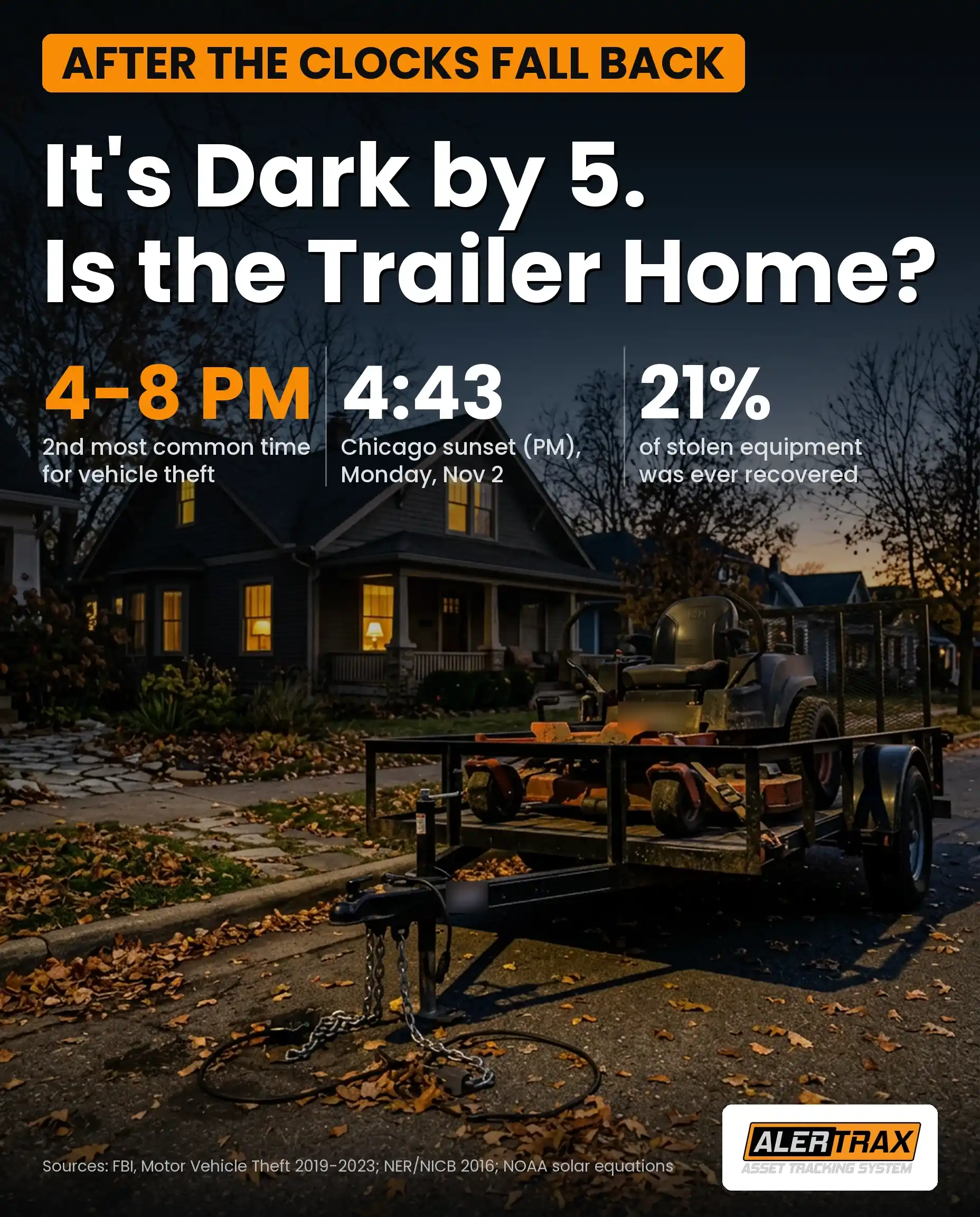
In August 2024, the FBI published a special report on motor vehicle theft using five years of incident data, 2019 through 2023, from the National Incident-Based Reporting System (NIBRS). Its finding on timing: "The time of day with the most reported motor vehicle thefts was from 8 p.m. to 11:59 p.m., with the second most reported time from 4 p.m. to 7:59 p.m." (FBI, Motor Vehicle Theft, 2019 to 2023).
The same report found that trucks made up 12.2 percent of motor vehicles stolen over those five years, and that residence/home was the most common location for every year in the study. From 2021 through 2023, highway/road/alley/street/sidewalk was second.
One caution: the FBI report covers motor vehicles, such as cars, trucks, buses, and motorcycles. It does not measure trailer or equipment theft. Treat it as the best federal picture of when thieves are active around vehicles, not as a count of stolen trailers.
Sunset Moves Into the Window
Daylight saving time ends at 2 AM on the first Sunday of November (15 U.S.C. 260a), which is November 1, 2026. Overnight, an hour of evening light moves to the morning.
Here is sunset on Saturday, October 31, and then on Monday, November 2, calculated with NOAA's solar equations for each city center:
Boston: 5:39 PM, then 4:36 PM.
Chicago: 5:46 PM, then 4:43 PM.
Denver: 5:59 PM, then 4:57 PM.
Minneapolis: 6:02 PM, then 4:59 PM.
Columbus, OH: 6:31 PM, then 5:28 PM.
Dallas: 6:37 PM, then 5:35 PM.
Atlanta: 6:46 PM, then 5:44 PM.
In most of those cities, the second most common theft window in the FBI data, 4 PM to 8 PM, is now mostly dark. That is also the window when crews are finishing the last job, driving back, unloading, and parking trucks at the yard or at home.
The Real Problem Is Discovery Time
The equipment theft data has its own warning. Of the 11,574 equipment thefts reported in 2016, only 2,442 were recovered, about 21 percent (NER/NICB 2016 Equipment Theft Report, the most recent edition). The report lists "delays in discovery of thefts and subsequent delays between time of the occurrence and reporting" among the reasons recovery rates are low.
Darkness makes that delay longer. Here is an example, not survey data: a trailer taken from a job site at 6:30 PM may not be missed until the crew comes back for it at 7 AM. That is more than 12 hours of head start before anyone calls the police.
The same report recommends getting equipment information to law enforcement as soon as a theft is discovered, so it can be identified "even during weekends or at night." That only works if someone knows.
Where the Risk Goes After November 1
The last job site. Equipment left on a trailer at the curb while the crew finishes is now sitting there in the dark. The NER report says equipment "should also never be left on trailers," and notes that work sites usually have lower physical security than the owner's own yard.
The driveway. If your foremen take trucks and trailers home, the FBI's most common theft location, residence/home, is where your equipment spends the evening.
The yard after the last truck. When the last crew gets back at 5:30 and it is already dark, lock-up happens in the dark too, and gets rushed.
Five Changes for the Dark Months
1. Re-plan the last stop. Look up your sunset for the week. If the last property on a route cannot be finished by then, move it earlier or to a different day.
2. Nothing stays at the job site overnight. If a trailer or machine has to stay, chain it, lock the coupler, and disable it. Better, bring it home.
3. Lock up take-home rigs. A coupler lock and a wheel lock on a trailer in a driveway cost far less than the mower on it.
4. Turn on evening alerts. If your tracking system lets you set parked hours, move them earlier now that the crews are back earlier.
5. Keep your serial numbers ready. "Equipment owners' inaccurate or nonexistent ownership records" are on the NER list of reasons stolen equipment is not recovered. A current list with photos, on your phone, saves the first hour.
For a full lock-up routine, see Steal This Checklist: The 10-Minute Friday Lock-Up.
Where Alertrax Fits
Every change above makes theft harder. None of them tells you when it happens anyway. Alertrax closes the discovery gap.
- After-Hours Movement Alerts: Set the evening and overnight as parked hours. If a trailer or mower moves at 6:30 PM, your phone tells you at 6:30 PM, not the crew at 7 AM.
- AddressFence and Geofence Alerts: Set the yard and each foreman's home address, and get notified when a tracked trailer leaves.
- Live Fleet Map: Check at dusk that every trailer is where it should be, with location updates every 2 minutes in the Alertrax Fleet Portal.
- Shareable Tracking Link: If something does move, send the responding officer a live link.
- One-Year Battery, No Wiring Required: Alertrax runs on two AA cells, so it works on trailers and mowers that have no power of their own.
- 100% Waterproof, Covert Magnetic Mounting: Mounts out of sight on a steel frame in seconds.
- iOS and Android App: Alerts and the map on your phone.
Pricing
You can equip your fleet with Alertrax for a low monthly rate, no long-term contracts, no hidden fees.
(Want to own it outright? We offer a $599 Lifetime option for permanent, subscription-free tracking.)
Sources
Federal Bureau of Investigation (FBI), Uniform Crime Reporting Program, "Motor Vehicle Theft, 2019 to 2023," released August 2024, retrieved October 2026: based on NIBRS incident data; 8 p.m. to 11:59 p.m. was the time of day with the most reported motor vehicle thefts and 4 p.m. to 7:59 p.m. the second most; trucks 12.2 percent of motor vehicles stolen; residence/home the most common location each year, with highway/road/alley/street/sidewalk second from 2021 through 2023. NIBRS participation is voluntary for non-federal agencies, and the report covers motor vehicles, not trailers or equipment
National Equipment Register (NER) and National Insurance Crime Bureau (NICB), "2016 Equipment Theft Report," published 2017, retrieved October 2026: 11,574 equipment thefts reported in 2016 and 2,442 recoveries (21 percent); factors in low recovery rates, including delays in discovery and reporting and inaccurate or nonexistent ownership records; recommendation that equipment "should also never be left on trailers"; observation that work sites usually have lower levels of physical security than an owner's premises; recommendation to give equipment information to law enforcement promptly so it can be identified "even during weekends or at night." This is the most recent edition, and its figures are a decade old
United States Code, 15 U.S.C. 260a, "Advancement of time or changeover dates," retrieved October 2026: daylight saving time ends at 2 AM on the first Sunday of November
NOAA Global Monitoring Laboratory, solar position equations used in the NOAA Solar Calculator: sunset times in this article were calculated by Alertrax for city-center coordinates in October 2026 and may differ by a minute or so from other published tables
This article is provided for general informational purposes and is not legal, insurance, or law enforcement advice. The job site timeline above is an illustration, not a customer case or survey data. Never pursue a stolen vehicle or confront a suspect yourself; call 911 and follow the instructions of law enforcement. AlerTrax is a GPS tracking company, not a law enforcement agency or insurer, and no tracking device can guarantee recovery of stolen property.
Move the Lock-Up Before the Sunset Does
The clocks change on Sunday, November 1. Your routes, your last stops, and your lock-up routine should change with them.
Visit www.buyalertrax.com today and know the minute a trailer moves after dark.