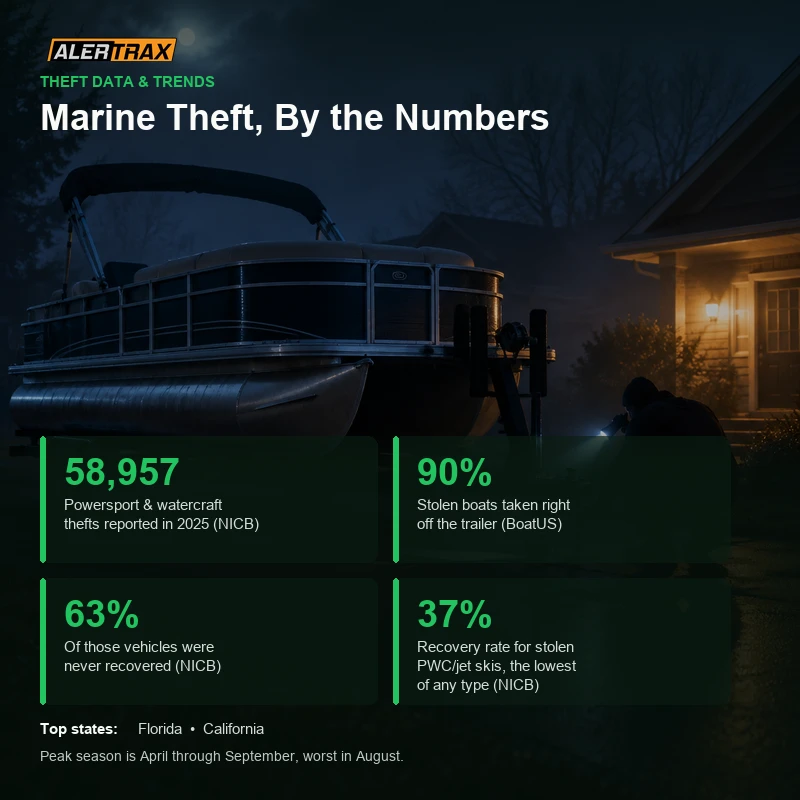
Most boat owners picture theft happening on the water: a thief backing a trailer down a ramp in the dark, or cutting a dock line and drifting off. The claims data tells a different story. Most of it happens in driveways, storage yards, and side lots, in broad daylight, to a boat that was already sitting on a trailer.
Here is what the National Insurance Crime Bureau (NICB) and BoatUS Marine Insurance actually report, and what it means for how you should be protecting a boat, a PWC, or a rental fleet of either.
The National Number: 58,957, and Falling
NICB's most recent theft report, released in August 2026 and covering 2025 incidents, counted 58,957 motorcycles, all-terrain vehicles, snowmobiles, and watercraft reported stolen in the United States, a 20 percent decline from 2024. That total spans several categories of powersport and recreational vehicle theft that NICB tracks together, and watercraft is one line inside it.
The number that matters more than the total is what happened after: 63 percent of those vehicles were never recovered. Of the categories NICB broke out individually, motorcycles made up the largest share at 44,564 units (76 percent of the total) with a 41 percent recovery rate, while ATVs, at 11,050 units, had the lowest recovery rate of any category reported at 23 percent.
63%
Share of stolen motorcycles, ATVs, snowmobiles, and watercraft never recovered in 2025, per NICB's 2026 theft report.
On the timing side, there is a genuine bright spot in the data: more than half of all recoveries happen within two weeks of the vehicle being reported stolen. Recovery is not a coin flip that resolves itself slowly over months. It mostly happens fast, or it does not happen.
It Happens on the Trailer, Not the Water
BoatUS Marine Insurance, which underwrites recreational boats rather than just tracking police reports, publishes its own claims-file analysis, and it points at a specific, fixable weak point: 90 percent of stolen boats are taken while sitting on their trailer, not while moored, docked, or underway.
The profile BoatUS describes as most commonly stolen is almost a checklist: a runabout under 26 feet, sitting on a trailer, with one or more outboard motors attached. That combination is light enough to tow away in minutes and valuable enough, motor included, to be worth the risk.
Theft is a relatively small slice of BoatUS claims by count, about 6 percent of all filed claims. But it ranks first in average dollar payout of any claim category, because a successful theft claim pays out the full insured value of the boat, not the cost of a repair.
90%
Share of stolen boats taken while sitting on a trailer, rather than on the water – BoatUS Marine Insurance claims data.
Recovery Depends Entirely on What You Own
NICB's 2021 watercraft analysis breaks recovery down by boat type, and the spread is wide. Overall recovery that year held steady at 42 percent, but that average hides a real split: cruisers and sailboats were recovered at the highest rate, 50 percent each, while personal watercraft, jet skis, were both the single most frequently stolen type, at 1,292 units, and the type least likely to come back, at a 37 percent recovery rate.
| Watercraft type | 2021 recovery rate | Note |
|---|
| Cruisers | 50% | Highest recovery rate of any type tracked |
| Sailboats | 50% | Tied for highest recovery rate |
| All watercraft (average) | 42% | National blended rate across all types |
| Personal watercraft (PWC/jet ski) | 37% | Most frequently stolen type; lowest recovery rate |
37%
Recovery rate for stolen personal watercraft, the lowest of any watercraft type NICB tracks, despite PWCs being the single most frequently stolen type.
The pattern is consistent with what makes a jet ski or small runabout easy to steal in the first place: light, trailerable, no title-and-VIN system anywhere near as tight as passenger vehicles, and a resale market that does not ask many questions.
Florida and California Are Not Close to the Rest of the Country
In NICB's most recent watercraft-specific breakout, covering 2022, the U.S. saw 4,461 watercraft thefts, down 4 percent from 4,644 the year before. Florida led the nation with 891 thefts, 20 percent of every watercraft theft reported in the country that year, with California second at 656. States near major bodies of water made up most of the top ten, and together those ten states accounted for 63 percent of all U.S. watercraft theft.
BoatUS's own claims-file data, a different methodology built from insurance claims rather than police reports, puts Florida's share even higher, at 47 percent of its theft claims. The two sources measure different things (claims filed vs. incidents reported), but they agree on the headline: if you keep a boat or PWC in Florida, you are not looking at a national-average risk. You are looking at something considerably higher.
Why Geography Concentrates This Hard
Warm-water states with long boating seasons simply have more boats sitting exposed, more often, for more months of the year. Florida and California also combine dense coastline with major ports, giving stolen watercraft and outboards a faster path out of state, or out of the country, than a landlocked market offers.
The Season Nobody Plans Around
Marine theft is not spread evenly across the calendar. BoatUS's claims data shows the large majority of thefts happen between April and September, with August as the single most common month. That is exactly the stretch when boats and PWCs come off winter storage, get used constantly, and spend the most nights sitting on a trailer in a driveway or a rental yard rather than locked in a garage.
For rental operators running jet skis or pontoons, that six-month window is also peak season for the business itself, which means the fleet is most exposed to theft at precisely the time it is generating the most revenue and doing the most trailer-to-trailer movement.
What This Means If You Own or Rent Marine Equipment
Put the numbers together and a pattern falls out clearly. Theft is concentrated by season (April through September), by geography (Florida and California well ahead of the field), by asset type (light, trailerable boats and PWCs), and it overwhelmingly happens on the trailer rather than the water. Recovery, when it happens, happens fast, mostly inside two weeks, or not at all.
That last point is the one GPS tracking is built to address. A tracker cannot stop someone from hitching up a trailer in a driveway at 2 a.m. But it changes what happens in the minutes and hours afterward, which the data says is the entire window that determines whether a boat comes back.
AlerTrax is built for exactly this asset profile, trailers, boats, and PWCs that sit outside, move seasonally, and have no factory tracking system of their own:
- Geofence and after-hours alerts: A notification the moment a boat or trailer leaves the yard, dock, or storage lot outside of normal hours.
- Live fleet map: Every unit visible in the AlerTrax Fleet Portal and the iOS and Android app, updating as often as every 2 minutes.
- Route history: A location trail to hand law enforcement immediately, instead of a description and a guess.
- Tamper alerts: Notification if a device is disturbed, removed, or loses power unexpectedly.
- Over a year of battery life, no wiring: Magnetic mount, about a minute per unit, built for a trailer or hull with no power source of its own.
- 100% waterproof and ruggedized: Rated for salt water, spray, and a season sitting outside.
Pricing
AlerTrax is $49.99 per month for 12 months, with no long-term contract and no hidden fees.
(Want to own it outright? There is a $599 Lifetime option for permanent, subscription-free tracking. No fees, ever.)
Before the Season Peaks Again
None of these numbers are a reason to keep a boat off the water. They are a reason to close the specific, well-documented gap the data keeps pointing at: the trailer sitting outside, unwatched, for the six warmest months of the year.
Visit www.buyalertrax.com, or email sales@buyalertrax.com with what you are running, boat, PWC, or a rental fleet of both, and we will tell you what it takes to cover it.
Sources
National Insurance Crime Bureau, 2026 theft report covering 2025 data (released August 2026), retrieved September 2026: 58,957 motorcycles, ATVs, snowmobiles, and watercraft reported stolen, a 20 percent decline from 2024; 63 percent never recovered; motorcycles 44,564 units (76 percent of total) with 41 percent recovery; ATVs 11,050 units with 23 percent recovery; majority of recoveries occur within two weeks
National Insurance Crime Bureau, watercraft theft report covering 2022 data, retrieved September 2026: 4,461 watercraft thefts, down 4 percent from 4,644 in 2021; Florida led with 891 thefts (20 percent of the national total); California second with 656; top 10 states accounted for 63 percent of all U.S. watercraft theft
National Insurance Crime Bureau, watercraft theft and recovery data covering 2021, retrieved September 2026: overall recovery rate 42 percent; cruisers and sailboats recovered at 50 percent each; personal watercraft (PWC/jet ski) most frequently stolen type at 1,292 units with the lowest recovery rate at 37 percent; more than 54 percent of recovered watercraft returned to owners within one week
BoatUS Marine Insurance, marine insurance claims file data, retrieved September 2026: theft accounts for approximately 6 percent of all claims by count but ranks first in average claim payout; approximately 90 percent of stolen boats taken while on a trailer; most commonly stolen profile is a runabout under 26 feet on a trailer with one or more outboard motors; approximately 47 percent of theft claims filed in Florida; most thefts occur April through September, peaking in August
Disclaimer: AlerTrax is a GPS tracking company, not an insurance provider or law enforcement agency. Figures above are drawn from published NICB and BoatUS Marine Insurance reporting and reflect national or claims-file data, not a guarantee of outcomes for any individual boat, PWC, or fleet.