It's 10:15 on a Tuesday morning. You have four crews out, a client calling to ask why nobody has shown up yet, and no idea which truck is where. You try calling your crew lead. No answer. You try the next one — he's running a mower and can barely hear you. By the time you sort it out, you've burned twenty minutes, frustrated a client, and still aren't sure whether your other two crews made it to their job sites on time.
If you run a landscaping company, this isn't a hypothetical. It's a Tuesday. And in a $188.8 billion industry that employs nearly 1.5 million people (NALP, 2025), the inability to track where crews are at any given moment is quietly draining profits across the country.
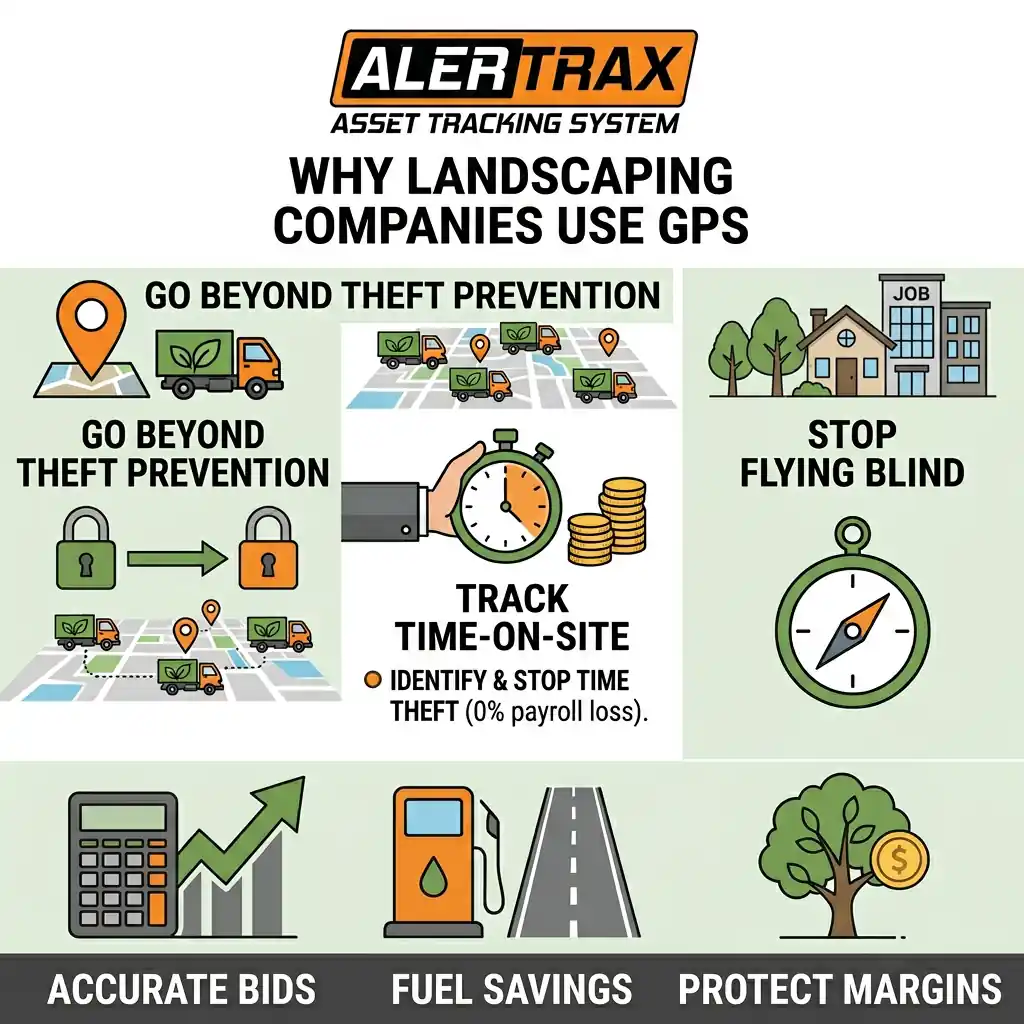
That's exactly why more and more landscaping companies are putting GPS trackers on every truck and trailer in their fleet — and it has surprisingly little to do with theft.
The Real Problem Isn't Stealing. It's Not Knowing.
When most people think about GPS tracking, their mind goes straight to theft prevention. And yes, that's a real concern — the landscaping industry loses an estimated $400 million annually to equipment theft (AMAROK / National Equipment Register). But when you talk to the owners and operators who are actually running crews day in and day out, theft isn't the thing keeping them up at night.
What keeps them up is the not knowing.
Not knowing if the crew actually arrived at the first job by 7:30. Not knowing whether they left the Henderson property at noon or at 1:15. Not knowing if your newest crew lead took the highway across town to a job that's ten minutes away on surface streets. In an industry where 72% of business owners say labor availability and retention are their biggest barriers to growth (Aspire, 2025), you can't afford to waste the labor you do have on inefficiency you can't even see.
The Cost of Flying Blind
Let's put some numbers behind the problem. Labor is the single largest expense for landscaping businesses, consuming 30% to 50% of total revenue (Aspire, 2025). For a company doing $1 million a year, that's $300,000 to $500,000 going to payroll. And the true cost is even higher — labor burden (taxes, insurance, workers' comp, benefits) typically adds another 20% to 35% on top of base wages, meaning a $20-per-hour employee actually costs $24 to $27 per hour before they ever touch a mower (Service Autopilot, 2026).
Now consider what happens when you can't verify how that labor is being used. Studies estimate that businesses lose 5% to 10% of payroll costs annually to time theft — extended breaks, early clock-outs, and inflated hours. For a landscaping company with $400,000 in annual payroll, that's $20,000 to $40,000 in losses that are nearly invisible without tracking data.
GPS fleet tracking data from operators across industries consistently reveals 30 to 60 minutes of unproductive time per vehicle per day before tracking is implemented (Spytec GPS, 2026). At a loaded labor cost of $35 to $50 per hour, recovering even 30 minutes daily per vehicle saves $350 to $500 per month per truck. For a company running five trucks, that's potentially $21,000 to $30,000 per year recovered — just by knowing where your crews are and how long they're spending at each stop.
Time on Site: The Metric You Didn't Know You Needed
Most landscaping companies bid jobs based on estimated labor hours. You walk a property, figure it'll take a three-person crew about two and a half hours, price it accordingly, and move on. But do you actually know if it takes two and a half hours? Or does it take three? Or three and a half?
GPS tracking gives you time-on-site data for every single job. The tracker logs when the truck arrives at an address and when it leaves. Over the course of a few weeks, patterns emerge. Maybe the Ridgewood community takes forty minutes longer than you estimated every single visit. Maybe the commercial lot on Fifth Street is consistently done thirty minutes early.
This matters because the industry already operates on thin margins. Average profit margins for U.S. landscaping companies sit around 6.2%, with well-run operations targeting 10% to 14% net (Wifitalents / Fieldcamp, 2025). If you're consistently underbidding a property by forty minutes per visit on a weekly contract, that's roughly 35 hours of unbilled labor over the course of a season. Multiply that across several accounts and those razor-thin margins vanish entirely.
On the flip side, if a crew is finishing a job significantly faster than expected, that's an opportunity to tighten up the route and add another property. Either way, you can't make those adjustments without data. GPS gives you the data.
Fuel and Route Efficiency: Savings That Add Up Fast
Beyond time on site, GPS history shows the actual routes your crews take between jobs. This is where a lot of landscaping companies find money they didn't know they were losing.
Industry data shows fleets typically cut fuel spending by 15% to 25% after implementing GPS tracking (Spytec GPS, 2026). For a service truck averaging $400 to $600 per month in fuel, that's $60 to $150 per vehicle per month in savings. Across a fleet of ten trucks, that's $7,200 to $18,000 per year — often more than enough to pay for the trackers many times over.
These savings come from identifying and eliminating inefficiencies: crews zigzagging across town instead of working in a logical geographic sequence, trucks idling for extended periods between jobs, or drivers taking longer routes out of habit. A typical service truck burns roughly half a gallon to a full gallon of fuel per hour of idle time (GPS Insight). When you can see those patterns on a map, reorganizing the daily schedule becomes obvious.
Fleet tracking also delivers returns through reduced vehicle wear and maintenance costs. Systems that monitor driving behavior — hard braking, rapid acceleration, excessive speeding — help companies cut maintenance expenses by 15% to 20% (US Fleet Tracking). For landscaping trucks hauling heavy trailers over rough terrain, those savings are significant.
Accountability Without Micromanaging
Nobody gets into landscaping because they love babysitting grown adults. You want to hire good people, give them the tools they need, and trust them to get the work done. But in an industry with an annual employee turnover rate of roughly 42% (Wifitalents, 2023) and where 51% of businesses cite staffing shortages as a major risk (Aspire, 2025), you need every crew member operating at peak efficiency.
GPS tracking creates a layer of accountability that's objective, consistent, and doesn't require uncomfortable conversations based on gut feelings. If a crew says they were on the Johnson property until 3:00 but the GPS shows they left at 2:15, that's not a he-said-she-said situation. It's data.
And here's what might surprise you: employees generally respond well to GPS tracking. According to one independent survey, 95% of employees who had experience with GPS tracking at work described their experience as positive or neutral (TSheets / HR C-Suite). Three out of four employees said they believed GPS tracking would help them more accurately track mileage and travel time, ensure paycheck accuracy, and keep them safer on the job. For the crews doing good work, GPS data becomes their proof — especially when a client disputes whether someone showed up on a given day.
Scaling Without Losing Control
Maybe the most important benefit of GPS tracking shows up when your company is growing. Running two or three crews from the cab of your own truck is manageable. But the landscaping industry is fragmented — there are roughly 700,000 landscaping businesses in the U.S. (NALP, 2025), and firms with 5 to 19 employees represent 52% of total industry revenue (Wifitalents, 2023). The companies that break out of the one-to-three crew range and push into five, eight, or ten crews are the ones that build real enterprise value.
GPS tracking breaks through the scaling ceiling. You can manage ten crews with the same clarity you had when you were running two. The overall ROI data supports this: fleet tracking systems typically deliver 200% to 400% annual ROI, with most companies seeing measurable savings within the first 30 to 90 days (Traxelio / Spytec GPS). Seventy percent of fleets using GPS tracking report significant operational benefits, and 41% achieve positive ROI in under 12 months (Heavy Duty Journal, 2026).
For growing landscaping companies, that means the investment in GPS pays for itself quickly while giving you the operational infrastructure to take on more work, manage more crews, and deliver more consistent service without adding layers of management overhead.
Oh, and It Prevents Theft Too
After all of that — the crew visibility, the time-on-site tracking, the route efficiency, the accountability, the ability to scale — it's almost easy to forget that the GPS tracker is also protecting your equipment around the clock.
This is no small thing. Equipment theft costs the landscaping industry $400 million annually, and 40% of stolen landscaping equipment is never recovered (AMAROK). A single landscaping truck can generate up to $4,000 in daily revenue — money lost for every day that vehicle is out of service due to theft or vandalism. The same GPS device that helps you run a tighter operation during the day sends you an alert if a truck or trailer moves after hours, dramatically improving your chances of recovery.
But for most landscaping operators, theft prevention is the cherry on top. It's the daily operational visibility that delivers the consistent, compounding return on investment.
The Alertrax Advantage for Landscaping Fleets
This is exactly why we built Alertrax.
Alertrax was designed for the real-world conditions that landscaping companies deal with every day — rain, mud, dust, vibration, and the kind of abuse that destroys consumer-grade trackers in weeks.
- Ruggedized and Weatherproof: Alertrax features a 100% waterproof, ruggedized housing built to survive high-pressure washdowns, torrential rain, deep mud, and the constant vibration of a work truck or trailer bouncing between job sites all day long.
- One-Year Independent Battery Life: Because Alertrax features a massive, self-contained battery that lasts for an entire year on a single charge, no wiring is required. Mount it on a trailer, a skid steer, a mower trailer — anywhere you need visibility — without worrying about electrical connections or dead batteries.
- Covert and Tamper-Proof Placement: With no wires to trace, crews and would-be thieves will never know the Alertrax device is there. Magnetically mount it inside a trailer frame, behind a bumper, or inside an equipment compartment for silent, always-on tracking.
- Instant Geofence Alerts: Draw an invisible boundary around your yard, your shop, or any job site. If a truck or trailer moves outside that boundary during off-hours, you receive an instant alert on your phone — giving you the ability to act before a theft gets far.
- Live Fleet Visibility: Open the Alertrax app and see every truck, trailer, and piece of equipment on a single map. Know which crews are on site, which are in transit, and which are running behind — all without making a single phone call.
Protection That Fits Your Budget
You don't have to spend a fortune to get fleet-level visibility. Alertrax makes enterprise-grade GPS tracking accessible to landscaping companies of every size.
You can equip your entire fleet today with Alertrax for a low monthly rate — with no long-term contracts and no hidden fees.
(Hate monthly fees? We also offer a one-and-done $599 Lifetime option for permanent, subscription-free tracking).
Think about the math: The industry data shows that GPS tracking saves fleets $350 to $500 per truck per month in recovered productivity alone. That means a single Alertrax device pays for itself within the first few weeks — and everything after that is pure profit.
The Bottom Line
The landscaping companies growing fastest right now aren't just the ones with the best crews or the best equipment. They're the ones with the best information. In an industry approaching $190 billion in annual revenue with labor costs under constant pressure and profit margins averaging single digits, the ability to see where your people are, how long jobs are taking, and where the inefficiencies are hiding isn't a luxury. It's a competitive necessity.
A GPS tracker isn't a surveillance tool. It's a management tool. And once you have the visibility it provides, you'll wonder how you ever ran your operation without it.
Visit www.buyalertrax.com today to equip your landscaping fleet with ruggedized, long-lasting GPS tracking that pays for itself.
Sources: NALP (2025), AMAROK, National Equipment Register, Aspire 2025 Landscaping Industry Report, Service Autopilot (2026), Spytec GPS (2026), GPS Insight, US Fleet Tracking, Wifitalents, Fieldcamp, Heavy Duty Journal (2026), Traxelio, TSheets/HR C-Suite Independent Survey.