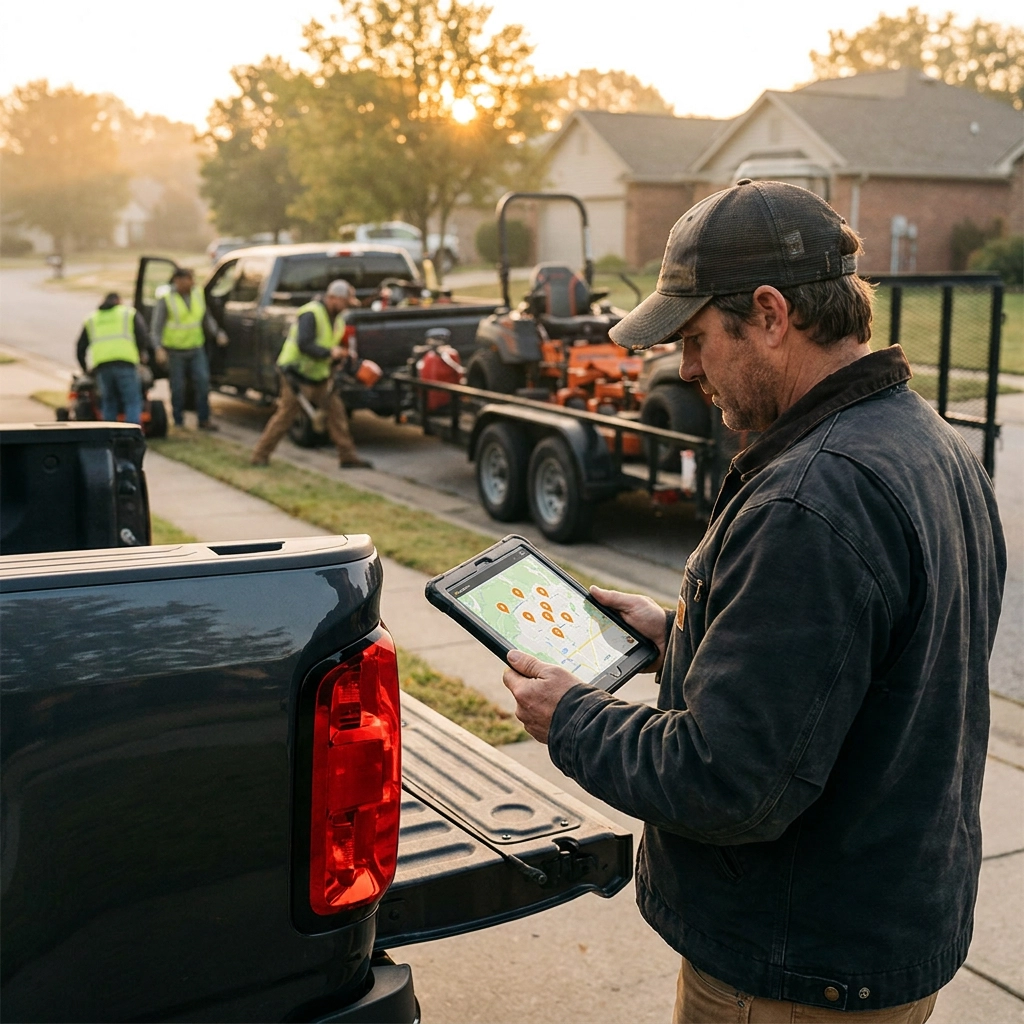
Ask a landscaping company owner what their plan is for next season and you will almost always hear some version of the same answer: grow. Add a crew. Pick up a few more commercial contracts. Push revenue past the next milestone.
Now ask that same owner a different question: at 10:30 this morning, where was each of your crews, when did they arrive at their first job, and how long did they stay?
Most owners cannot answer it. Not precisely. They have a schedule, a group text from this morning, and a general sense of where everyone should be. What they do not have is verified, live knowledge of where their crews, trucks, and equipment actually are, and what that means for the jobs they bid, the hours they bill, and the margins they keep.
That is the visibility gap. And the latest industry data shows it is the single biggest thing standing between the companies that want to grow and the companies that are actually built to do it.
The Industry Is Growing. Most Companies Aren't Ready For It.
The landscaping industry is in a genuine growth period. The U.S. landscaping services market reached $188.8 billion, growing at 6.5 percent annually in recent years (NALP). Roughly 700,000 landscaping businesses employ 1.5 million people across the country (NALP), and firms with 5 to 19 employees generate 52 percent of the industry's revenue (Wifitalents). If you run a 5-truck operation, you are the backbone of this industry.
But here is the number that should stop you cold. According to the 2026 Aspire Commercial Landscape Industry Report, 79 percent of landscaping companies are focused on growing revenue this year, but only 41 percent are optimizing their processes to support sustainable growth.
That is a 38-point gap between ambition and infrastructure. Nearly four out of five owners want to get bigger. Fewer than half have the systems to do it without losing control of their operation. The rest are planning to grow on guesswork.
And guesswork is exactly how businesses end up in the failure statistics. BLS data shows 20.4 percent of businesses fail in their first year, 48.4 percent fail by year five, and 65.1 percent are gone by year ten (LendingTree / BLS). The companies that survive are not the ones that worked the hardest. They are the ones that knew their numbers.
Labor Is Your Biggest Cost. It's Also Your Biggest Blind Spot.
In landscaping, labor runs 30 to 50 percent of total revenue (Aspire). It is by far the largest line item in the business, and it is about to get more expensive: 70 percent of landscaping companies plan wage increases in 2026, and 44 percent plan increases of 4 percent or more (Aspire 2026).
The real cost is even higher than the wage. Labor burden, the payroll taxes, insurance, and overhead stacked on top of base pay, adds another 20 to 35 percent. A crew member you pay $20 an hour actually costs you $24 to $27 an hour (Service Autopilot, 2026).
Owners feel this. 72 percent cite labor as their number one growth barrier (Aspire), and 54 percent name recruiting and retention as their top business risk (Aspire 2026), in an industry with a 42 percent annual employee turnover rate (Wifitalents).
So here is the question: if labor is your largest cost, your fastest-rising cost, and your hardest resource to replace, why is it the one part of your business you have the least verified data about?
You know exactly what you spent on fertilizer last month. You can pull your fuel card statement in thirty seconds. But the hours your crews actually spent on each job site, the asset you are paying $27 an hour for, lives on handwritten timesheets and memory. The American Payroll Association has found that businesses lose an estimated 5 to 10 percent of payroll to time theft, through late starts, long lunches, early departures, and padded hours. On a $500,000 payroll, that is $25,000 to $50,000 a year leaving the business without a trace.
At a 6.2% Margin, Guesswork Is Fatal
The average landscaping company runs a 6.2 percent profit margin (Wifitalents). Well-run companies target 10 to 14 percent (Fieldcamp). The difference between those two numbers is not effort. It is information.
Industry analysis from Duranta found that 1 in 5 landscaping jobs is unprofitable, and the most common reason is the most preventable one: actual labor hours exceeded the estimate, and nobody caught it until the season was over. The crew spent six and a half hours on a job you bid at five. It happened again the next week. Multiplied across a season and a fleet, those quiet overruns are the difference between a 6 percent year and a 12 percent year.
Meanwhile, costs keep climbing on the other side of the ledger. 48 percent of owners cite material costs as their top concern for 2026, and 37 percent anticipate cost increases of 10 percent or more (Aspire 2026). Cash flow has its own gap: 76 percent of companies send invoices within four days of finishing work, but only 39 percent get paid on time (Aspire 2026).
You cannot control material prices, wage pressure, or how fast customers pay. The one thing entirely inside your control is knowing exactly where your crews are, how long every job actually takes, and which contracts make money. That is what crew visibility is.
What Crew Visibility Actually Looks Like
Crew visibility is not a dot on a map. It is a set of verified, automatic data streams that replace guesswork in the four places it costs you the most.
A live fleet map. Every truck, trailer, and piece of equipment on one screen, live, from your phone or desktop. When a customer calls asking where your crew is, you answer in five seconds instead of starting a phone chain.
Automatic time-on-site logging. Arrival and departure timestamps recorded at every stop, with no crew input, no check-in app, and no buddy punching. These are the real labor hours behind every job, the numbers you compare against your estimates to find out which contracts are quietly losing money.
Complete route history. A breadcrumb trail of everywhere a vehicle went, every stop made, every detour taken. Lay it next to the planned schedule and the wasted drive time, repeat supply runs, and zigzag routing show up immediately.
Trip reports you can export. Date, address, arrival, departure, duration, mileage, for every vehicle, every day. This is proof of service when a customer asks "did your crew even come?", documentation for billing, and the raw data for repricing next season's contracts with confidence.
Your Crews Won't Hate It. The Data Says They'll Prefer It.
The objection every owner raises first: "my guys will think I'm spying on them." The research says the opposite.
Surveys from TSheets and HR C-Suite found that 95 percent of employees rate GPS tracking as positive or neutral. 75 percent say it helps track their mileage and time accurately, and 50 percent say it actually builds trust with their employer.
Think about why from the crew's perspective. When a customer claims nobody showed up Tuesday, the GPS record defends your crew, not just your invoice. When a foreman finishes early and moves to the next job on his own initiative, the data shows it. Your best people have nothing to hide and everything to prove, and verified records give them the credit they have been earning all along without anyone watching.
The key is transparency from day one. Frame it as exactly what it is: a business tool for routing, billing accuracy, and protecting the crew. Introduced that way, resistance drops to nearly zero, and the phone calls that actually feel like surveillance, the mid-job "where are you guys?" check-ins, stop entirely. You glance at the map instead.
Closing the Gap: Why Alertrax Is Built for Landscaping Fleets
Most GPS tracking systems were designed for long-haul logistics fleets: hardwired installs, constant 12-volt power, dedicated drivers. A landscaping operation is nothing like that. You have trucks, trailers, mowers, and skid steers that move between crews and job sites every single day.
Alertrax was engineered for that reality.
- One-Year Battery Life, No Wiring Required: Runs over a year on two AA batteries. No splicing into electrical systems, no OBD-II ports, no installation appointments. Mount it and it works.
- Track Anything That Moves: Because there are no wires, you can put Alertrax on trucks, trailers, mowers, skid steers, compressors, anything in your fleet. One platform for every asset.
- 100% Waterproof, Ruggedized Housing: IP67 rated. Survives rain, mud, and pressure washing, because that is a normal Tuesday in this business.
- Covert Magnetic Mounting: Mounts magnetically to any steel surface. No visible antennas, no wires to trace, nothing for anyone to tamper with.
- Live Fleet Map: The Alertrax Fleet Portal shows every tracked asset on a single live map, from your desktop or the iOS and Android app.
- Automatic Time-on-Site Logging: Every arrival and departure recorded with a timestamp, for job costing, billing verification, payroll accuracy, and proof of service.
- Complete Trip Reports: Exportable reports with addresses, times, durations, and mileage for every vehicle, every day.
- Geofence and After-Hours Alerts: Draw virtual boundaries around your yard, job sites, and customer properties. Get instant notifications on arrivals, departures, and any movement that shouldn't be happening.
Pricing Built for a 6.2% Margin Business
You can equip your entire fleet with Alertrax for a low monthly rate, with no long-term contracts and no hidden fees.
(Want to own it outright? We offer a $599 Lifetime option for permanent, subscription-free tracking.)
Run the math against your own payroll. If verified time-on-site data recovers even 2 percent of a $500,000 payroll, that is $10,000 a year. If it catches one mispriced contract before you renew it, that is thousands more. At the margins this industry runs on, visibility is not an expense. It is one of the few investments that pays for itself in the first season.
And Yes, It Prevents Theft Too
This article is about running your crews, but the same device watching your job times is watching your equipment at 2 AM. Equipment theft costs the industry an estimated $400 million annually, and 40 percent of stolen landscaping equipment is never recovered (AMAROK / NER). A single truck out of service can cost up to $4,000 a day in lost revenue (AMAROK).
With geofence alerts and after-hours movement notifications, you know within minutes if a trailer leaves the yard at night, and you have a live location to hand to law enforcement. It is not the reason to buy GPS tracking. It is the cherry on top of a system that earns its keep every working day.
Be in the 41%
Four out of five landscaping companies are planning to grow this year. Most of them will try to do it the same way they always have: more trucks, more crews, more guessing. The companies that come out ahead will be the minority that built the systems first, the ones that know their real job times, their real routes, and their real margins before they take on the next contract.
You do not need new software for your crews to learn or a consultant to install anything. You need verified data on where your fleet is and how long every job actually takes. That starts with one device, mounted in under a minute.
Visit www.buyalertrax.com today and close the visibility gap before your busiest season opens it wider.
Sources
NALP, "$188.8B U.S. landscaping services market; 6.5% annual growth; ~700,000 businesses; 1.5 million employed"
Aspire Commercial Landscape Industry Report (2026), "79% focused on growing revenue; 41% optimizing processes; 70% plan wage increases; 44% plan increases of 4%+; 48% cite material costs as top concern; 37% anticipate 10%+ cost increases; 54% cite recruiting/retention as top risk; 76% bill within 4 days, 39% paid on time"
Aspire (2025), "Labor = 30-50% of total revenue; 72% of owners cite labor as biggest growth barrier"
Service Autopilot (2026), "Labor burden adds 20-35% on top of base wages; a $20/hr employee costs $24-$27/hr"
Wifitalents, "Firms with 5-19 employees = 52% of industry revenue; 42% annual turnover; 6.2% average profit margin"
Fieldcamp, "Well-run companies target 10-14% net profit"
Duranta, "1 in 5 landscaping jobs is unprofitable"
American Payroll Association, "Businesses lose 5-10% of payroll to time theft annually"
TSheets / HR C-Suite, "95% of employees rate GPS tracking positive or neutral; 75% say it tracks time accurately; 50% say it builds trust"
BLS / LendingTree, "20.4% of businesses fail in year 1; 48.4% by year 5; 65.1% by year 10"
AMAROK / NER, "$400M annual equipment theft losses; 40% never recovered; up to $4,000/day lost revenue per truck"