It is 5:30 on a Wednesday morning. You walk out the front door, coffee in one hand, keys in the other, ready to head to the job site. You look toward your driveway and your stomach drops.
Your dump trailer is gone. The $4,000 in tools you had locked inside the bed, the concrete saw, the plate compactor, the transit level, gone with it. The safety chains are in a pile on the ground where somebody cut them. There are scuff marks on the asphalt where the trailer was dragged sideways until they could get the hitch over their ball.
You call the police. They take a report. They tell you what you already suspect: the odds of getting your trailer back are not good. Your insurance deductible is $2,500. The tools were not covered under your auto policy. And the three jobs you had scheduled this week that require that trailer and those tools? You are going to have to figure something out.
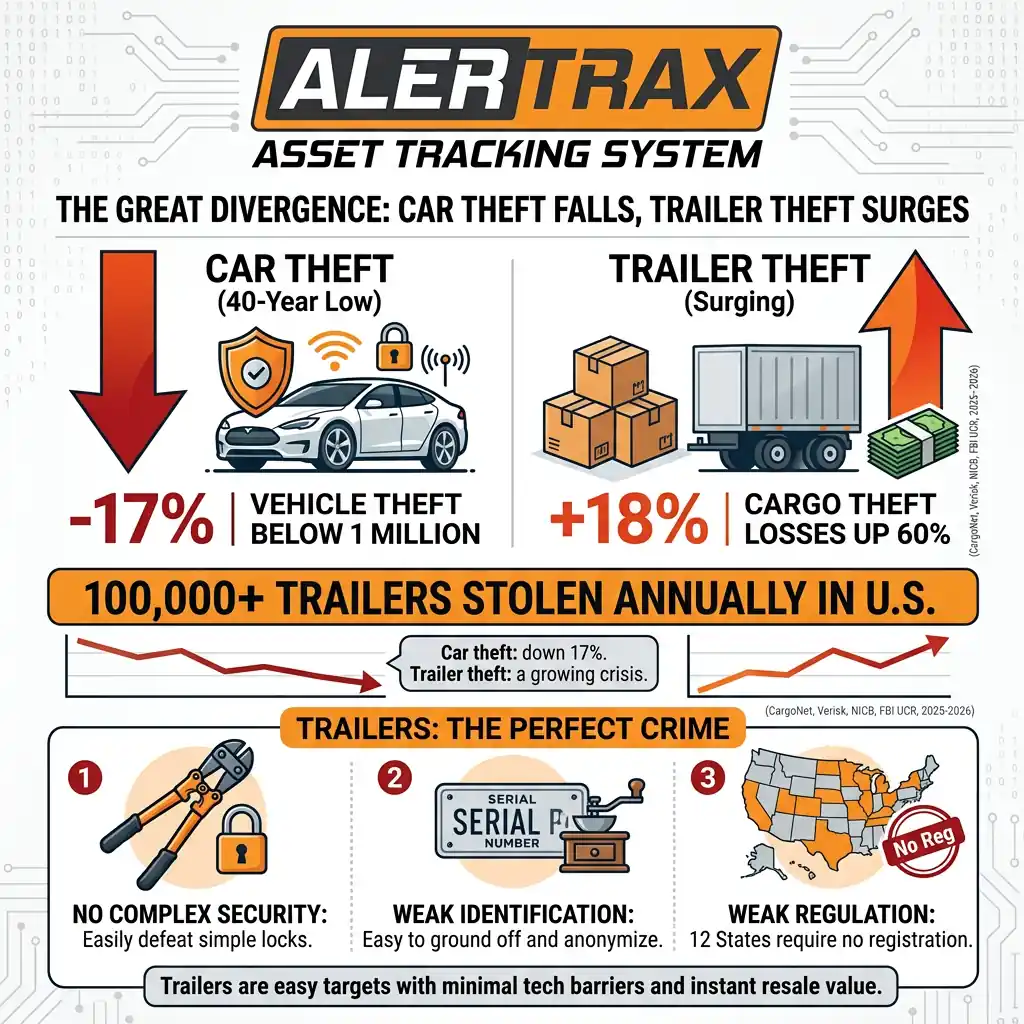
This is not a rare event. It is happening more than 100,000 times per year across the United States, and the problem is getting worse at the exact moment that every other kind of vehicle theft is getting better.
The Great Divergence: Car Theft Is Plummeting. Trailer Theft Is Surging.
Here is the statistic that should alarm every trailer owner in America: overall motor vehicle theft fell 17 percent in 2024, the largest annual decline in 40 years, dropping below one million stolen vehicles for the first time since 2021. The FBI's Uniform Crime Report confirmed an estimated 18.6 percent decrease in motor vehicle theft from 2023 to 2024 (NICB / FBI UCR). The trend continued into 2025, with vehicle thefts falling an additional 23 percent in the first half of the year and the national theft rate dropping from 126.62 to 97.33 per 100,000 residents (NICB).
Car theft is at a 40-year low. It is the biggest success story in property crime in a generation.
But trailer and cargo theft did not follow that trend. It went in the opposite direction.
Verisk CargoNet recorded 3,594 supply chain crime events across the United States and Canada in 2025. Confirmed cargo theft incidents climbed 18 percent year-over-year, rising from 2,243 to 2,646 confirmed thefts. Estimated losses surged 60 percent to nearly $725 million, up from approximately $454 million the year before. The average value per theft rose 36 percent to $273,990 (CargoNet / Verisk, January 2026).
The NICB warned in mid-2025 that cargo crimes had increased to an all-time high, up 27 percent from 2023, and predicted another 22 percent increase through the remainder of 2025 and into 2026. Overhaul's data showed the average number of cargo thefts per day climbing from 4.06 in 2023 to 6.07 in 2024, and their 2026 annual report recorded 2,576 cargo thefts in the U.S. in 2025, a 16 percent increase over the prior year, with a further 13 percent increase projected for 2026 (Overhaul / Commercial Carrier Journal, 2026).
Cars are getting harder to steal. Trailers are not. And the criminals know it.
Why Trailers Are the Perfect Crime
Modern cars have immobilizers, encrypted key fobs, GPS-enabled infotainment systems, and VINs stamped into a dozen components. Stealing one requires defeating multiple layers of technology, and the recovery infrastructure, license plate readers, OnStar, police databases, makes it increasingly difficult to get away with.
Now compare that to a utility trailer sitting in a driveway.
No ignition to defeat. A trailer does not have an engine, a key, or a starter circuit. There is nothing to bypass. The only thing between a thief and your trailer is whatever lock you put on the coupler, and we will get to how effective those are in a moment.
Weak identification. Unlike cars, trailers do not have standardized VIN systems that are tracked in national databases. Serial numbers are often stamped on a single plate that can be removed, ground off, or replaced in minutes. Once the identification is gone, the trailer becomes essentially anonymous.
12 states require no registration at all. According to a review of state trailer regulations, 12 U.S. states have no registration requirements for small utility trailers. That means a thief can steal your trailer tonight, drive it across a state line, apply for a homemade trailer title, and have it registered in their name, legally, within days. The regulatory gap is a gift to organized theft operations.
They all look the same. A black enclosed cargo trailer in your driveway looks identical to a black enclosed cargo trailer in 50,000 other driveways. There are no distinctive features, no unique paint jobs, no license plates in many states. Once a stolen trailer is parked in a different zip code, it is virtually invisible.
Instant resale market. Utility trailers, dump trailers, and enclosed cargo trailers are in constant demand. They sell fast on Facebook Marketplace, Craigslist, and at flea markets. A thief can steal a $10,000 enclosed trailer at midnight and have $4,000 in untraceable cash by noon the next day. The buyer often has no idea, or does not care, that it is stolen.
The 60-Second Problem
If you own a trailer, you probably have some form of physical lock on it. A coupler lock. A hitch pin lock. Maybe a wheel boot. And you probably feel reasonably secure about it.
Here is the reality: a battery-powered angle grinder, the same tool you can buy at Home Depot for $89, cuts through a hardened steel coupler lock in under 60 seconds. A diamond cutoff wheel does not care how much your lock cost. It does not care if it is "military grade" or "pick-proof." Sixty seconds, and the lock is on the ground in two pieces.
Thieves know this. They have known it for years. The modern trailer thief does not pick locks. He destroys them. A 20-volt cordless grinder weighs four pounds, fits in a backpack, and makes less noise than a lawnmower. In many cases, the thief does not even bother with the lock. He uses the trailer's own safety chains to drag it down the street to a secondary location where he can work on it without being seen.
Physical locks are a speed bump. They deter the casual opportunist who tries the coupler and walks away when it does not open. They do absolutely nothing to stop a prepared thief who arrives with a grinder, a ball mount, and a plan.
The only security measure that matters after the lock is defeated is knowing where your trailer is, live, the moment it moves.
The Real Cost Is Not the Trailer
When most people think about trailer theft, they think about the replacement value of the trailer itself. A quality utility trailer: $3,000 to $5,000. A dump trailer: $8,000 to $15,000. An enclosed cargo trailer: $6,000 to $20,000.
But the trailer is often the least expensive part of the loss.
The tools and equipment inside. Contractors, landscapers, roofers, and tradespeople load their trailers with thousands of dollars in tools and equipment, saws, compressors, generators, welders, hand tools, safety equipment. A fully loaded work trailer can easily carry $10,000 to $30,000 in contents. Most auto insurance policies do not cover tools and equipment stored in a trailer unless you carry a separate inland marine or tools/equipment rider, and many owners discover this after the theft, not before.
The lost revenue. If your dump trailer is stolen on Tuesday night and you have three hauling jobs scheduled for Wednesday through Friday, those jobs do not happen. Your crew stands around. Your clients call someone else. You lose the revenue from those jobs and potentially the clients forever. For a contractor or service company, a single week without a critical trailer can cost more in lost revenue than the trailer itself was worth.
The insurance reality. Your deductible is probably $1,000 to $2,500. The claims process takes weeks. Your premiums go up after a claim, sometimes significantly. And if you file a second claim within a year, your carrier may non-renew your policy entirely. Many small business owners absorb the loss rather than file a claim, which means the true financial impact of trailer theft across the industry is significantly higher than what the official numbers show.
The replacement timeline. A new trailer is not sitting on a lot waiting for you. Lead times for custom-built or specialty trailers can be weeks to months. In the meantime, you are renting, at premium daily rates, or you are turning down work because you do not have the equipment to do it.
The Federal Government Is Paying Attention
Trailer and cargo theft has grown large enough that it has reached the floor of the United States Senate.
In July 2025, the Senate Judiciary Committee convened hearings on organized cargo theft networks. The National Insurance Crime Bureau (NICB) testified that six to eight cargo theft incidents occur every day on average, with an average loss exceeding $200,000 per incident. Homeland Security Investigations (HSI) estimated total annual cargo theft costs between $15 billion and $35 billion, a figure that includes not just the stolen goods but the cascading economic damage across supply chains, insurance markets, and consumer prices (NICB Senate Judiciary Committee testimony, July 2025).
The NICB noted that the value of stolen merchandise first exceeded $1 billion in a single year in 2023, and that the problem has only accelerated since. Criminal enterprises have shifted from opportunistic theft to organized, high-value operations, and trailers are at the center of that shift because they are the easiest high-value assets to steal and the hardest to recover.
Geographically, the problem concentrates in a handful of states. California, Texas, and Illinois accounted for nearly 52 percent of all cargo theft in 2025 (CargoNet). But the NICB emphasized that theft is expanding beyond traditional hotspots, with significant year-over-year increases in New Jersey, Indiana, and Pennsylvania (Carrier Management, 2026). If you own a trailer anywhere in the country, you are a potential target.
Who Is Losing Trailers?
Trailer theft is not limited to one industry. It hits every business and every individual that owns a towable asset:
- Landscaping and hardscaping companies, landscape trailers loaded with mowers, trimmers, and blowers; dump trailers with equipment; skid steer haulers
- General contractors and subcontractors, enclosed tool trailers, equipment haulers, flatbeds with materials
- Roofers, dump trailers for debris, enclosed trailers with nail guns and compressors
- HVAC, plumbing, and electrical companies, specialty tool trailers, equipment trailers, parts trailers
- Pest control and cleaning companies, chemical and supply trailers
- Event and rental companies, enclosed cargo trailers with staging, AV equipment, and furniture
- Farmers and ranchers, livestock trailers, flatbeds, equipment haulers
- Homeowners, utility trailers, boat trailers, RV and travel trailers
The common thread is simple: if it has wheels and a hitch, it is a target. And the less technology protecting it, the easier it is to steal.
Recovery Rates Are Dismal, Unless You Have GPS
Here is the number that should keep every trailer owner up at night: recovery rates for stolen trailers and equipment without GPS tracking can drop as low as 7 percent for individual items (NICB / industry data). The broader recovery rate for stolen trailers hovers below 30 percent, meaning that if your trailer is stolen tonight, there is a 70 percent chance you will never see it again.
Why so low? Because trailers lack the recovery infrastructure that cars have. There are no OnStar systems. There are no factory-installed GPS modules. There are no license plate readers scanning for stolen trailers at highway toll plazas. A stolen trailer disappears into the general population of identical-looking trailers, and unless someone happens to stumble across it, or unless the thief gets pulled over for something unrelated, it is gone.
GPS tracking fundamentally changes this equation. When your trailer has a covert GPS tracker, the moment it moves without authorization, you know. You can see its exact location on a live map. You can watch it live as the thief drives. And you can direct law enforcement to the trailer's precise location, not a general area, not a neighborhood, but the specific address or parking lot where it is sitting right now.
The difference between a 7 percent recovery rate and getting your trailer back is a hidden GPS tracker that the thief does not know is there.
Why Alertrax Was Built for Trailers
Most GPS trackers on the market were designed for cars. They plug into an OBD-II port or wire into a 12-volt electrical system. Trailers do not have either of those things. A trailer has no engine, no battery, no electrical system, and no diagnostic port. It is a steel frame on wheels with a coupler on the front.
This is the exact problem Alertrax was engineered to solve.
- One-Year Battery Life, No Wiring Required: Alertrax runs on a self-contained battery that lasts a full year. There is nothing to plug in, nothing to wire, nothing to connect to an electrical system that does not exist. Mount it on your trailer and it starts working immediately.
- Works on Any Trailer Type: Utility trailers. Dump trailers. Enclosed cargo trailers. Equipment haulers. Flatbeds. Landscape trailers. Boat trailers. If it has a steel frame, Alertrax mounts to it. One tracker. One portal. Every trailer you own.
- Covert Magnetic Mounting: Alertrax mounts magnetically to any steel surface. Tuck it inside the frame rail, behind a cross member, underneath the tongue, or inside an enclosed trailer's wall cavity. No visible hardware. No wires to trace. No antennas to spot. The thief will never know it is there, and that is exactly the point.
- 100% Waterproof, Ruggedized Housing: Trailers live outside. They sit in rain, mud, snow, and direct sun. They get towed down gravel roads and backed through puddles. Alertrax is fully waterproof and built to take every bit of it without missing a beat.
- Geofence and After-Hours Movement Alerts: Draw a virtual boundary around your driveway, your yard, your storage lot, or a job site. If your trailer moves outside that boundary, at 2:00 AM, on a Sunday, over a holiday weekend, you get an instant alert on your phone. You are not discovering the theft Monday morning. You are discovering it the moment it happens.
- Live Fleet Portal and Mobile App: See every tracked trailer on a single live map. The Alertrax Fleet Portal is accessible from any browser. Your computer, your tablet, or your phone. Track your trailer's exact location live and share the coordinates directly with law enforcement.
- Complete Location History: Every movement is logged with timestamps. If you need to prove where your trailer has been, for insurance, for law enforcement, or for your own records, the data is there.
The Math Is Simple
You can protect every trailer you own with Alertrax for a low monthly rate, no long-term contracts, no hidden fees.
(Want to own it outright? We offer a $599 Lifetime option for permanent, subscription-free tracking.)
Now consider the alternative. Your dump trailer is worth $12,000. The tools inside are worth $8,000. Your insurance deductible is $2,500. The three days of lost work while you scramble for a rental cost you another $4,000 in revenue. The total loss: somewhere between $10,000 and $24,000, depending on what insurance covers and how long it takes you to get back up and running.
The cost of an Alertrax tracker on that trailer for an entire year is a fraction of your deductible alone. And if someone does steal it, you are not filing a claim and hoping for the best. You are watching the thief's exact location on your phone and calling the police with GPS coordinates.
Which version would you rather have?
It Also Tells You Where Your Trailers Are Every Day
We have spent this entire article talking about theft, because the numbers are staggering and the trend is alarming. But there is a benefit to trailer GPS tracking that has nothing to do with criminals.
If you run a business with multiple trailers, a landscape trailer, a dump trailer, an equipment hauler, you know the daily headache of figuring out where they all are. Who has the dump trailer? Is the landscape trailer at the shop or at the HOA? Did someone leave the equipment trailer at the job site over the weekend?
With Alertrax on every trailer, you open the fleet portal and the answer is on the screen. No phone calls. No texts. No guessing. You see every trailer on a map, where it is right now, how long it has been there, and where it was yesterday. That is not theft prevention. That is operational intelligence that saves you time, fuel, and headaches every single day.
Your Trailer Is a Target. What Happens Next Is Up to You.
Over 100,000 trailers are stolen in the United States every year. The recovery rate without GPS is below 30 percent. Car theft is at a 40-year low but trailer theft is at an all-time high. The U.S. Senate has held hearings on it. The NICB calls it a crisis. And estimated annual losses have surged past $725 million.
Your coupler lock will not stop a $89 angle grinder. Your driveway camera will record the theft but will not tell you where your trailer went. And your insurance will cover some of it, eventually, minus the deductible, minus the premium increase, minus the tools that were not covered.
Or you can put a covert GPS tracker on every trailer you own. Know the moment it moves. Track it live. Get it back.
Visit www.buyalertrax.com today and protect every trailer you own.
Sources
National Insurance Crime Bureau (NICB), Motor vehicle theft declined 17% in 2024 (largest drop in 40 years); additional 23% decline in first half of 2025; cargo theft warning June 2025
FBI Uniform Crime Report (UCR), Estimated 18.6% decrease in motor vehicle theft 2023–2024
Verisk CargoNet (January 2026), 3,594 supply chain crime events in 2025; confirmed cargo thefts up 18% to 2,646; estimated losses $725M (up 60%); average value per theft $273,990 (up 36%); California, Texas, Illinois = 52% of all cargo theft
NICB (June 2025), Cargo crimes up 27% from 2023; predicted additional 22% increase through 2025–2026
Overhaul / Commercial Carrier Journal (2026), 2,576 confirmed U.S. cargo thefts in 2025 (16% increase); 13% increase projected for 2026; average daily thefts rose from 4.06 (2023) to 6.07 (2024)
NICB Senate Judiciary Committee Testimony (July 2025), 6–8 cargo theft incidents per day; average loss exceeding $200,000; Homeland Security estimates total annual costs $15B–$35B
Carrier Management (January 2026), Geographic expansion of cargo theft into New Jersey, Indiana, Pennsylvania
State trailer registration data, 12 U.S. states have no registration requirements for small utility trailers
Industry data / NICB, Recovery rate for stolen trailers below 30%; equipment recovery as low as 7% without GPS