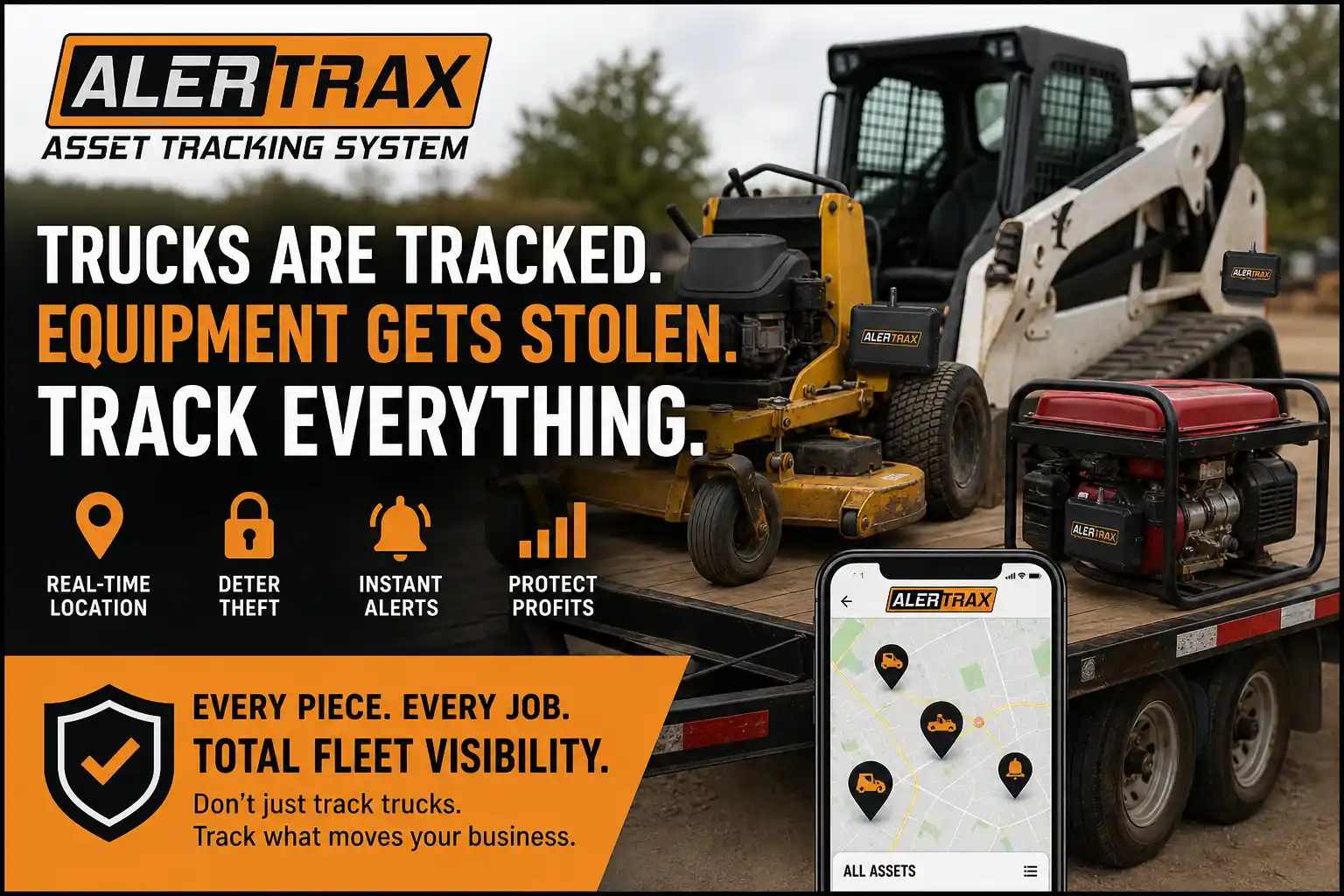
Most fleet owners track their trucks. A few track their trailers. Almost none track the equipment the trucks and trailers are carrying.
That gap is where the real money is.
A work truck is a $50,000 to $80,000 asset, and it is the easiest thing in your operation to recover if it goes missing, police pull license plates, dealerships scan VINs, insurance covers most of the loss. The asset you cannot replace easily, cannot insure cheaply, and cannot recover quickly is the $14,000 stand-on mower on the back of the trailer. The $48,000 mini skid steer parked at the job site over the weekend. The $4,500 portable generator left running at the new construction site overnight. The plate compactor, the trash pump, the wire-feed welder, the pressure washer.
Every one of those is a thousand-to-fifty-thousand-dollar machine that walks off a job site, falls off a trailer, gets "borrowed" by a sub, or disappears from a residence without a trace. And every one of those is the asset most fleets do not have eyes on, because tracking has always been thought of as a truck thing, not an equipment thing.
This article is about why that needs to change, and what fleet visibility actually looks like when you track every piece of equipment that moves, not just the ones with steering wheels.
The Equipment Theft Problem Most Owners Have Never Quantified
If you ask a fleet owner how much they lose to truck theft per year, they usually know. If you ask them how much they lose to equipment theft, you get a shrug.
The numbers, when you actually look them up, are alarming. The National Equipment Register (NER), which tracks heavy and light commercial equipment theft, estimates that between $300 million and $1 billion worth of construction and outdoor power equipment is stolen in the United States every year. The wide range is itself the problem, much of it never gets reported because owners assume there is no chance of recovery.
And they are largely right. The National Insurance Crime Bureau (NICB) reports that recovery rates for stolen heavy equipment hover at roughly 23 percent, compared to recovery rates well above 50 percent for stolen passenger vehicles. For smaller items, handheld tools, portable generators, mowers, blowers, trimmers, the recovery rate drops further, because there are no VINs, no license plates, and no central registry that ties a serial number to an owner.
Put differently: when a truck gets stolen, the system is built to find it. When a mower gets stolen, you are on your own.
The financial exposure goes well beyond the asset itself. The Associated Equipment Distributors (AED) Foundation has documented that equipment theft costs the construction and outdoor services industries an additional $1 billion or more annually in downtime, rental replacements, project delays, and increased insurance premiums on top of the value of the stolen equipment. A $12,000 mower that walks off a trailer is not a $12,000 loss. It is a $12,000 mower, plus three days of lost route revenue, plus a rental, plus the higher premium next year.
Why the Truck Is the Wrong Thing to Be Watching
Truck-only tracking creates a false sense of fleet visibility. You can see where every vehicle is, and that feels like fleet management. But your trucks are not your most vulnerable assets. They are not your most expensive assets per pound. And they are not the assets that go missing most often.
Industry research consistently shows that theft of equipment, attachments, and small tools occurs at a far higher frequency than theft of full-size vehicles, because smaller equipment is easier to move, easier to fence, harder to identify, and almost never recovered (NICB; AED Foundation).
A typical landscaping, hardscape, or trades fleet might run 5 trucks and 30 to 80 pieces of trackable equipment behind those trucks: mowers, skid steers, mini-excavators, generators, compressors, pressure washers, trash pumps, plate compactors, log splitters, dump trailers, dingo loaders, stump grinders, wood chippers, leaf vacuums, sprayer rigs, and on and on. The asset base is six to fifteen times larger than the truck count, but the visibility almost always stops at the truck.
And there is an operational angle that has nothing to do with theft. When the truck pulls onto a job site, the truck is at the job site. The mower? You assume it is on the trailer. The skid steer? You assume it got dropped off Tuesday like it was supposed to. The generator? You hope it is still where the foreman left it overnight. Tracking trucks tells you where the cab is. It does not tell you what is on the trailer, what is on the job, or what is missing.
The Six Equipment Categories Most Often Lost, and Most Worth Tracking
Different industries lose different equipment, but the patterns are remarkably consistent. Here are the six categories where untracked assets disappear most often, and where GPS tracking pays for itself fastest.
1. Ride-on and stand-on mowers ($10,000 to $20,000 each). Stand-on and zero-turn mowers are the single most stolen category of outdoor power equipment in the country. They are heavy enough to require a trailer to move but light enough to roll up a ramp in under a minute. NER data has shown that mowers and tractors consistently rank in the top categories of reported equipment theft, year after year. A single missing commercial mower can take a crew out of service for an entire week while a replacement is sourced.
2. Skid steers, mini-excavators, and compact loaders ($30,000 to $90,000 each). Compact machines are the highest-value rolling assets in most small fleets, and they are routinely left at job sites overnight or over weekends because moving them every day is impractical. The NICB reports that compact construction equipment is stolen at higher rates on weekends and holidays than on working days, because the equipment is sitting still and unattended.
3. Portable generators, compressors, and trash pumps ($1,500 to $8,000 each). These are the "cash-equivalent" assets on a job site. They are easy to lift into the bed of a pickup, easy to resell on online marketplaces, and almost never have a serial number anyone has bothered to register. The U.S. Bureau of Justice Statistics reports that small-equipment theft from job sites and storage yards rose sharply over the past decade, driven largely by the resale market for portable power equipment.
4. Trailers (utility, equipment, enclosed) ($3,000 to $25,000 each). Trailers are the most-stolen piece of equipment in many fleets, full stop, because they are easy to hitch and tow, frequently parked unattended overnight, and often left fully loaded with even more valuable equipment. NICB reports trailer theft has trended upward year over year, with enclosed cargo trailers a particular target.
5. Specialty attachments and implements ($500 to $15,000 each). Hydraulic breakers, augers, pallet forks, snowplow blades, brush cutters, grapple buckets, these are the easiest items in a fleet to walk off a job site. They are unmarked, fit in a pickup bed, and disappear into the secondhand market without a trace.
6. Handheld power equipment in bulk ($300 to $1,200 each, $3,000 to $15,000 by the truckload). Backpack blowers, string trimmers, chainsaws, hedge trimmers, pressure washers, plate compactors. Individually small. Collectively, when a locked trailer gets broken into overnight, the loss can run into five figures in under sixty seconds.
The Hidden Operational Cost of Untracked Equipment
Theft is the loudest cost. The quieter cost, the one that bleeds margin every single week, is the operational drag of not knowing where any of your equipment is right now.
Equipment hunting. When the Wednesday morning crew shows up at the yard and the plate compactor they need is not on its trailer, somebody starts calling around. "Did Crew 3 take it to the Lakewood site? Is it still at the Maple Ridge job? Did Greg leave it at his house again?" Industry research from the Associated General Contractors of America (AGC) has long noted that field-level equipment locating consumes a meaningful portion of weekly crew time on multi-site operations, often more than owners realize. Every hour spent finding equipment is an hour not spent doing billable work.
Duplicate purchasing. When an owner does not know where a piece of equipment is, the default move is to buy another one, because the work still has to get done. Multi-site fleets routinely end up with two or three more units of common equipment than they actually need, simply because nobody could find the one they already owned when it was needed. The Bobit Fleet Technology Trends Report has documented that small fleets with comprehensive asset tracking systematically reduce duplicate equipment purchases compared to fleets that track only vehicles.
Underutilization. A $35,000 mini skid steer that sits idle at one job site for three weeks while another crew is paying to rent a similar unit is the silent killer of small fleet ROI. Without asset-level visibility, you cannot match equipment to need across crews. The AED Foundation has reported that commercial equipment utilization rates in small fleets without telematics often fall below 50 percent, meaning more than half the time you are paying for ownership, the asset is doing nothing.
Maintenance and warranty leakage. Tracked equipment generates run-hour data. Untracked equipment generates guesses. Skipped service intervals shorten equipment life, void warranties, and lead to premature replacement, every one of which is a five-figure decision being made on incomplete information.
Insurance claim friction. When equipment goes missing and the claim gets filed, the first question the insurer asks is "when was the last time the asset was confirmed at a verified location?" Without a tracking record, the answer is "we don't know." That uncertainty is what drives partial settlements, denied claims, and higher renewal premiums on equipment policies.
A Real-World Day on a Fully-Tracked Fleet
Here is what fleet visibility actually looks like when every piece of equipment is on the map, not just the trucks:
- 6:45 AM, Crew 1 hooks up Trailer A and pulls out of the yard. Trailer A reports it is now moving. The two mowers and three handhelds mounted on it report they are now moving with it.
- 7:32 AM, Trailer A arrives at the Lakewood job. Geofence trips automatically. The mowers and handhelds confirm they are at the site too.
- 9:14 AM, A backpack blower's tracker reports it has left the geofence. It is moving toward the road, then south on the highway. Owner gets an alert in seconds. (It turns out a homeowner picked it up "by mistake." A phone call brings it back within the hour.)
- 11:50 AM, The mini skid steer left at the Crofton job site Tuesday reports it has not moved in 48 hours. Owner schedules it for pickup that afternoon to be used on Thursday's job in Towson, instead of renting one.
- 4:18 PM, Crew 1 returns to the yard. Trailer A arrives. The two mowers and three handhelds all confirm yard arrival. Nothing missing. Pay period continues clean.
- 11:42 PM, A pressure washer at the residential yard pings movement. Outside its allowed hours. Owner gets the alert, opens the live map on their phone, sees the unit moving north on Route 50, and calls the police with a live link.
Every one of those events is the kind of thing that, on an untracked fleet, would either never get caught, get caught hours or days too late, or get caught by accident. With every asset reporting, every event becomes a data point, and every data point becomes an opportunity to recover money, reduce risk, or improve operations.
Why Most "Equipment Tracking" Solutions Fail in the Real World
Fleet owners who have looked into equipment tracking before usually run into the same three problems, which is why most of them give up and stick with truck-only tracking.
The wiring problem. Most commercial GPS systems were designed for trucks with constant 12-volt power. They draw from a vehicle battery, get installed by a fleet shop, and require the asset to have an electrical system the tracker can tap into. Mowers, generators, and handheld equipment have either no electrical system, an electrical system you cannot tap, or an electrical system that gets killed every time the equipment is shut off, meaning the tracker dies too. Wired trackers, in practice, do not work for the equipment that needs tracking most.
The cost problem. Many tracking solutions charge per-device monthly fees high enough that tracking a $1,500 generator costs $25 a month, $300 a year, $3,000 over the life of the asset. Owners do the math and decide it is cheaper to absorb the occasional theft. The math changes completely when the per-device cost is flat and the device runs for a year without wiring.
The installation problem. Even if a wired tracker would technically work on a piece of equipment, the installation appointment, the downtime, the cabling, and the install fee for each individual unit means that tracking a fleet of 60 small assets becomes a project, not a purchase. By the time an owner finishes pricing it out, they have moved on.
These three problems are why most fleets, in practice, track 5 trucks and ignore 60 pieces of equipment, and why a battery-powered, magnetic, install-yourself tracker changes the entire economics of fleet visibility.
Why Alertrax Is Built for Equipment-on-Equipment Tracking
Alertrax was engineered for exactly the scenario most tracking systems fail at: putting a tracker on assets that have no electrical system, no install bay, no constant power, and no dedicated driver.
- One-Year Battery Life, No Wiring Required: Alertrax runs on a self-contained battery that lasts a full year on two AA batteries. No splicing into an electrical system, no OBD-II port, no power feed. Mount it once. Replace the batteries annually.
- Covert Magnetic Mounting: Mounts magnetically to any steel surface. Tuck it inside a mower deck housing, behind a generator's frame rail, under a skid steer's belly pan, inside a trailer crossmember. No visible antennas, no wires to trace, no obvious indicator that an asset is being tracked.
- 100% Waterproof, Ruggedized Housing: Built to survive rain, mud, road salt, pressure-washing, snow, and the day-to-day abuse of commercial work. Mount it on a mower deck or a generator frame and forget about it.
- Works on Anything That Moves: Trucks, trailers, mowers, skid steers, mini-excavators, generators, compressors, pumps, attachments, handheld trailers, every asset on one platform, on one map.
- Geofence Alerts at Yards, Job Sites, and Storage Locations: Set virtual boundaries around your yard, your active job sites, and your overnight storage spots. Get automatic alerts when any asset leaves a fence outside of expected hours.
- After-Hours Movement Alerts: Configure each asset with the hours it is allowed to move. Get an instant notification the moment any asset moves outside that window, across every piece of equipment, simultaneously.
- Tamper Alerts: If the tracker is removed or disturbed, an alert hits your phone within seconds.
- Live Fleet Map: The Alertrax Fleet Portal shows every tracked asset on one live map. Pull it up at any moment and see exactly which mower is at which site, which trailer is on the road, and which generator has been sitting in the yard for three weeks waiting to be used.
- Shareable Tracking Link: If something does go missing, send law enforcement a live tracking link, no app, no login, just a live map of the asset moving live.
- iOS and Android App: Check on any asset from your phone, anywhere, anytime.
Pricing That Makes Tracking Every Asset Actually Make Sense
You can equip your entire fleet, trucks, trailers, mowers, skid steers, generators, attachments, everything, with Alertrax for a low monthly rate. No long-term contracts, no hidden fees, no install fees, and no per-device variable charges.
(Want to own it outright? We offer a $599 Lifetime option for permanent, subscription-free tracking on any asset.)
Run the numbers on the worst case. One stolen mower at $14,000. One stolen skid steer at $48,000. One trailer full of handhelds at $9,000. A single recovery in the life of the device covers the cost of tracking the entire fleet for years. And that is before you count the operational savings, eliminated duplicate purchases, recovered idle equipment, faster locate times in the field, and the reduced insurance premiums that come with documented telematics on every asset.
For most small-to-mid commercial fleets, the math works out the moment you decide tracking a $4,000 generator is no longer too expensive to be worth it.
And Yes. Your Trucks Are Tracked Too
Everything this article describes for equipment applies equally to the trucks. Engine-on time, route history, geofences, after-hours alerts, the shareable link for customer ETAs and law enforcement, every truck in your fleet gets the same visibility as every mower behind it. Same platform. Same map. Same app.
The difference is that with Alertrax, the truck is no longer the only thing on the map. The mower is on the map. The generator is on the map. The trailer is on the map. The whole fleet, finally, actually, completely, is on the map.
Stop Tracking Trucks. Start Tracking the Whole Fleet.
The trucks are the easy assets to recover, the easy assets to insure, and the easy assets to replace. The mower, the skid steer, the generator, the trailer full of handhelds, those are the ones that disappear, sit idle, get hunted for, and never come back.
A magnetic, battery-powered GPS tracker on every piece of equipment that moves is the difference between thinking you have fleet visibility and actually having it.
Visit www.buyalertrax.com today and put a tracker on every truck, every trailer, and every piece of equipment in your operation, not just the ones with steering wheels.
Sources
National Equipment Register (NER) — Annual equipment theft volume estimates for construction and outdoor power equipment
National Insurance Crime Bureau (NICB) — Recovery rates for stolen heavy equipment vs. passenger vehicles; trailer theft trends; weekend/holiday theft patterns for compact construction equipment
Associated Equipment Distributors (AED) Foundation — Annual industry-wide cost of equipment theft including downtime, replacement, delays, and premium increases; small-fleet equipment utilization rates
U.S. Bureau of Justice Statistics — Small-equipment and job-site theft trends
Associated General Contractors of America (AGC) — Field-level equipment locating time on multi-site operations
Bobit Fleet Technology Trends Report — Comprehensive asset tracking and reduction in duplicate equipment purchasing