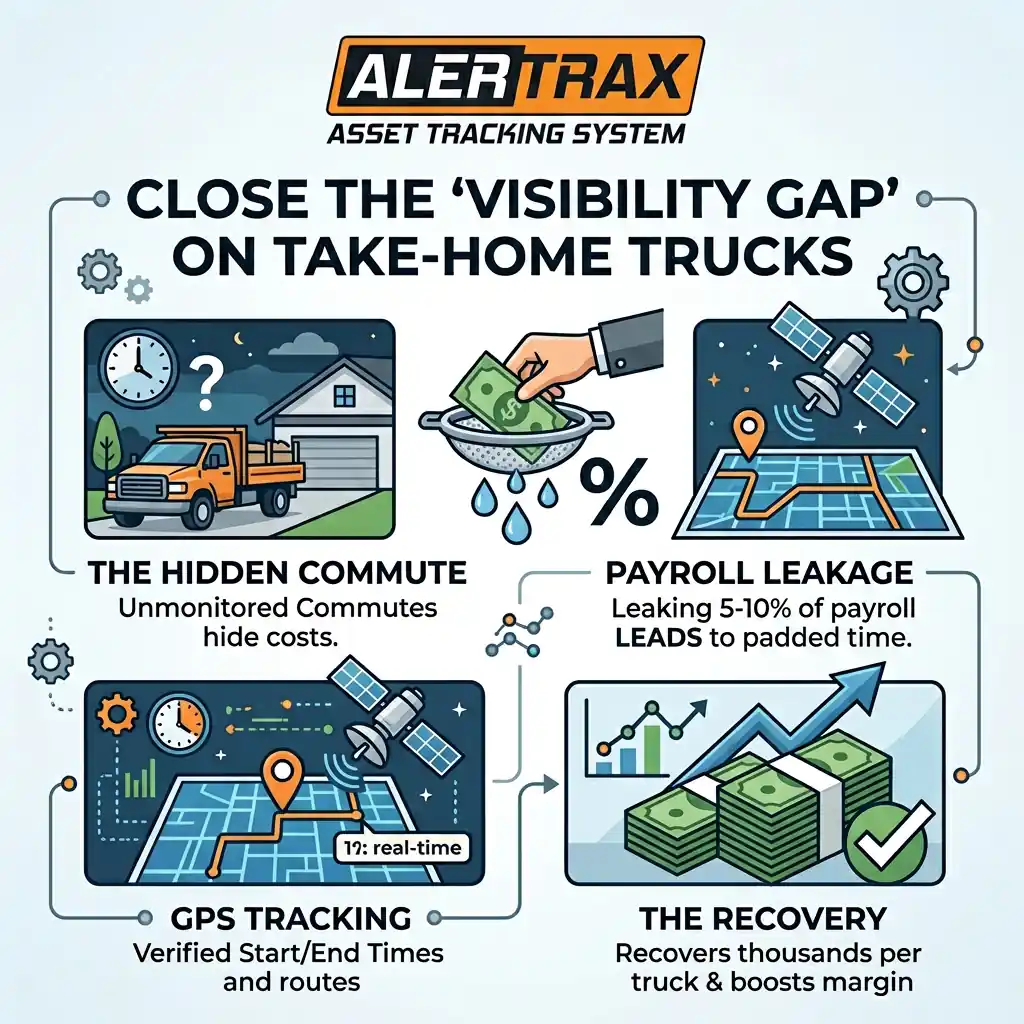
Your foreman takes the F-250 home every night. So does the lead on Crew 2. It saves you a parking spot at the yard, it saves them a 20-minute drive in their personal car at the start of every shift, and it gets the trailer to the first job faster in the morning. On paper, take-home trucks are a win for everyone.
Then the time card hits your desk. The foreman clocked in at 6:30 AM. The first job site logs the crew arriving at 8:15. That's an hour and forty-five minutes you're paying for, driving, fueling up, grabbing breakfast, picking up the second guy, sitting in traffic. Some of that time is legitimate. Some of it is not. You have absolutely no way to tell the difference.
Same thing on the other end of the day. The last job wraps at 3:30. The truck is home by 4:00, but the foreman clocked out at 5:15. What happened in those seventy-five minutes? Maybe a stop at the supply house. Maybe a stop at the bank, the grocery store, his girlfriend's apartment. You're paying for it either way.
This is the take-home vehicle visibility gap. It's the single biggest unmonitored block of paid time in most landscaping, hardscaping, and trades operations, and almost no one is measuring it. The crews know that. The good ones don't take advantage of it. The bad ones absolutely do.
The Hours Hiding on Both Ends of the Day
Most owners think of payroll leakage as something that happens during the work day, extended lunches, slow starts on a job site, a 3 PM "we're wrapping up" that's really a 2:15 wrap. Those are real. But the largest single block of unmonitored, unverifiable, billable time on a take-home truck is the morning commute and the evening return.
According to research published by Workpuls on time theft in field-based businesses, employers lose 5 to 10 percent of total payroll annually to time theft, padded timesheets, buddy punching, late starts, and early departures. For a landscaping company with $500,000 in annual labor cost, that's $25,000 to $50,000 walking out the door every year. And take-home trucks are where most of that walking happens, because the morning and evening hours are the ones nobody is watching.
The math is simple and it's brutal. If a foreman pads his start time by 30 minutes a day and his stop time by 30 minutes a day, one full hour of paid time he didn't actually work, at a fully-burdened cost of $27 per hour (a $20/hr employee plus the 20–35% labor burden documented by Service Autopilot), that's $27 a day, $135 a week, and roughly $7,000 a year. Per truck. Per foreman.
Run that across a fleet of five take-home trucks and you're looking at $35,000 a year in payroll being spent on time that does not exist. For a company averaging the industry's 6.2 percent net profit margin (Wifitalents), recovering that $35,000 is the equivalent of booking more than $560,000 in new revenue. You don't need to grow your way out of this. You need to see it.
Why Take-Home Trucks Are the Hardest Hours to Verify
Every other category of paid time has at least one natural witness. Office time has the office. Job site time has the customer, the property, the crew, the materials being delivered. Even shop time has other employees coming and going.
Take-home truck time has nobody. The truck leaves a private driveway. It travels alone. It arrives at a job site sometime later. There is no one to say what time it actually started moving, what route it took, whether it made stops, or whether the engine was idling in front of a McDonald's for twenty-five minutes before continuing on.
That's why fleet research consistently finds that vehicles run with significant unproductive windows before any tracking is in place. The Aberdeen Group has documented that fleets without GPS visibility average roughly an hour of unaccounted vehicle time per day, and the Bobit Fleet Technology Trends Report finds that vehicles dispatched from a yard show meaningfully lower unaccounted time than vehicles that begin and end the day at private residences. When the day starts and ends at a driveway, the unproductive window is essentially invisible to management.
The opportunity cost is enormous. The American Transportation Research Institute (ATRI) calculates the total operating cost of a commercial work truck at over $2.00 per mile when fuel, depreciation, insurance, maintenance, and driver wages are combined, meaning every unaccounted mile and every unaccounted minute on a take-home route is a direct hit to margin. The Bobit Fleet Technology Trends Report finds that more than 70 percent of fleets that implement GPS tracking report measurable productivity gains, and the largest single source of that gain on small business fleets is the elimination of unverifiable start and stop time on take-home routes.
The Five Categories of Loss on a Take-Home Truck
When you look closely at where the money actually goes on an untracked take-home vehicle, the leakage falls into five distinct categories. Each one is small. The combined effect is enormous.
1. Padded start times. The foreman writes 6:00 on the time card. The truck didn't actually leave the driveway until 6:35. That 35 minutes is paid commute the company never agreed to pay for. Across a year of working days, that's roughly 145 hours per truck, close to four full work weeks of paid time spent on a couch.
2. Padded stop times. The truck pulls into the driveway at 4:15. The time card says 5:00. That 45-minute window is the second-largest source of payroll leakage on take-home routes, and it's almost impossible to catch without GPS data because the foreman is "still in the truck on the way home", except he isn't.
3. Personal stops on the company's clock. The bank. The pharmacy. The kid's school. The Home Depot run that turns into a 90-minute browsing trip. None of these are inherently a fireable offense, but when they happen on the clock, in the company truck, burning company fuel, they are payroll leakage. U.S. Department of Energy research on idling shows that a typical light-duty truck burns roughly half a gallon to a full gallon of fuel for every hour it idles, and at current diesel prices that adds up to hundreds of dollars per truck per year disappearing into a parking lot somewhere on the way home.
4. Side jobs run on company time. This is the worst-case scenario and it's more common than owners want to admit. A foreman with access to a truck, a trailer, and a yard full of equipment can run a small "weekend" mowing or installation operation entirely on the company's dime, leaving 30 minutes early to "drop the truck off," only to swing by a side-job property on the way home. GPS route history makes this pattern obvious within a single week of data.
5. Unverified mileage and fuel. Most take-home truck arrangements include some allowance for personal use of fuel (around the neighborhood, to the gas station, etc.), but without route data, there is no way to distinguish reasonable personal use from a foreman driving the truck 40 miles to a relative's house every weekend. The Bobit Fleet Technology Trends Report finds that fleets implementing GPS tracking consistently report double-digit reductions in fuel spend, and a meaningful portion of that recovery comes from the elimination of unmonitored personal mileage on take-home vehicles.
The Insurance and Liability Side Nobody Talks About
Beyond payroll, take-home trucks carry a category of risk that does not exist for yard-parked vehicles: every mile driven outside the scope of work is a mile your commercial auto policy may not cover.
Commercial auto insurance typically covers business use, with limited allowances for incidental personal use. When a foreman uses a company truck to move furniture for a friend on a Saturday, or drives the truck to a side job, or has a non-employee passenger on the way home, the insurer's exposure shifts, and so does yours. The National Insurance Crime Bureau (NICB) has long documented that vehicles with verified GPS tracking are recovered at significantly higher rates than those without, and many commercial insurance carriers offer premium credits for GPS-equipped fleets because verifiable usage data lets them price the policy against actual risk instead of worst-case assumptions.
And the regulatory side is real. The Federal Motor Carrier Safety Administration (FMCSA) requires accurate records of vehicle use for commercial operations meeting certain weight and route thresholds. For landscaping fleets running larger trucks and trailers, undocumented personal use of a commercial vehicle can create compliance exposure that nobody thinks about until something goes wrong.
The single accident on an unauthorized personal trip is the one that sinks an uninsured claim. GPS data is, in that moment, the only source of truth about who was driving where and why.
What GPS Actually Tells You About a Take-Home Truck
The reason GPS closes this gap so cleanly is that the data answers every question a payroll review would otherwise have to guess at. With Alertrax on a take-home vehicle, you get:
- Exact engine-on time at the residence each morning, the real start of the workday, not the time written on the time card
- Route taken from the residence to the first job site, including any stops along the way, with duration logged at each one
- Arrival timestamp at the first job, automatically recorded, no crew input required
- Total drive time from home to first job, so you can compare it to a reasonable baseline and spot outliers
- Departure time from the last job of the day, the moment paid work ends
- Route taken from the last job to the residence, including any stops, idling, or detours
- Arrival timestamp back at the residence, the actual end of the workday
- After-hours movement, instant alerts if the truck moves between, say, 7 PM and 5 AM, when it should be sitting in a driveway
Every one of these data points is logged automatically. There is no app for the crew to open, no button to press, no check-in. The truck reports itself.
The Conversation This Data Lets You Have
One of the biggest reasons owners avoid talking to crews about take-home truck abuse is that, without data, the conversation is impossible to have. "I think you're padding your time" is not a conversation. It's an accusation. And it always ends with the foreman insisting he was working, and the owner with no way to prove otherwise.
GPS data turns that accusation into a calm, factual review. "The truck left your house at 6:42 last Tuesday. The first job site is 14 minutes away. You logged your start at 6:00 and your arrival at the job at 7:30. Help me understand the gap." There's no opinion in that sentence. There's no judgment. There's just a clock, a map, and a question.
This is why GPS implementations consistently find that 95 percent of employees rate workplace GPS tracking as positive or neutral, and 50 percent say it actually builds trust with their employer (TSheets / HR C-Suite surveys). Good employees stop being suspected. Bad behavior gets surfaced as data, not personal conflict. And in cases where the truck did, in fact, sit in traffic for 45 minutes, the GPS proves the foreman right.
The data is not the enemy of the crew. The data is the only thing in the building that treats every crew member exactly the same.
A Real-World Day on a Take-Home Truck
Here's what one day on an Alertrax-tracked take-home F-250 actually looks like in the fleet portal:
- 5:47 AM, Engine on at foreman's residence, 1180 Maple Ridge Rd
- 5:51 AM, Truck departs residence
- 6:09 AM, Stop at supply house, 800 Industrial Blvd (18 minutes, pulled tarps and edging)
- 6:31 AM, Stop at QuickMart, 240 Main St (12 minutes, coffee and snack run)
- 6:48 AM, Arrival at first job site, 1420 Lakewood Dr (logged automatically)
- 2:14 PM, Departure from second job site, 805 Maple Ridge Ct
- 2:31 PM, Arrival at yard, drops off trailer (8 minutes)
- 2:46 PM, Stop at bank, 105 Center St (14 minutes)
- 3:09 PM, Arrival at residence, engine off
That single day's data tells you exactly what to do at the next pay period. The clock-in time on the card should be 5:51, not 5:30. The 12-minute coffee run is incidental and probably fine. The 14-minute stop at the bank on the way home is on personal time, the workday ended at 2:31 when he left the yard. The clock-out should be 2:31, not 4:00.
Multiply that level of clarity across every take-home truck, every day, every pay period, and the payroll leakage problem stops being invisible.
Why Alertrax Is Built for Take-Home Truck Visibility
Most GPS tracking systems were designed for over-the-road logistics fleets, long-haul trucks with constant 12-volt power, hardwired installations, and dedicated drivers. Take-home trucks in a landscaping or trades fleet do not look like that. They are work trucks that get used hard, sit in private driveways overnight, and need a tracking solution that does not require a wiring job, a monthly install fee, or a foreman's cooperation to operate.
Alertrax was built for exactly this scenario.
- One-Year Battery Life, No Wiring Required: Alertrax runs on a self-contained battery that lasts a full year. No splicing into the truck's electrical system, no OBD-II port the foreman could unplug, no installation appointments at a fleet shop.
- Covert Magnetic Mounting: Mounts magnetically to any steel surface, under a bumper, inside a frame rail, behind a panel. The truck looks completely untouched. No visible antennas, no wires to trace, no obvious "I'm being tracked" indicator on the dash.
- 100% Waterproof, Ruggedized Housing: Survives rain, mud, road salt, pressure-washing, and the day-to-day abuse of a working truck. Mount it once and forget about it for a year.
- Automatic Start and Stop Logging: Every trip is automatically logged with engine-on time, departure time, every stop along the way, and final destination. No app for the crew to open. No button to press. The truck reports itself.
- After-Hours Movement Alerts: Set the hours the truck should be parked at home, typically evenings, overnights, and weekends, and get an instant notification the moment the truck moves outside that window. If the truck pulls out of the driveway at 9:30 PM on a Saturday, you know within seconds.
- Geofence Alerts at Residences and Yards: Geofence each take-home address and each yard. Get automatic timestamps the moment the truck enters or exits. Your verified start-of-day and end-of-day, without anyone writing anything down.
- Live Fleet Map: The Alertrax Fleet Portal shows every tracked truck on a single live map. Pull it up at 6:15 AM and see which take-home trucks are already moving and which ones are still in the driveway.
- Detailed Trip Reports: Export CSV or PDF reports for any vehicle and any date range. Every stop, every duration, every mile, perfect for payroll review, dispute resolution, or end-of-month job costing.
- iOS and Android App: Check on a take-home truck from your phone, anywhere, anytime, including the moment a 9:30 PM movement alert hits.
Pricing That Pays for Itself the First Time the Time Card Doesn't Match the Map
You can equip your entire fleet with Alertrax for a low monthly rate, no long-term contracts, no hidden fees.
(Want to own it outright? We offer a $599 Lifetime option for permanent, subscription-free tracking.)
Run the numbers on a single take-home truck. If a foreman is padding his time by an hour a day at a fully-burdened cost of $27 per hour, that's $7,000 a year in recovered payroll on one truck, and that's before you count fuel savings, reduced insurance exposure, and the elimination of personal-use mileage. The Bobit Fleet Technology Trends Report finds that the majority of fleets implementing GPS tracking achieve positive ROI in their first year, and take-home truck visibility is one of the largest contributors to that number on small business fleets.
For most landscaping and trades operations running take-home vehicles, Alertrax pays for itself in the first month, on the first truck.
And Yes. It Protects the Truck When It's Sitting in the Driveway
This article is about visibility, but a take-home truck spends most of its life parked at a residence, often a residence in a quiet residential neighborhood with no security cameras and no fenced yard. Equipment theft and vehicle theft are real risks anywhere a working truck sits overnight.
Alertrax's after-hours movement alerts are not just a payroll tool. If a take-home truck moves at 2:14 AM, you get an alert in seconds, and law enforcement gets a live tracking link that follows the truck live, anywhere it goes. The same feature that catches an unauthorized side trip on Saturday afternoon also catches a stolen truck on Tuesday at 3 AM.
AMAROK reports that 40 percent of stolen landscaping equipment is never recovered, and a single stolen truck can cost up to $4,000 a day in lost revenue on top of the asset itself. One device, one platform, payroll visibility during the day, theft protection at night.
Stop Paying for Hours You Can't See
Take-home trucks are a real operational advantage. They get your crews to the first job faster, they save you parking, and they're a meaningful perk for the foremen and leads who get to drive them. None of that has to change.
What has to change is the visibility gap. The hours between the residence and the first job, and the hours between the last job and the residence, are some of the largest unmonitored blocks of paid time in your entire payroll. You can keep guessing what happens in those hours, or you can put a magnetic device on every truck and know.
Visit www.buyalertrax.com today and put a tracker on every take-home truck in your fleet, before next pay period.
Sources
Workpuls — "Businesses lose 5 to 10 percent of payroll annually to time theft"
Service Autopilot (2026) — "Labor burden adds 20 to 35 percent on top of base wages; a $20/hr employee actually costs $24 to $27/hr"
Wifitalents (2023) — "Average landscaping industry profit margin: 6.2 percent"
Aberdeen Group — Research on unaccounted vehicle time in fleets without GPS visibility
Bobit Fleet Technology Trends Report — Productivity gains, fuel reduction, and first-year ROI data on commercial GPS implementations
American Transportation Research Institute (ATRI) — Annual operational cost per mile for commercial work trucks
U.S. Department of Energy — Idle fuel consumption rates for light-duty trucks
TSheets / HR C-Suite Surveys — "95 percent of employees rate GPS tracking positive or neutral; 50 percent say it builds trust with employer"
National Insurance Crime Bureau (NICB) — Recovery rates for GPS-equipped vehicles
Federal Motor Carrier Safety Administration (FMCSA) — Recordkeeping requirements for commercial vehicle use
AMAROK — "40 percent of stolen landscaping equipment is never recovered; up to $4,000 per day in lost revenue per stolen truck"