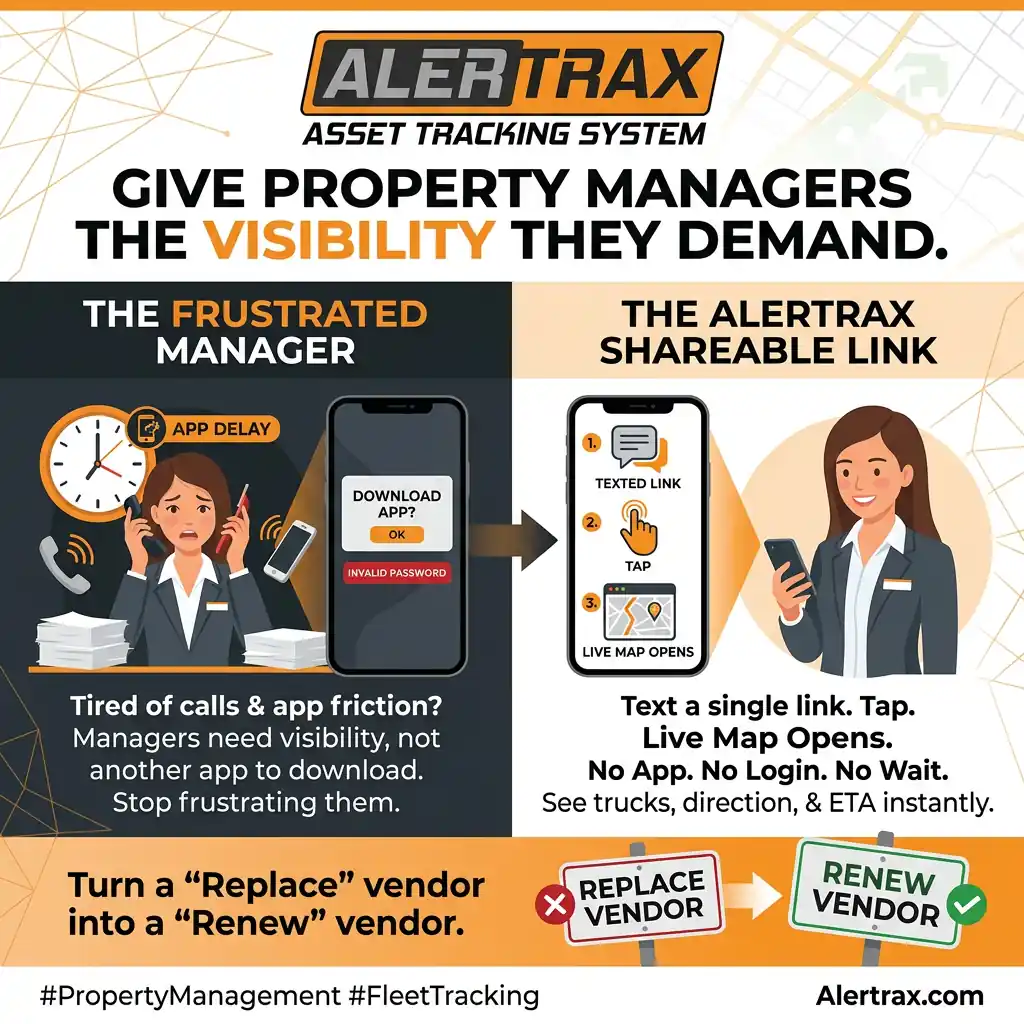
It is 7:42 AM on a Wednesday. The property manager who oversees twelve commercial buildings across your service area has already been on the phone for forty-five minutes. Three tenants want to know when the HVAC tech is showing up. The lawn at the corporate park is supposed to be cut before the 9 AM tenant walk-through. The plumber promised to be on-site at one of her retail centers by 8 AM, and she has not heard a word from anyone.
So she does what she always does. She picks up the phone and calls you.
Your dispatcher does not know exactly where your crew is right now. She knows they left the yard at 6:30. She thinks they are on the way. She tells the property manager "they should be there shortly" and hangs up. Forty minutes later, the property manager calls again. Different building, same question.
Now imagine a different version of that morning. The property manager texts: "Are they coming today?" Your dispatcher replies in five seconds with a link. The property manager taps it on her phone. A live map opens in her browser, no app, no login, no password, and she can see exactly where your truck is, how fast it is moving, and that it will be at her property in about eighteen minutes. She puts her phone down and gets back to her job.
That single link just saved your dispatcher a phone call. It saved your driver from getting interrupted with another "where are you?" text. And it just made your company look like the one that has its act together, the one she will keep calling next year, and the year after that.
The "Where Are You?" Tax Hiding in Your Workday
Most service company owners have never put a number on what inbound check-in calls actually cost their business. Once you do, the number is shocking.
Industry data on small field service teams suggests a 3-person crew averages around 15 check-in calls per day at roughly 4 minutes per call. That works out to roughly 20 hours of lost billable labor every single month, just answering and making "where are you?" calls (Repair-CRM, 2026). Scale that to a 10-truck operation and you are looking at more than 65 hours a month burned on a question a tracking link could answer in two seconds.
That is the soft cost. The hard cost is worse, because every one of those calls represents a customer who is anxious, uncertain, and one bad day away from calling your competitor instead.
According to a 2025 study by Salesforce, 80 percent of customers say the experience a company provides is as important as its products and services. Hiver reports that 72 percent of customers will switch companies after a single negative experience, and 45 percent will end the relationship the same day. In commercial service contracts, where a single property manager can represent fifteen, twenty, or fifty buildings, losing one customer over poor responsiveness is not losing one job. It is losing a portfolio.
The friction is so well documented that the industry has a name for it: the "Where is my technician?" call. According to Serfy.io, this is the single most persistent friction point in commercial facility management, eroding trust, triggering SLA penalties, and inflating administrative overhead through high call volumes (Serfy.io, 2026).
Your customers are not calling because they are difficult. They are calling because you have given them no other way to know.
Customer Expectations Have Shifted, And Most Service Companies Have Not Caught Up
The reason commercial customers are so impatient about visibility has nothing to do with you specifically. It is because every other industry has trained them to expect it.
According to SupplySense 360, 93 percent of customers now want to know where their order is at all times, and 47 percent will not order again from a company with poor delivery visibility. HubSpot's State of Service Report found that 90 percent of consumers rate an immediate response as important when they have a service question, and 60 percent define "immediate" as 10 minutes or less.
Industry research from logistics technology firms describes the new baseline this way: customers are used to tracking their Uber live and watching their food delivery approach on a live map, and static delivery windows now feel broken to them (Locus.sh, 2026). When your customer can pull up a live map for a $14 burrito, "we will be there sometime between 8 and noon" no longer cuts it for a $4,000 service contract.
This is the mismatch most service companies are running into. The customer is not asking for too much. They are asking for what every other vendor in their life already provides.
And the data is brutal on what happens when you fail to provide it. Research from Liveforce found that every extra hour a customer waits can reduce conversions and retention by up to 80 percent. Bain & Company reports that businesses that prioritize better customer service experiences grow revenues 4 to 8 percent above their market average. Visibility is no longer a competitive edge. It is the floor.
The Account Problem No One Talks About
Here is where almost every "customer-facing tracking" solution falls apart in the real world.
Most field service tracking platforms will let you give your customer access to a tracking page, but only if your customer creates an account, downloads an app, sets up a password, agrees to terms, and figures out how to log in. For a residential homeowner waiting on a service tech, that is already too many hoops. For a commercial property manager juggling fifty vendors across twenty buildings? Forget it. She is not downloading your app. She is not creating yet another login. She does not have time.
So the feature exists, but no one uses it. The phone keeps ringing.
The Alertrax shareable tracking link works differently. You generate a link from the fleet portal or the mobile app. You copy it. You paste it into a text message, an email, a Slack thread, a calendar invite, wherever your customer prefers to communicate. Your customer taps the link. A live map opens in their browser. Done.
No app to download. No account to create. No password to remember. No software for your customer to learn.
That single design choice is what makes the feature actually get used. And the data backs up why that matters: customer experience research consistently finds that the tracking experiences that drive loyalty are the ones that require zero friction from the recipient. The moment you ask a busy property manager to "log in to our customer portal," you have lost.
What the Link Actually Shows Your Customer
When your commercial customer taps the link you sent, here is what they see in their phone's browser:
- The exact, live location of the tracked vehicle or asset, updated continuously on a live map
- Movement status, whether the vehicle is moving, parked, or sitting
- Direction of travel, so they can see at a glance whether you are heading toward them or finishing somewhere else first
- Distance and approximate ETA, based on current location relative to the destination
What they do not see is anything you did not want to share. The link is scoped to a single asset. It does not give your customer access to your fleet portal. It does not show them other jobs, other crews, your route history, or any of your operational data. It is a single live map of a single vehicle, exactly what you chose to share, nothing more.
And because every Alertrax tracker logs arrival and departure timestamps automatically, the data your customer is looking at is the same data feeding your internal records. There is no way for the two stories to diverge. What the customer sees on the link is what your dispatcher sees on the fleet portal is what shows up on the trip report at the end of the week.
5 Ways Commercial Service Companies Use the Link Every Day
The shareable link is not a single-use feature. Once your team has it in their toolkit, it changes how you communicate with customers across dozens of everyday situations. Here are the five most common.
1. Property managers tracking your crew's morning arrival. Commercial property managers are managing buildings, tenants, vendors, leases, and maintenance schedules all at once. The single most useful thing you can give them is the ability to know when you are showing up without picking up the phone. A landscaping crew arriving at a corporate office park before tenants get to work, an HVAC tech on the way to a chiller alarm, a plumber dispatched to a retail center, every one of these is a perfect use case.
2. Replying to "are you coming today?" texts in five seconds. Instead of your dispatcher saying "let me check and get back to you," she sends the link. The customer answers their own question. The dispatcher gets back to actual dispatching.
3. Subcontractor and crew coordination. If you have a hardscape installer waiting on a delivery of pavers, or an electrician waiting on the HVAC crew to finish before they can start, send them the tracking link for the truck or trailer they are waiting on. No more "I'll text you when we leave." They watch the truck approach live.
4. Customer-supplied delivery and equipment drop-offs. If you are dropping off a chipper, a mini-skid, a portable restroom, or any other piece of equipment at a job site, send the customer the tracking link so they can be ready to receive it. No standing around waiting. No missed deliveries. No "I waited all morning and you never showed."
5. Documenting service for SLA compliance. Commercial service contracts increasingly include service-level agreements with response time requirements. When your tech is dispatched to an emergency call, sending the property manager a live tracking link is, in itself, documented proof that the response started immediately. The link is the receipt.
The Internal ROI: What Your Office Gets Back
Customer experience is the loudest benefit of the shareable link, but the operational savings are just as real.
Dispatcher time recovered. If your dispatcher fields even ten "where are you?" calls a day at four minutes per call, that is forty minutes a day, more than three hours a week, more than 170 hours a year, recovered the moment your customers can answer that question themselves. For a 10-truck operation, the recovered time often pays for the entire tracking system multiple times over.
Drivers stop getting interrupted. Service techs and crew foremen pulling out their phones every twenty minutes to reply to "ETA?" texts is not just lost productivity. It is a safety issue. When the customer has the link, the driver gets to drive. The crew gets to work.
Disputed arrival times disappear. The most common billing dispute in service work is some version of "you billed me for a 9 AM start but I don't think your guys got there until 9:45." With the live link, the customer watched the truck arrive live. Industry data finds that GPS-verified arrival timestamps eliminate the vast majority of service verification disputes (FleetRabbit, 2026), and the shareable link makes that verification visible to your customer in the moment, not after the fact.
Fewer SLA penalties. Commercial service contracts with SLA penalties for slow response are a common source of unexpected losses. The shareable link gives the customer live evidence that the response is in progress, which dramatically reduces the friction around SLA enforcement. Property managers are far less likely to invoke a penalty against a vendor whose truck they can literally see approaching the building.
Customer retention. According to HubSpot Research, 93 percent of customers are likely to make repeat purchases with companies that offer excellent customer service. Khoros reports that 83 percent of customers feel more loyal to brands that respond and resolve issues quickly. In commercial service work, where one renewed contract can be worth tens of thousands of dollars, the link pays for itself the first time it saves an account.
Why Alertrax Is Built for Real Service Operations
Most GPS tracking systems were designed for over-the-road logistics fleets, long-haul trucks with constant 12-volt power, hardwired installations, and dedicated drivers. Service companies do not operate that way. You have work trucks, trailers, mowers, skid steers, and equipment that moves in and out of crews and job sites every day.
Alertrax was engineered for that reality.
- One-Year Battery Life, No Wiring Required: Alertrax runs on a self-contained battery that lasts a full year. No splicing into a vehicle's electrical system, no OBD-II ports, no installation appointments. Mount it and it works.
- Track Anything That Moves: Because there are no wires, you can put Alertrax on service vans, work trucks, trailers, mowers, skid steers, generators, compressors, anything you take to a customer site. Every asset shareable, every asset trackable.
- 100% Waterproof, Ruggedized Housing: Built to survive rain, mud, pressure-washing, and the day-to-day abuse of commercial service work.
- Covert Magnetic Mounting: Mounts magnetically to any steel surface. Tuck it under a bumper, inside a frame rail, behind a panel, no visible antennas, no wires to trace.
- Shareable Tracking Link: Generate a live tracking link from the fleet portal or the mobile app, then send it to anyone, no app, no login, no account required for the recipient. Scoped to a single asset, revocable anytime.
- Live Fleet Portal: The Alertrax Fleet Portal shows every tracked asset on a single live map. Internal visibility for your team, external visibility for your customers, both from the same data.
- Geofence and After-Hours Alerts: Set virtual boundaries around customer properties, equipment yards, or storage lots. Get instant notifications when an asset arrives, departs, or moves outside the boundary after hours.
- Automatic Time-on-Site Logging: Every arrival and departure is recorded with a timestamp, for proof of service, payroll verification, job costing, and SLA documentation.
- iOS and Android App: Generate and share tracking links right from your phone, anywhere.
Pricing That Pays for Itself the First Time the Phone Doesn't Ring
You can equip your entire fleet with Alertrax for a low monthly rate, no long-term contracts, no hidden fees.
(Want to own it outright? We offer a $599 Lifetime option for permanent, subscription-free tracking.)
Run the numbers on your dispatcher alone. If you are paying her $25 an hour, fully burdened, and the shareable link saves her three hours a week of "where are you?" calls, that is roughly $300 a month in recovered labor, for a single employee, before you count the recovered driver productivity, the saved customer accounts, and the eliminated billing disputes.
For most commercial service companies, the shareable link feature alone justifies the entire cost of the system within the first month.
And Yes, The Same Link Helps Recover Stolen Equipment
This article is about customer communication, but the shareable link has one more job worth mentioning. If a tracked truck, trailer, or piece of equipment ever gets stolen, you can send law enforcement the same kind of live tracking link live, no waiting for them to install software, no walking a dispatcher through a screen-share, no delays. They tap the link on a phone or a laptop and see the asset moving live.
The same feature that makes you look professional to a property manager makes you fast and effective when something gets stolen. One device, one platform, two completely different problems solved with the same tool.
Stop Answering "Where Are You?", Send a Link Instead
Every commercial service company is in the same race for the same accounts. The companies that win the renewal next year are the ones whose customers feel calm, informed, and respected throughout the relationship. The ones that lose are the ones whose property managers spend their mornings calling around asking where everyone is.
You do not need to overhaul your operation to land on the right side of that line. You need a way for your customers to answer their own most common question, without picking up the phone, without downloading your app, without learning anything new.
Visit www.buyalertrax.com today and put a shareable tracking link on every truck, trailer, and piece of equipment in your fleet.
Sources
Salesforce, "80% of customers say experience is as important as products"
Hiver, "72% of customers switch companies after a single negative experience"; "45% end a relationship the same day"
HubSpot State of Service Report, "90% rate immediate response as important; 60% define immediate as 10 minutes or less"
HubSpot Research, "93% likely to make repeat purchases with excellent service"
SupplySense 360, "93% of customers want to know where their order is; 47% won't reorder with poor visibility"
Locus.sh (2026), Customer expectations around live tracking and live ETAs
Liveforce, "Every extra hour of wait time can reduce conversions by up to 80%"
Khoros, "83% feel more loyal to brands that respond and resolve quickly"
Bain & Company, "Companies prioritizing service grow revenues 4-8% above market"
Repair-CRM (2026), Field service check-in call volume data (15 calls/day, 4 min each, 20 hours/month)
Serfy.io (2026), "Where is my technician?" call data and SLA penalty impact in commercial facility management
FleetRabbit (2026), Service verification dispute reduction with GPS timestamps