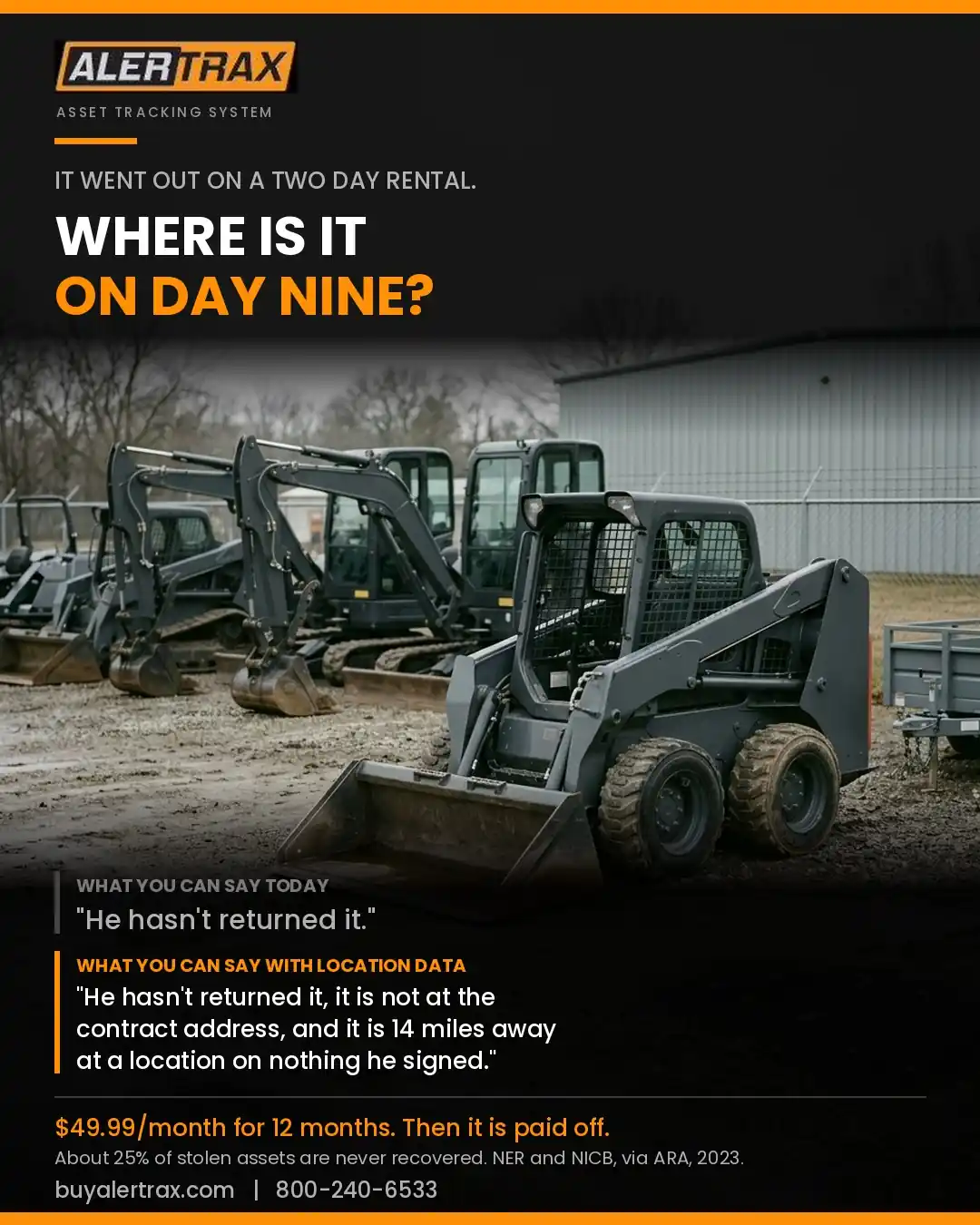
The skid steer went out on a Thursday on a two day rental. It is now the following Friday. Day nine.
Your counter guy has called four times. The first two went to voicemail. The third one, the customer picked up and said the job ran long and he would have it back Monday. That was Monday before last. The fourth call went to voicemail again.
You know the address on the contract. You do not know whether the machine is still there. You do not know whether it went to a second job, got subcontracted to somebody you have never heard of, or is sitting in a driveway two counties over with a For Sale sign on it.
And here is the part that makes this different from every other collection problem in your business: you are not sure whether you are the victim of a crime or a party to a contract dispute, and until you know which, nobody is coming to help you.
That ambiguity is the central operational problem of an independent rental yard, and almost every other issue in this article is a variation of it.
Theft or Breach of Contract? The Answer Decides Whether Anyone Helps You
When a machine is taken off your lot at 2 AM through a cut fence, that is a burglary. Police take a report. Your insurer opens a claim. Everyone understands their role.
When a machine leaves your yard legitimately, on a signed contract, with a credit card on file, and simply never comes back, the picture gets murky fast. Writing in ARA's Rental Management in September 2023, the industry addressed this directly, noting the ambiguity around criminal offense versus breach of contract when it comes to equipment rental theft, and describing it as a problem that continues to affect all levels of the industry (Rental Management, American Rental Association, September 5, 2023).
That ambiguity has practical consequences. A responding officer who hears "he rented it and did not bring it back" often hears a civil matter, not a felony, and tells you to call a lawyer. Meanwhile the clock runs. Every day the machine is unaccounted for is a day it can be moved, disassembled, repainted, or sold.
Location data changes that conversation in a specific way. "He has not returned it" is a contract claim. "He has not returned it, it is no longer at the contract address, and it is currently at a location fourteen miles away that appears on no document he signed" is a different kind of statement. It does not automatically make anything a crime, and your attorney should be the one to advise you on that. But it converts a vague grievance into a documented set of facts, and it lets you act in hours rather than weeks.
The National Equipment Register maintains standing rental fraud alerts precisely because equipment obtained legitimately and never returned is its own category of loss, distinct from a yard break-in.
There Is No Federal Scoreboard for This
One reason the scale of the problem stays fuzzy is that no single government dataset captures it.
The FBI's Uniform Crime Reporting program does not count construction and heavy equipment within its motor vehicle theft category, which is why national vehicle theft dashboards do not reflect what happens in your yard. The result is that the best available figures come from insurers, industry registries, and trade associations rather than from a federal table.
What those sources report is a wide range. The National Equipment Register and the National Insurance Crime Bureau are cited as putting annual equipment and materials theft losses at roughly $300 million, with some estimates running as high as $1 billion, and roughly 25 percent of assets never recovered (Rental Management, American Rental Association, September 5, 2023). CONEXPO-CON/AGG reported in March 2023 that approximately 1,000 pieces of construction equipment are stolen per month in the United States (CONEXPO-CON/AGG, March 28, 2023).
Worth being straight about the limits of this data. Published figures for average loss per incident vary widely between sources, with some industry summaries citing figures around $6,000 per incident and others around $30,000, depending on which equipment classes and which years are included. Recovery rate figures vary similarly. We are not going to pick the most dramatic number and present it as settled. The honest summary is that the losses are large, the recovery rates are poor, and the reporting is inconsistent enough that you should treat any single headline figure with caution, including ones you see from vendors selling you something.
Your Core Metric Is Built on Data You Cannot Verify
Set theft aside, because the everyday version of this problem costs most yards more.
In 2011 the American Rental Association published ARA Rental Market Metrics, a white paper establishing industry standard definitions for calculating and reporting rental company performance. It defined the standards for a rental day, for original equipment cost, and for the calculation of time utilization, financial or dollar utilization, fleet age, and period over period rate change (American Rental Association, ARA Rental Market Metrics, September 2011).
Time utilization is the fraction of your fleet that is on rent for a given period. Dollar utilization measures annualized revenue against the original cost of the fleet. Both are the right metrics. Both are the ones every yard manages against.
And both are computed from days on rent, which most independent yards derive from contract records rather than from observation. Your system knows when a contract opened and when it closed. It does not know when the machine actually left the yard, when it actually arrived at the job, whether it sat unused for six of the nine days it was out, or whether it was returned Tuesday afternoon and not checked in until Thursday morning.
None of those gaps is fraud. Most are ordinary friction. But they mean the number on which you price your fleet, plan your purchases, and judge your business is an approximation built on paperwork, not on where the machine was.
The Unbilled Day Problem
Here is the arithmetic, and the inputs are illustrative placeholders chosen to show the method rather than survey findings. Substitute your own fleet size and rates.
Say you run 60 rental units at an average day rate of $180. Say each unit turns roughly 140 rental days a year. That is 8,400 billable rental days across the fleet, or about $1.5 million in rental revenue.
Now assume that 3 percent of actual days on rent never make it onto an invoice. A machine goes out Friday afternoon but the contract starts Monday. A unit comes back late and the extra days get waived at the counter to keep a good customer happy. A return sits in the yard for two days before anyone checks it in, and the customer is credited for those days.
Three percent of 8,400 days is 252 days. At $180, that is roughly $45,000 a year that the fleet earned and the business did not bill. Not stolen. Not disputed. Just never captured, because nobody had a record of where the machine actually was and when.
Adjust the percentage to whatever you believe is true for your operation. The point is not the specific figure. The point is that this leakage is invisible by construction, because the only record of it would be the location data you do not currently collect.
The Sublocation Problem
There is a second exposure that has nothing to do with billing.
Your contract names a job site. Your insurance, your rates, and in some cases your legal obligations assume the equipment is at that site. Then the customer finishes early, has another job across the county, and moves the machine rather than returning it and re-renting. From his side this is efficient. From yours it means an asset is operating at an address you cannot name, possibly outside your service territory, possibly outside the terms your coverage assumes.
You find out when something goes wrong, if you find out at all.
A geofence around the contract address turns this into a notification instead of a discovery. The machine crosses the boundary, you get an alert, and you make a phone call the same day. That call is usually not adversarial. Most customers who move equipment are not trying to cheat anyone, and a yard that says "I see the machine moved to the Route 40 job, do you want me to extend the contract to cover it" is a yard that just protected itself and sold an extension in the same sentence.
Most of a Rental Fleet Has No Power to Draw From
If tracking rental fleets were straightforward, this would be a solved problem. The reason it is not is a hardware constraint.
Nearly all fleet tracking hardware was designed around vehicles with 12 volt electrical systems, drawing power from a battery or an OBD-II port. Some of your fleet fits that description. Most of it does not.
Walk your yard. Trailers, towable compressors, light towers, generators, plate compactors, walk behind saws, scaffolding, pumps, heaters, attachments, augers, breakers, mixers, and every piece of light equipment on the racks. Almost none of it has continuous power, and a good deal of it has no electrical system at all. On the machines that do have batteries, a hardwired tracker draws current while the unit sits between rentals, which is exactly when it is most likely to kill the battery and generate a service call.
The consequence is that the assets most likely to disappear, most likely to be moved without notice, and most likely to be returned late are the ones the tracking industry never built for.
This also happens to be where the economics work in a rental yard's favor. Because the constraint is a wiring constraint rather than a value constraint, a battery powered tracker costs the same whether it goes on a $90,000 machine or a $4,000 towable. Yards typically tag by risk and by turn rate, not by purchase price.
Why the Rental Model and This Device Fit Each Other
Rental is a per unit, per period business, and rental operators are already fluent in the arithmetic. You do not need to be convinced that a per unit cost can be recovered through a per unit fee. You do that every day.
Which means the question for a rental yard is not philosophical. It is whether the cost per unit is small enough relative to the day rate and the loss exposure to be obvious. On a machine that rents for $180 a day, the tracking cost is a fraction of a single rental day per month. Many yards recover it directly by adding a small equipment protection or asset recovery line to the contract, which is a structure the industry already uses for damage waivers.
And the demand is moving in your direction. The American Rental Association reported on May 19, 2026 that the combined U.S. construction and industrial equipment and general tool rental industry is projected to reach $83.5 billion in 2026, up 3.6 percent, and noted that the trend toward renting rather than owning continues (American Rental Association, May 19, 2026). More rental penetration means more machines in the hands of more customers, more often. Every point of growth is another unit you need to be able to find.
What AlerTrax Does in a Rental Yard
AlerTrax was built for assets with no power to give, which describes most of a rental fleet.
- Two AA batteries, no wiring: Over a year of battery life in low movement use. Nothing to splice, no port to occupy, no parasitic draw on a machine sitting on the lot between rentals.
- Mounts to anything: An 8 lb magnet, screw mounts, or zip ties. Trailer tongues, generator frames, compactor housings, light tower masts, attachment racks.
- IP67 waterproof and salt water protected: A ruggedized housing at 3.2 by 1.8 by 1.6 inches and 5.3 ounces that survives the wash bay and the weather along with the equipment.
- Automatic time on site logging: Arrival and departure timestamps for every asset at every location. This is the observed record behind your utilization math, not the paperwork approximation.
- AddressFence: Upload contract addresses and receive arrival and departure alerts automatically, without drawing a boundary by hand for every open contract.
- Geofence and after hours movement alerts: Boundaries around the yard and around each contract address. Know when a unit leaves the site it was rented to, and when something moves on the lot at 2 AM.
- Tamper notification: If the device is pulled off the machine, you find out within minutes rather than at check in.
- Live fleet map: Every unit on one view in the AlerTrax fleet portal or the mobile app, with updates as often as every 2 minutes when an asset is moving.
- Shareable tracking link: Send a live location link to a driver, a customer, or law enforcement. No app, no account, no login required by the recipient.
- GNSS, WiFi, and LTE positioning: GPS, GLONASS, GALILEO, and BEIDOU, with WiFi and LTE fallback so a unit parked inside a shop or a container still reports.
Pricing
AlerTrax is $49.99 per month for 12 months per device, no hidden fees. That is a capped total, not an open ended subscription: once the 12 payments are made, the device is paid off. (A $599 Lifetime option is also available as a single up front payment.)
For a yard evaluating this across a fleet, the useful comparison is against a single loss. One machine that never comes back, or one season of unbilled days on a handful of units, generally exceeds the cost of tagging a substantial portion of the fleet.
Most yards do not start with the whole fleet. They start with the categories that cause the most trouble: the towables, the light equipment that walks, and the units with the highest turn rate. Call 800-240-6533 or email sales@buyalertrax.com and we will work through fleet quantities with you.
On the Yard Itself
Everything above is about equipment that is out. The yard is its own exposure, because equipment staged between rentals sits in a known location, in quantity, often with nobody on site overnight.
A geofence around the property turns overnight movement into an alert. It does not stop anyone from cutting a fence. What it does is compress the interval between the equipment leaving and you knowing it left, and given how poor recovery rates are once a machine has a head start, that interval is most of what determines the outcome.
Start With the Ones That Do Not Come Back
Every independent yard has a mental list. The categories that go out and come back late. The customers you rent to with a slight hesitation. The units you have replaced twice.
That list is where to start, and you do not need to solve the whole fleet to find out whether this works. Tag one category for one season and compare what the trackers recorded against what the contracts recorded. If the two agree, you have learned something valuable and cheap. If they do not, you have found the gap.
Visit www.buyalertrax.com, or call 800-240-6533 and we will talk through what to tag first for a rental operation. You can also reach us at sales@buyalertrax.com.
Paul
NautAlert, LLC
Sources
American Rental Association, Rental Management, September 5, 2023. Cites National Equipment Register and National Insurance Crime Bureau figures of approximately $300 million in equipment and materials stolen per year, with some estimates as high as $1 billion, and roughly 25 percent of assets never recovered. Also discusses the ambiguity between criminal offense and breach of contract in equipment rental theft.
American Rental Association, ARA Rental Market Metrics, published September 2011. Industry standard definitions for a rental day, original equipment cost, time (physical) utilization, financial (dollar) utilization, fleet age, and period over period rate change.
American Rental Association, updated North American equipment and event economic forecast, published May 19, 2026. Combined U.S. construction and industrial equipment and general tool rental industry projected at $83.5 billion in 2026, up 3.6 percent, with the shift toward renting over ownership continuing.
CONEXPO-CON/AGG, industry briefing, March 28, 2023. Approximately 1,000 pieces of construction equipment stolen per month in the United States.
National Equipment Register. NER maintains standing rental fraud alerts covering equipment obtained through legitimate rental transactions and not returned.
Federal Bureau of Investigation, Uniform Crime Reporting program. Construction and heavy equipment are not counted within the UCR motor vehicle theft category, which is why no single federal dataset tracks construction equipment theft.
Note on conflicting figures: Published estimates of average loss per equipment theft incident vary substantially across industry sources, with figures around $6,000 and around $30,000 both in circulation depending on equipment classes and years included. Recovery rate estimates vary similarly. This article deliberately presents the range rather than selecting a single figure.
Note on illustrative arithmetic: The unbilled day calculation uses placeholder inputs (60 units, $180 average day rate, 140 rental days per unit per year, 3 percent unbilled) chosen to demonstrate the calculation method. These are illustrative examples, not survey data, and are not drawn from any published study of rental billing leakage.
Disclaimer: This article provides general business information and is not legal advice. Consult your own attorney regarding rental agreements, non-return of equipment, and your options in a given situation.