Every truck in your fleet has a meter running, whether you look at it or not. It runs while the crew is producing revenue at a job site, and it runs exactly as fast while they are crossing town for the third time before lunch, sitting in a supply house parking lot, or backtracking to a job that should have been scheduled for Thursday.
Most owners have a feel for what a job pays. Very few have ever put a number on what a mile costs, or what an hour of drive time costs with a full crew aboard. This post is that number, built from sources that have no tracking product to sell you: the federal government's fuel data, the trucking industry's own research institute, and the Bureau of Labor Statistics.
Fair warning: once you see the meter, you cannot unsee it.
Want your own number instead of the estimate above?
Calculate What Your Miles Cost
Start With the Fuel, Because It Just Got Worse
- $3.855 per gallon. The national average price of regular gasoline as of mid-July 2026 (U.S. Energy Information Administration, weekly retail price data).
- Up 73 cents from a year ago. That is roughly 23 percent more per gallon than you were paying last July (EIA).
- Around $3.80 through the summer. EIA's July forecast has third-quarter prices averaging just under $3.80, easing only modestly from the spring's highs above $4.20 (EIA, Short-Term Energy Outlook, July 2026).
Now put that under a work truck. A pickup towing a loaded trailer is doing well to get 10 to 12 miles per gallon. At mid-July prices, every 25 unnecessary miles is roughly 2 gallons and $8 or more in fuel alone, and every route your fleet runs this season costs about a quarter more than the identical route cost last summer. Same customers, same miles, 23 percent more per gallon. The waste you tolerated at last year's prices got a raise.
The Whole Truck Costs More Than the Fuel
Fuel is only the visible slice. The most rigorous per-mile accounting in the country comes from the American Transportation Research Institute, which benchmarks the full operating cost of commercial trucks every year. Its newest report, released this month, found:
- $2.336 per mile. The industry-average cost of operating a truck in 2025, the highest in the report's history (ATRI, 2026 Analysis of the Operational Costs of Trucking).
- $1.854 per mile before fuel even enters it, up 4.2 percent in a year (ATRI).
- 40.4 cents per mile just for repair and maintenance, which jumped 8.6 percent, the biggest increase of any major line item alongside tolls (ATRI).
To be straight about what that number is: ATRI benchmarks heavy Class 8 trucks, so your pickup and trailer run meaningfully less per mile. But the structure of the number is identical for your fleet, fuel plus maintenance plus tires plus insurance plus depreciation, every line rising, and every one of them billed to you per mile whether the mile was necessary or not. Even if your true cost is only a fraction of ATRI's benchmark, a work truck's wasted mile is never free, and this year it is the most expensive it has ever been.
Now Add the People Riding in It
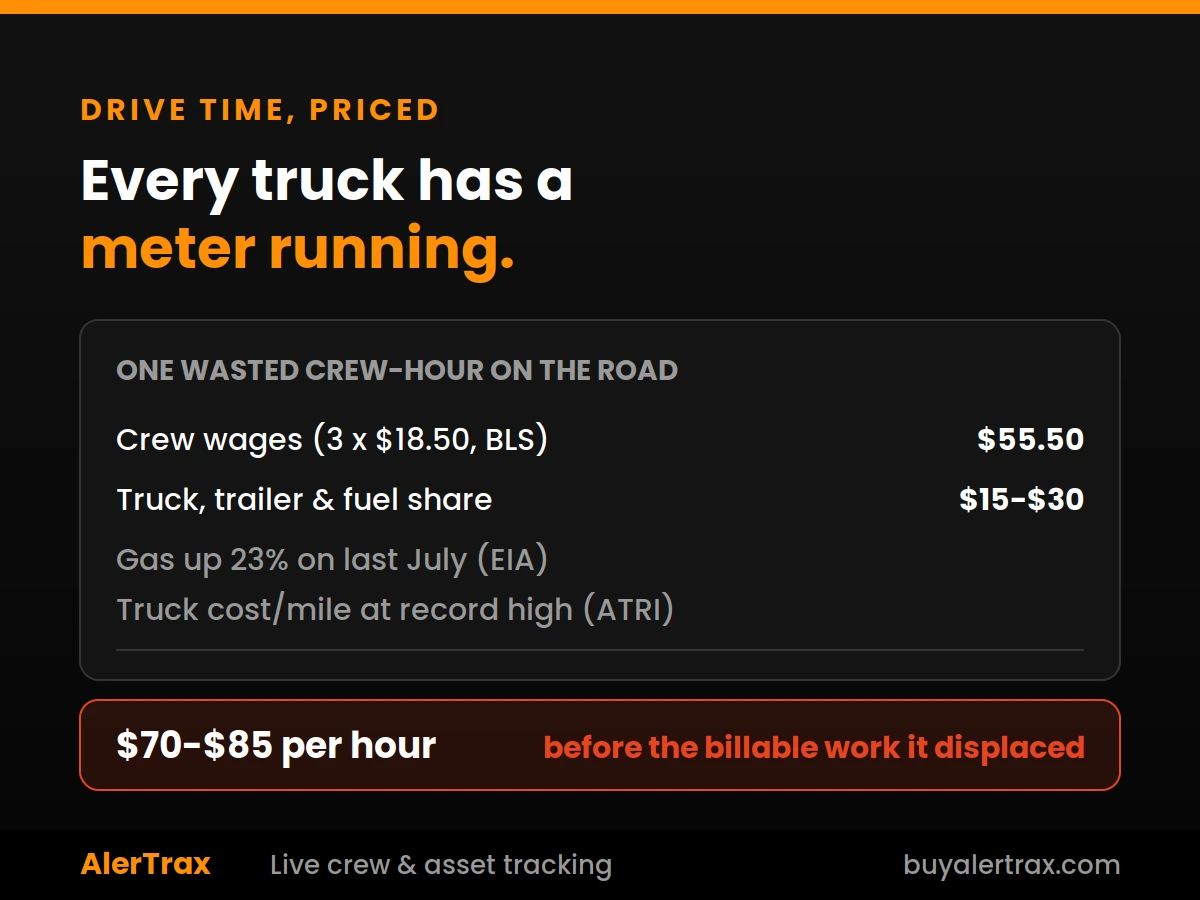
Here is the line item that dwarfs the truck. The median wage for grounds maintenance workers is $18.50 an hour (U.S. Bureau of Labor Statistics, May 2024). Put a three-person crew in the cab and the wages alone are $55.50 an hour, rolling down the road, before payroll taxes, insurance, and overhead, and before you count the foreman premium that most real crews carry.
That is $55.50 an hour whether the crew is edging a commercial property or sitting in traffic between two jobs that should never have been scheduled back to back. Labor already consumes 30 to 50 percent of revenue at a typical landscaping company (Aspire, 2025 Commercial Landscape Industry Report), and drive time is the portion of that spend that produces exactly nothing: it cannot be billed, it cannot be estimated into most contracts honestly, and it burns fuel while it happens.
The Meter, Totaled
So price one wasted hour of drive time for a three-person crew, conservatively. Call it $55.50 in wages. Call the truck and trailer's share, fuel at 2026 prices plus wear at a fraction of ATRI's benchmark, another $15 to $30 depending on the miles covered. You are somewhere between $70 and $85 for the hour, using median wages and deliberately modest truck costs, and that is before the real cost: the hour was not billable. If your crew bills out at $60 to $150 an hour depending on the work, the wasted hour did not just cost you $70-plus. It displaced revenue you will never get back.
Now run the season math. One wasted hour per crew per day, across the roughly 40 working days between now and Labor Day, is 40 hours per crew, call it $2,800 to $3,400 in direct cost per crew at the numbers above, plus the displaced billable work on top. Three crews, and the meter has quietly run past $8,000 before the leaves turn. Most owners would notice an $8,000 invoice. Nobody notices it 25 miles at a time.
Where the Wasted Miles Hide
The expensive miles are almost never dramatic. They hide in patterns that only show up when you can see a week of routes on a map:
- The crossed path. Tuesday's route goes east, then west, then east again, because jobs were scheduled by request date instead of geography.
- The outlier account. One customer, forty minutes from everything else, serviced in the middle of the day instead of batched with the one other job out that way.
- The supply run that repeats. Three trips to the supply house in a week, each one detouring a full crew, because nobody sees the pattern across days.
- The slow roll. The gap between a job ending and the truck actually moving, fifteen minutes here, twenty there, invisible on any timesheet.
Every one of these is visible in route history and time-on-site data, and every one is fixable in next week's schedule. This is also the drive time you should treat as yours to fix, not your crew's: scheduling, clustering, and supply logistics are owner decisions. The data does not exist to blame anyone. It exists so the person who builds the schedule can see what the schedule actually costs.
Turning the Meter Visible
That is the whole case for putting a tracker on every truck and trailer: it is the difference between feeling like the week got away from you and seeing exactly which 25 miles took it. With AlerTrax on the fleet you get:
- Route History: Every day's actual route for every vehicle, on a map, so the crossed paths and outliers identify themselves.
- Automatic Time-on-Site Logging: Arrival and departure timestamps at every stop, separating job time from drive time without anyone filling out a form.
- Live Fleet Map: Every asset in the AlerTrax Fleet Portal and the iOS and Android app, updated as often as every 2 minutes.
- AddressFence and Geofence Alerts: Notifications tied to job sites, supply houses, and the yard, so the repeat patterns surface on their own.
- Over a Year of Battery Life, No Wiring: No install appointment, no splicing, no OBD port. Magnetic mount, one minute per vehicle, on trucks, trailers, mowers, and skid steers alike.
- 100% Waterproof, Ruggedized, Covert Mount: Built for equipment that works outside for a living.
The Cheapest Line on the Whole Cost Sheet
You can put AlerTrax on your entire fleet for a low monthly rate, with no long-term contracts and no hidden fees. Hold it against the meter above: at $70-plus per wasted crew-hour, recovering a single hour a week per truck pays for the tracking many times over, and the route data keeps compounding every week after.
(Want to own it outright? There is a $599 one-time Lifetime option for permanent, subscription-free tracking. No fees, ever.)
See the monthly plan and get set up here.
And the Most Expensive Mile of All
For the record, the costliest mile a truck can travel is the one somebody else drives it: out of your yard at 2 AM. The same trackers pricing your routes stand guard overnight. Geofence the yard and AlerTrax alerts you within minutes of after-hours movement, with tamper notifications on the device and a live tracking link you can hand to law enforcement. One platform, watching the meter all day and the yard all night.
Read Your Own Meter
Fuel is up 23 percent on last summer. Truck operating costs just set an all-time record. Wages only move one direction. Every number in this post says the same thing: the era of not knowing what your miles cost is over, because the miles have never cost more.
Visit www.buyalertrax.com, put a tracker on every truck and trailer, and find out what your meter has been running all season.
Sources
U.S. Energy Information Administration, Weekly Retail Gasoline and Diesel Prices: National average regular gasoline price of $3.855 per gallon as of July 13, 2026, up $0.725 from one year earlier.
U.S. Energy Information Administration, Short-Term Energy Outlook (July 2026): Third-quarter 2026 gasoline prices forecast to average just under $3.80 per gallon, down from more than $4.20 in the second quarter.
American Transportation Research Institute, 2026 Analysis of the Operational Costs of Trucking: Industry-average cost of $2.336 per mile in 2025, the highest in the report's history; $1.854 per mile excluding fuel, up 4.2%; repair and maintenance at 40.4 cents per mile, up 8.6%. Figures benchmark heavy commercial trucks and are cited here as an upper-bound reference for cost structure.
U.S. Bureau of Labor Statistics, Occupational Outlook Handbook (Grounds Maintenance Workers): Median wage of $18.50 per hour, May 2024.
Aspire, 2025 Commercial Landscape Industry Report: Labor consumes 30 to 50% of total revenue at a typical landscaping company.