What an Overtime Hour Costs
In August 2026, production and nonsupervisory employees in landscaping services averaged $27.71 an hour, and all employees averaged 41.1 hours a week (BLS Current Employment Statistics, August 2026, preliminary).
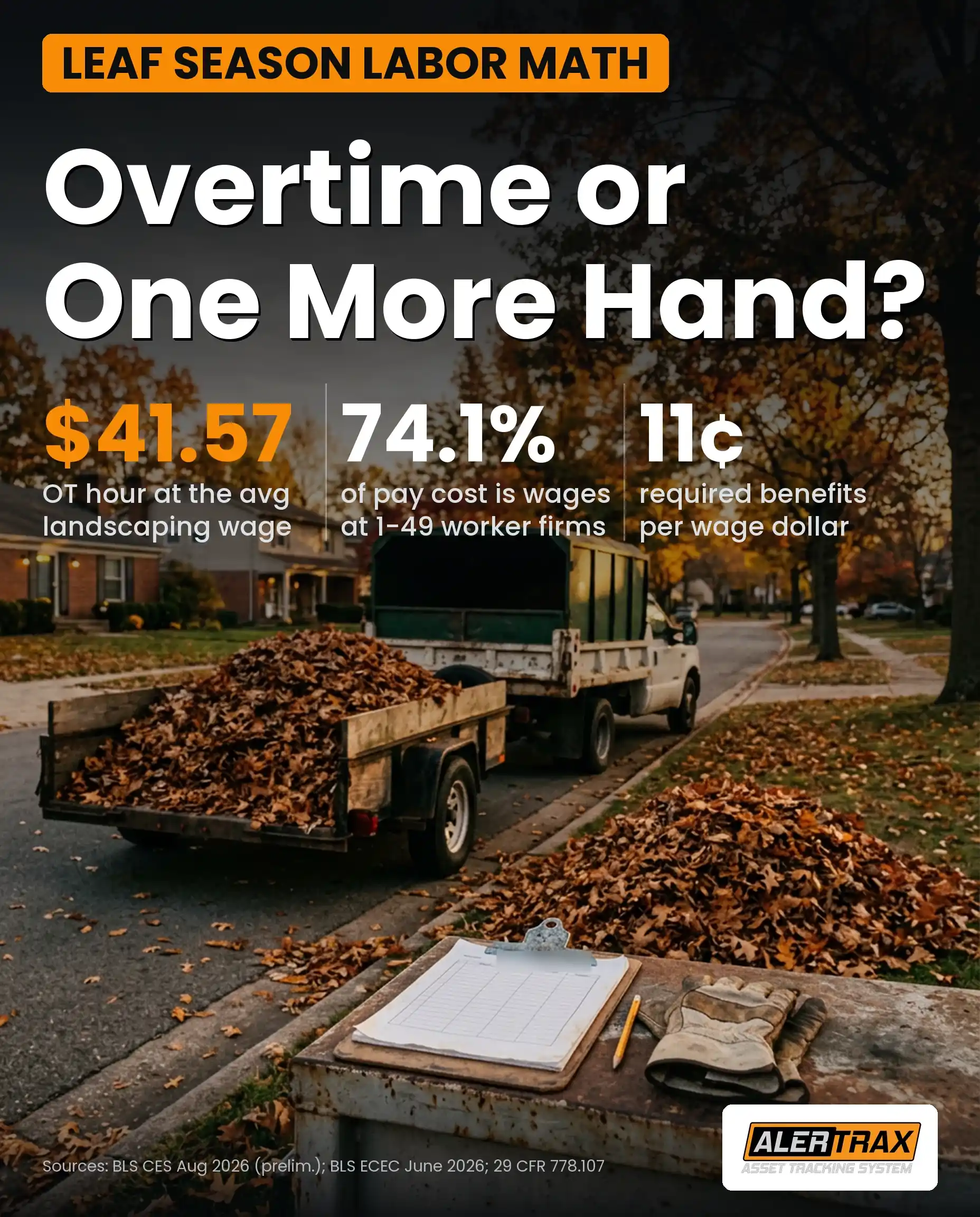
Hours over 40 in a workweek must be paid at no less than one and one-half times the regular rate (29 CFR 778.107). At the August average, that is $41.57 an overtime hour in wages alone.
Some employer costs rise with every dollar of wages, overtime included. The Bureau of Labor Statistics' Employer Costs for Employee Compensation (ECEC) survey calls them "legally required benefits": Social Security and Medicare, federal and state unemployment insurance, and workers' compensation. In June 2026, for private industry service occupations, the group that includes grounds maintenance workers, legally required benefits cost $2.08 for every $18.26 in wages per hour worked (BLS ECEC, June 2026). That is about 11 cents per wage dollar.
As an example, not survey data, using that ratio: an overtime hour at $41.57 in wages costs about $46.31 with legally required benefits. A straight-time hour at $27.71 costs about $30.87. The overtime premium is roughly $15.44 an hour.
What a New Hand Costs
A new hire avoids the time-and-a-half, but brings costs that overtime does not. Some of them are per person, not per hour: insurance, paid leave, onboarding, a uniform, a seat in a truck, and the weeks it takes to get up to speed.
For small employers, the BLS numbers put that in perspective. At private establishments with 1 to 49 workers, total compensation averaged $37.64 per hour worked in June 2026. Wages were $27.88, or 74.1 percent. Benefits were $9.76, or 25.9 percent, of which $2.97 was legally required benefits (BLS ECEC, June 2026). A seasonal hand may not get the full benefit package, but the legally required share comes with every hour you pay.
For a deeper look at the full cost of a crew hour, see What Your Crew Member Actually Costs You, or run your own numbers in the Labor Burden Calculator.
Run It on One Crew
Here is an example, not survey data. A three person crew is running 6 hours of overtime each, every week, for a six week leaf season. That is 18 overtime hours a week.
Paying that as overtime instead of straight time costs about $278 a week extra (18 hours times the $15.44 premium), or about $1,668 over the six weeks.
Now the catch. A new hand only saves that money if the hours they work replace overtime or bring in billable work. If you hire someone for 40 hours a week to take 18 overtime hours off the crew, the other 22 hours have to be billable. If they are not, those 22 hours cost about $679 a week at the straight-time example rate, which is more than double the overtime premium you were trying to save.
The rule of thumb that falls out of the math: hire when you have more billable work than hours, not when you have more hours than you want. If the work will fill a new person's week, hire. If it is just the existing work running long, overtime is often cheaper for a short season.
The Third Option: Find the Hours
Before choosing between overtime and a hire, ask where the overtime is coming from. Leaf season is heavy on the hours that are not raking: dump runs, drive time between properties, and yard time loading the truck.
All of that counts. Under 29 CFR 785.38, travel from job site to job site during the workday "must be counted as hours worked." And under the Portal-to-Portal rules, loading and fueling at the yard before the first stop are part of the workday too (see The 30 Minutes Before the First Mow).
Another example, not survey data: if better route order and less yard time save each person on that crew 20 minutes a day, that is 5 crew hours a week, which is 5 of the 18 overtime hours, worth about $232 a week at the $46.31 example rate. That is money saved without a hire and without anyone working less.
For more on where leaf season hours go, see Leaf Season Runs on Drive Time and You're Paying for 41 Hours a Week. How Many Are You Billing?
How to Decide This Week
1. Pull two weeks of hours by crew. Separate time on properties from time driving, dumping, and at the yard.
2. Find the overtime hours that are not billable work. Those are the cheapest hours to eliminate. Fix routing and dump runs first.
3. Count the leftover billable backlog. If it would fill most of a new person's week for the rest of the season, hire. If not, pay the overtime.
4. Put your own numbers in. Your wage, your workers' comp rate, your state unemployment rate. The national averages above are a starting point, not your number.
5. Price next fall. Whatever you decide, leaf season labor should be built into your fall cleanup prices, overtime included.
Where Alertrax Fits
Step 1 is where most owners get stuck, because timesheets show total hours, not where they went. Alertrax splits the day into time on site and time on the road, automatically.
- Automatic Time-on-Site Logging: Every arrival and departure at every property is timestamped, so you can see on-site hours by crew.
- Trip Reports You Can Export: Pull a date range by vehicle or across the fleet, with start time, stop time, addresses visited, duration, and distance, in a table you can put beside the timesheet.
- AddressFence: Set the yard and your dump site as addresses and see how long crews spend at each.
- Complete Route History: A full breadcrumb trail of the day, so you can see the backtracking that is costing you overtime.
- Live Fleet Map: Every tracked truck and trailer on one map in the Alertrax Fleet Portal, with location updates every 2 minutes.
- One-Year Battery, No Wiring Required: Alertrax runs on two AA cells, with nothing to wire in and nothing to charge.
- iOS and Android App: Check the map and the day's history from your phone.
Pricing
You can equip your fleet with Alertrax for a low monthly rate, no long-term contracts, no hidden fees.
(Want to own it outright? We offer a $599 Lifetime option for permanent, subscription-free tracking.)
Sources
U.S. Bureau of Labor Statistics (BLS), Current Employment Statistics, Landscaping Services (NAICS 56173), not seasonally adjusted, series CEU6056173002 and CEU6056173008, retrieved October 2026: average weekly hours of all employees of 41.1 and average hourly earnings of production and nonsupervisory employees of $27.71 in August 2026 (preliminary). August 2026 was the most recent month available for this industry at the time of writing
BLS, "Employer Costs for Employee Compensation, June 2026," news release USDL-26-1494, September 9, 2026, Tables 4 and 6, retrieved October 2026: private industry service occupations, wages and salaries of $18.26 and legally required benefits of $2.08 per hour worked; private industry establishments with 1 to 49 workers, total compensation of $37.64, wages and salaries of $27.88 (74.1 percent), benefits of $9.76 (25.9 percent), and legally required benefits of $2.97 per hour worked
Electronic Code of Federal Regulations (eCFR), 29 CFR 778.107, "General standard for overtime pay," retrieved October 2026
eCFR, 29 CFR 785.38, "Travel that is all in the day's work," retrieved October 2026
This article is provided for general informational purposes and is not legal, payroll, tax, or financial advice. It summarizes federal rules only; state and local wage laws may impose different or stricter overtime requirements, and some employees may be exempt. BLS figures are national averages and will not match your company's wages, workers' compensation rates, or unemployment insurance rates. The crew, overtime, and savings figures above are illustrations, not survey data. Talk to your accountant or payroll provider before making staffing decisions.
Know Where the Hours Go First
Overtime versus a new hire is a real decision, but it is the second one. The first is how many of this week's hours were spent on properties, and how many were spent getting to them.
Visit www.buyalertrax.com today and see exactly where every crew hour goes this fall.