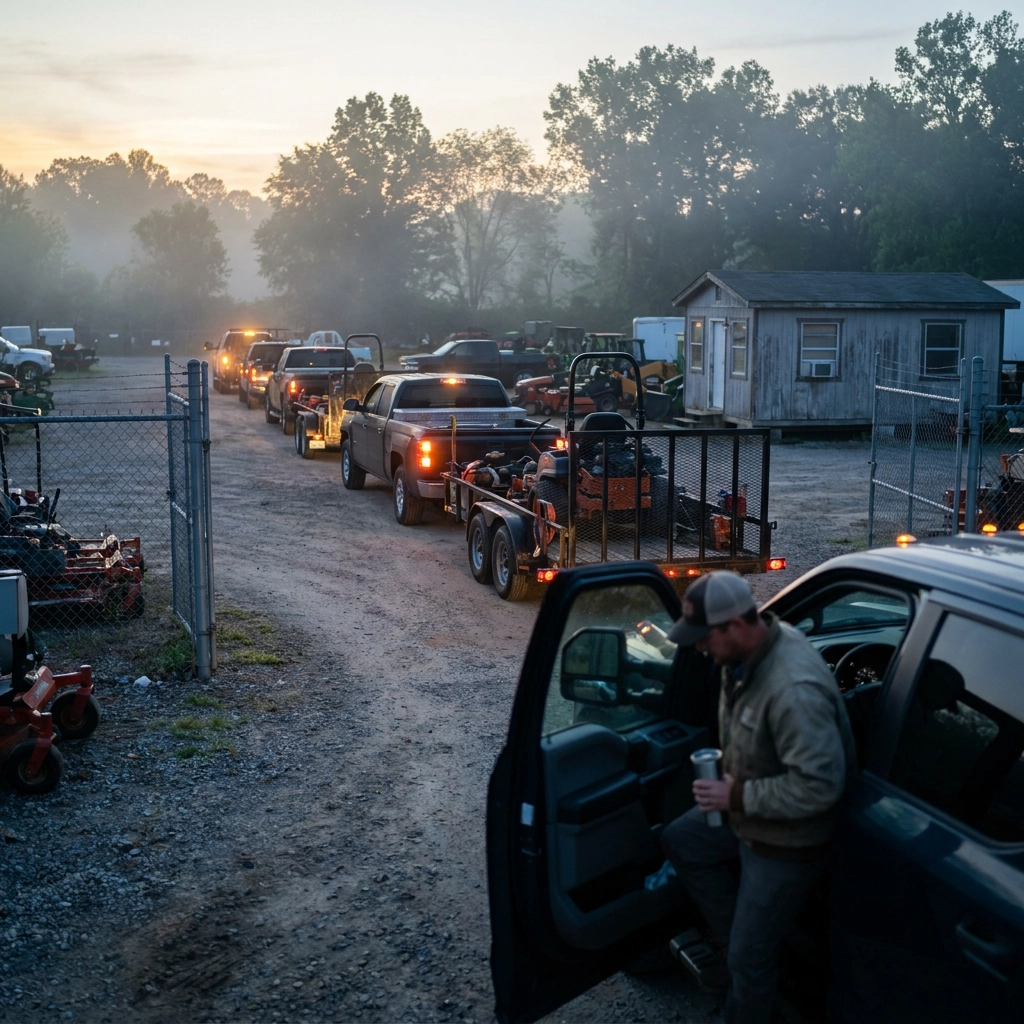
The trucks leave the yard at 6:30. The first jobs are supposed to start at 7:00. You sent the schedule the night before, the crews loaded up, and everybody rolled out on time. As far as you know, the day started clean.
But here is what you don't know. Crew one stopped for gas and coffee and didn't pull onto the first property until 7:20. Crew two took the long way because the foreman wasn't sure which job was first, and got there at 7:25. Crew three was on site by 6:55 but spent twenty minutes standing around because the gate was locked and nobody had the code.
None of that shows up anywhere. No timesheet records it. No customer complained. By the time the trucks are back at the yard that evening, the morning is a blur and nobody remembers the details. But you paid for every minute of it, at full burdened labor cost, and you will pay for it again tomorrow.
The single most expensive hour in your operation is the one between the yard and the first job. And for most landscaping companies, it is also the one hour they have zero visibility into.
Why the First Hour Is the One That Leaks
Labor is the biggest cost in your business by a wide margin. In landscaping it runs 30 to 50 percent of total revenue (Aspire), and once you stack on labor burden, the payroll taxes, insurance, and overhead, that cost climbs another 20 to 35 percent on top of base wages. A crew member you pay $20 an hour actually costs you $24 to $27 an hour (Service Autopilot, 2026).
Now think about where labor leaks. It rarely happens in the middle of the day when the crew is heads-down on a property and you can see the work taking shape. It happens at the edges, and the biggest edge is the start of the day. The American Payroll Association estimates businesses lose 5 to 10 percent of payroll to time theft, and the most common forms are exactly the ones that hide in the morning: late starts, extended stops, and the gap between "clocked in" and "actually working." On a $500,000 payroll, that is $25,000 to $50,000 a year, and a large share of it is bleeding out before 8 AM.
Here is the math that should bother you. If three crews each lose 25 minutes every morning, late starts, an extra stop, a wrong turn, that is 75 minutes a day of fully burdened labor going nowhere. At a blended $26 an hour across a small crew, across 250 working days, the morning slippage alone can quietly cost a 3-crew operation well over $20,000 a year. You never see the invoice, because there isn't one. The cost just shows up as a thinner margin at the end of the season.
A Thin Margin Can't Absorb a Leaky Morning
If margins in this business were fat, a slow morning wouldn't matter much. They are not. The average landscaping company runs a 6.2 percent profit margin (Wifitalents), and even well-run operations only target 10 to 14 percent net (Fieldcamp). At 6.2 percent, you have to do roughly $16 of revenue to net a single dollar of profit. Every dollar of unbilled, unproductive morning labor comes straight out of that razor-thin slice.
It compounds with everything else owners are fighting right now. 72 percent cite labor as their number one growth barrier (Aspire), 70 percent plan wage increases in 2026 (Aspire 2026), and the industry carries a 42 percent annual turnover rate (Wifitalents). You are paying more for labor, it is harder to keep, and a meaningful chunk of what you do pay for is evaporating in the first hour of every day.
This is also a quiet driver of the failure statistics. BLS data shows 48.4 percent of businesses are gone by year five and 65.1 percent by year ten (LendingTree / BLS). Companies rarely fail from one big mistake. They fail from a hundred small leaks nobody measured, and the morning is one of the steadiest leaks there is.
What You Can Actually See When the Day Starts
You cannot fix a leak you cannot see. The moment your trucks have GPS tracking, the first hour stops being a black box and becomes the most useful data in your operation.
- What time the truck actually rolled. Not when the schedule said to leave, when the wheels actually started moving. If the yard departure is consistently drifting later, you find out in week one, not at the season review.
- What time the crew reached the first job. Automatic arrival timestamps tell you when each crew was actually on site and working, with no foreman call-in and no honor-system timesheet.
- What happened in between. A complete route history shows the stop at the gas station, the wrong turn, the unplanned supply run. You see the difference between a crew that drove straight to the job and one that took the scenic route.
- Whether the route even made sense. Three jobs on the south side and one on the north, assigned to the wrong truck? The map shows it. You fix the dispatch instead of paying for the drive.
None of this requires your crews to do anything different. There is no app for them to open, no button to push, no clock to punch. The device on the truck logs it automatically, and the data is waiting for you on the fleet map and the trip report.
From Guessing at 7 AM to Knowing at a Glance
The difference visibility makes to your morning is not subtle. Picture the same 6:30 start with a live fleet map open on your phone.
You glance at it over your own coffee. All three trucks are moving. By 7:05 you can see crew one and crew three have arrived and the dots have gone stationary on the right properties. Crew two is still moving and is two minutes out. You didn't make a single phone call. You didn't interrupt a foreman who is trying to get his guys working. You just know.
Over the next few weeks, the patterns surface on their own. One crew is reliably the last to start, every day, by fifteen minutes. One route has the trucks crossing town twice before lunch. One job that you bid as a quick stop is eating ninety minutes every visit. These are not things you could have caught by being there, because you cannot be in four places at 7 AM. The data catches them for you, and now you can actually manage them: tighten the route, move the start time, reprice the job.
That is the shift. You go from reacting to problems after they have cost you a season, to spotting them the same week they start.
Your Crews Won't Fight It. The Data Says They'll Back It.
Every owner's first worry is that the crews will feel watched. The research consistently says the opposite. Surveys from TSheets and HR C-Suite found 95 percent of employees rate GPS tracking positive or neutral, 75 percent say it helps track their time and mileage accurately, and 50 percent say it actually builds trust with their employer.
It makes sense once you see it from the crew's side of the truck. The foreman who is genuinely on site at 6:55, working hard, has nothing to fear from an arrival timestamp, it backs him up. When you stop calling to ask "are you guys there yet?" because you can already see that they are, the crew feels less micromanaged, not more. The data takes the suspicion out of the morning for everyone. The only people it makes uncomfortable are the ones who were counting on you not knowing.
Frame it honestly from day one: this is how we manage routes, verify job times, and bill accurately. Introduced that way, resistance drops to nearly zero.
Why Alertrax Fits the Way Landscapers Actually Work
Most GPS systems were built for long-haul logistics: hardwired installs, constant vehicle power, one dedicated driver per truck. That is not your world. Your trucks, trailers, mowers, and skid steers move between crews and job sites every day, and you do not have time for installation appointments.
Alertrax was built for the way landscaping fleets actually run.
- One-Year Battery Life, No Wiring Required: Runs over a year on two AA batteries. No splicing, no OBD-II port, no install appointment. Mount it and it works.
- Track Anything That Moves: No wires means you can put it on trucks, trailers, mowers, skid steers, and equipment, one platform for the whole fleet.
- Automatic Time-on-Site Logging: Arrival and departure timestamps at every stop, recorded automatically, the backbone of fixing your morning.
- Complete Trip Reports: Date, address, arrival, departure, duration, and mileage for every vehicle, every day, exportable to PDF or CSV.
- Live Fleet Map: Every asset on one live map from the Fleet Portal or the iOS and Android app, so your 7 AM check takes five seconds.
- Geofence and After-Hours Alerts: Draw boundaries around the yard, job sites, and customer properties. Get notified on arrivals, departures, and any movement that shouldn't be happening.
- 100% Waterproof, Ruggedized Housing: IP67 rated, with covert magnetic mounting that survives mud, rain, and pressure washing.
Pricing That Pays for Itself Before Lunch
You can equip your entire fleet for a low monthly rate, with no long-term contracts and no hidden fees.
(Want to own it outright? We offer a $599 Lifetime option for permanent, subscription-free tracking.)
Go back to that morning math. If tightening up your first hour recovers even 20 minutes per crew per day across a 3-crew operation, that is roughly an hour of burdened labor a day, more than $6,000 a year, recovered from a problem you could not even see last month. The device pays for itself off the morning alone. Everything it does the rest of the day is on top of that.
And Yes, It Protects Your Equipment Too
The same device watching your morning is watching your yard at night. Equipment theft costs the industry an estimated $400 million annually, and 40 percent of stolen landscaping equipment is never recovered (AMAROK / NER), with a single truck out of service costing up to $4,000 a day in lost revenue (AMAROK). With after-hours movement alerts, you know within minutes if a trailer leaves the lot at 2 AM, and you have a live location to hand to police. It is not why you buy tracking. It is the bonus that comes with it.
Stop Paying for an Hour You Can't See
You already pay for the first hour of every workday, at full burdened labor cost, whether or not it produces anything. The only question is whether you can see what you are paying for. Right now, most owners can't, and the leak just shows up as a thinner margin they can't explain.
Visibility into that hour does not require new habits from your crews or new software for anyone to learn. It takes one device, mounted in under a minute, and a glance at a map over your morning coffee.
Visit www.buyalertrax.com today and find out what your most expensive hour is really costing you.
Sources
Aspire (2025), "Labor = 30-50% of total revenue; 72% of owners cite labor as biggest growth barrier"
Aspire Commercial Landscape Industry Report (2026), "70% plan wage increases in 2026"
Service Autopilot (2026), "Labor burden adds 20-35% on top of base wages; a $20/hr employee costs $24-$27/hr"
American Payroll Association, "Businesses lose 5-10% of payroll to time theft annually (late starts, extended stops, padded hours)"
Wifitalents, "6.2% average profit margin; 42% annual employee turnover"
Fieldcamp, "Well-run companies target 10-14% net profit"
TSheets / HR C-Suite, "95% of employees rate GPS tracking positive or neutral; 75% say it tracks time accurately; 50% say it builds trust"
BLS / LendingTree, "48.4% of businesses fail by year 5; 65.1% by year 10"
AMAROK / NER, "$400M annual equipment theft losses; 40% never recovered; up to $4,000/day lost revenue per truck"