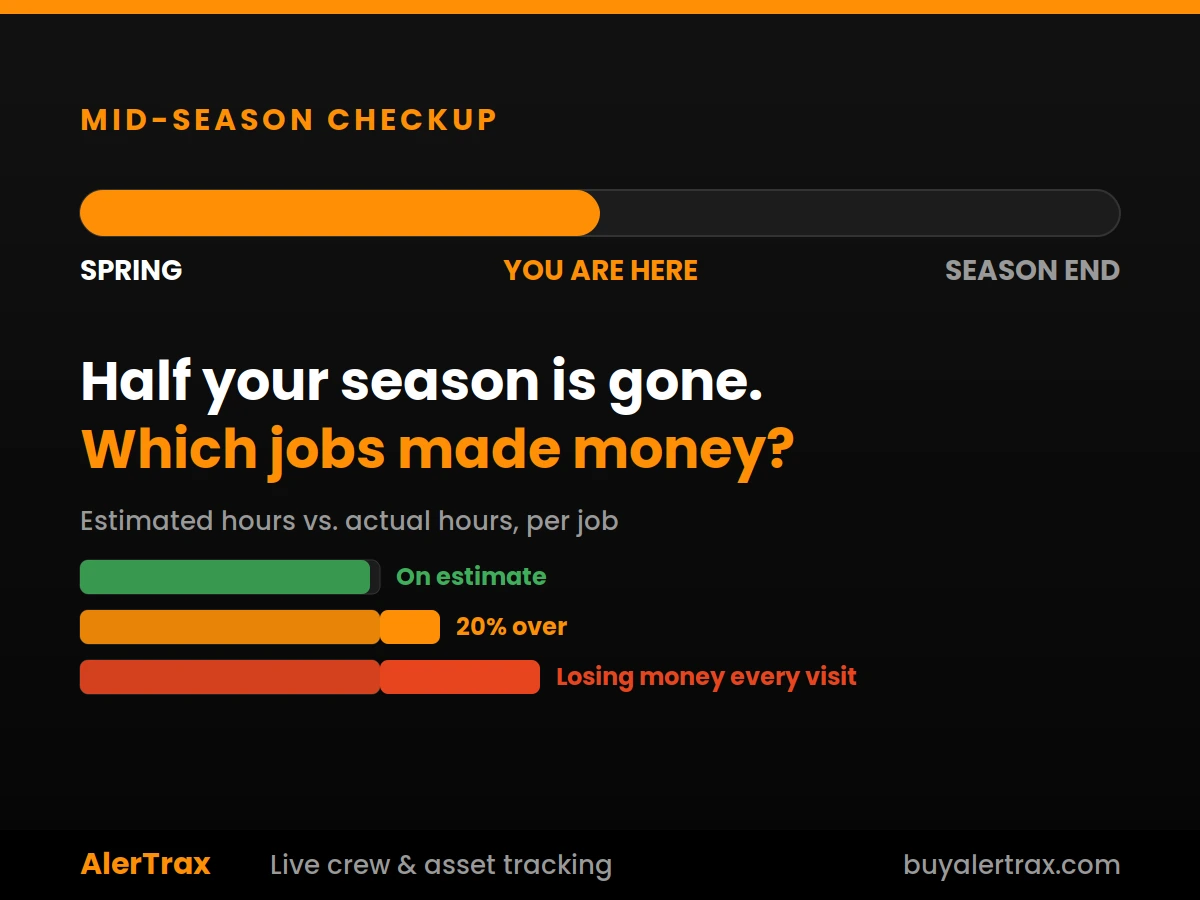
It is the second week of July. Spring cleanups, the first flush of mowing season, the install rush, all of it is behind you now. The trucks have been rolling for four solid months. Revenue is coming in. The bank account looks okay.
Now the uncomfortable question: which of those jobs actually made you money?
Not which customers paid. Not which weeks felt busy. Which specific jobs, which properties, which contracts came in profitable once you count the real hours your crews spent there, the drive time to get there, and the fuel to do it. If you cannot answer that property by property, you are not alone. Most owners cannot. But right now, at the midpoint of the season, is the single best moment on the calendar to find out, because every answer you get this week can be fixed before the same jobs run another eight, ten, twelve more times between now and the end of the season.
Wait until fall and you will know exactly which jobs lost money all year. You just will not be able to do anything about it.
The Mid-Season Blind Spot
The industry data points at a gap most owners will recognize. In Aspire's survey of over a thousand commercial landscape contractors, 79 percent said they are focused on growing revenue, but only 51 percent named improving operational efficiency as a key goal (Aspire, 2025 Commercial Landscape Industry Report). Nearly everyone is chasing the top line. Barely half are looking at what each job actually costs to deliver.
That gap matters more in this business than almost any other, because labor is your biggest expense by far, 30 to 50 percent of total revenue across the industry (Aspire, 2025 Commercial Landscape Industry Report), and labor is exactly the cost that drifts. Materials get quoted. Fuel gets noticed at the pump. But an extra forty minutes on a property every visit? That disappears into the week without a trace, unless something is writing it down.
And some of the drift is not innocent. The American Payroll Association reports that 75 percent of companies experience some form of time theft, and that it can cost up to 7 percent of total payroll (American Payroll Association). On a $400,000 payroll, that is up to $28,000 a year leaking out through padded hours, long lunches, and early wrap-ups that still get billed as full days. You do not need to assume the worst about your people to want the real numbers.
How a Job Quietly Loses Money for an Entire Season
Almost no job loses money in a way you would notice from the truck window. It happens in small, repeating gaps between what you estimated and what actually happens:
- The estimate was built on a guess. You priced the property at two crew-hours per visit back in March, based on a walkthrough and experience. Nobody has checked the actual number since.
- The property changed. The customer added beds, the growth came in heavier than expected, the gate on the far side adds ten minutes of walking every visit. The scope crept. The price did not.
- The drive is longer than the job deserves. A forty-minute round trip wrapped around a one-hour job means a third of that visit's labor cost is windshield time you probably did not price in.
- The hours on the invoice are the hours on the timesheet, and the timesheet is whatever got written down at the end of the week from memory.
Any one of these is small. Multiplied across every visit, every week, for a full season, they are the difference between the 6 percent margin the average operation limps along on and the double-digit margin a well-run company earns.
The Three-Question Mid-Season Audit
You can run this checkup in an evening if you have the data, and the whole point of GPS time-on-site records is that you have the data. Three questions:
1. Which jobs are running past their estimate? Pull the actual arrival and departure timestamps for your recurring properties over the last month. Compare the real average time on site against the hours the job was priced on. Every property running 20 percent or more over its estimate goes on the reprice list. This is the highest-value twenty minutes of analysis you will do all year.
2. Which routes are burning hours between jobs? Pull route history for each truck for a typical week and look at the drive legs, not the stops. Jobs that force a crew across town and back, days where the map looks like a plate of spaghetti, repeated supply runs mid-route. Cluster what can be clustered, move the outliers to the day you are already in that area, and consider whether the far-flung one-off is worth keeping at its current price at all.
3. Where does billed time not match logged time? Compare what went out on invoices against what the timestamps say. Gaps in one direction mean you are under-billing hours you actually worked. Gaps in the other direction mean your records could not survive a customer dispute. Both are fixable the moment you can see them, and the fix pays you every week for the rest of the season. This matters for cash flow too: 76 percent of contractors bill within four days of finishing a job, but only about half report getting paid on time (Aspire, 2025 Commercial Landscape Industry Report), and disputed hours are a big reason invoices stall. Timestamped records make the invoice hard to argue with.
The Data That Makes the Audit Possible
Everything above depends on one thing: real numbers instead of recollections. That is exactly what a tracker on every truck and trailer produces, automatically, with no crew input required:
- Automatic arrival and departure timestamps at every stop, so every property has a true time-on-site history you can hold against the estimate.
- Route history for every vehicle, so the wasted drive legs show up as lines on a map instead of a feeling that the week got away from you.
- AddressFence alerts tied to customer addresses, logging arrivals and departures at the properties you care about without anyone checking in.
- A live fleet map, updated as often as every 2 minutes, so the corrections you make after the audit (tighter routes, rebalanced schedules) are visible working on the live map the following week.
- Exportable reports from the fleet portal, so the numbers drop into a spreadsheet next to your estimates instead of living in a binder.
Owners who run this exercise for the first time almost always find the same two things: a handful of properties that have been quietly unprofitable since the day they were priced, and at least one route that gives back several hours a week with a simple reshuffle. Neither is visible without the timestamps.
Reprice Now, Not at Renewal
Here is why the timing matters so much. Say the audit turns up a maintenance property estimated at two hours per visit that actually takes three. At a $60-per-hour billable rate, that is $60 of unbilled labor every single visit. Weekly service from mid-July through the end of October is roughly 15 more visits, which is about $900 on that one property, this season, if you act this week. Find four or five properties like that (most operations do) and the mid-season checkup is worth several thousand dollars before the leaves turn.
The conversation with the customer is easier than you think, because now you have the receipts. You are not saying "we feel like this job takes longer." You are showing dated arrival and departure records over a month of visits. Most commercial customers respect a vendor who knows their numbers, and the ones who will not pay what the job actually costs are the ones quietly sinking your margin anyway.
Why AlerTrax Fits the Way You Actually Work
Most GPS systems were built for over-the-road trucking fleets with constant 12-volt power and hardwired installs. Landscaping does not work that way. You have work trucks, trailers, mowers, and skid steers moving in and out of crews and job sites all day. AlerTrax was built for that reality.
- Over a Year of Battery Life, No Wiring: AlerTrax runs on its own battery for a full year or more. No splicing into your electrical system, no OBD port, no install appointment. Mount it and it works.
- Put It on Anything That Moves: Trucks, trailers, mowers, skid steers, or any piece of equipment you take to a job. One platform for your whole fleet.
- Automatic Time-on-Site Logging: Arrival and departure timestamps on every stop, the raw material for job costing, repricing, payroll verification, and proof of service.
- AddressFence and Geofence Alerts: Tie alerts to customer addresses and get arrival and departure records for every property that matters, hands-free.
- Live Fleet Map and Reports: Every asset in the AlerTrax Fleet Portal and the iOS and Android app, with updates as often as every 2 minutes and trip reports you can export and analyze.
- 100% Waterproof, Ruggedized, Covert Mount: Built to take rain, mud, and pressure washing, and to tuck out of sight on any steel surface.
Pricing That the First Repriced Job Covers
You can put AlerTrax on your entire fleet for a low monthly rate, with no long-term contracts and no hidden fees. One repriced property or one tightened route typically covers the cost of tracking the whole fleet, and the data keeps paying you every week after that.
(Want to own it outright? There is a $599 one-time Lifetime option for permanent, subscription-free tracking. No fees, ever.)
See the monthly plan and get set up here.
And Yes, the Same Data Protects the Equipment Too
The audit is about margin, but the trackers earning you that margin are also standing guard. Set a geofence around your yard and AlerTrax alerts you if a truck, trailer, or mower moves after hours, with tamper notifications if someone messes with the device. The same timestamps that reprice your jobs will tell you within minutes if your gear leaves at 2 AM. One device, one platform, both problems handled.
Run the Checkup While There Is Still Season Left to Fix
Half the season is behind you and nothing can change that. What you can change is the second half. The jobs that lost money in May and June will lose money in August and September too, unless this is the week you find them.
Visit www.buyalertrax.com, put a tracker on every truck and trailer, and go into the back half of the season knowing exactly which jobs are making you money.
Sources
Aspire, 2025 Commercial Landscape Industry Report: 79% of contractors are focused on growing revenue while 51% name improving operational efficiency as a key goal; labor is the single largest expense at 30 to 50% of total revenue; 76% of contractors bill within four days of job completion while only about half report being paid on time.
American Payroll Association: 75% of companies experience some form of time theft, which can cost up to 7% of total payroll annually.