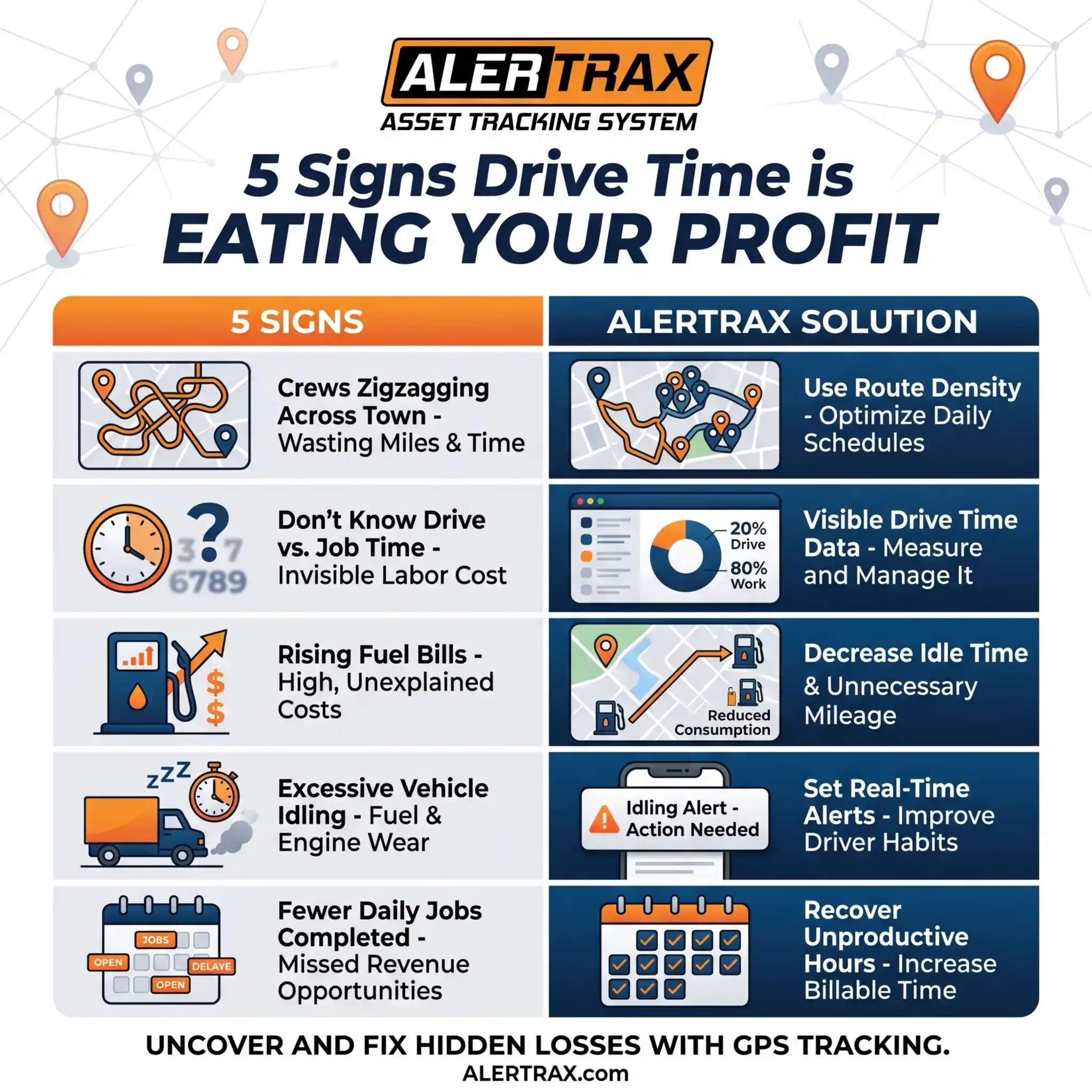
There's a cost hiding in every landscaping operation that almost nobody measures. It doesn't show up as a line item on your P&L. It doesn't trigger an alert in your accounting software. It doesn't announce itself at the end of the month when you're wondering why margins were thinner than expected.
It's drive time. And it's quietly eating your profit every single day.
Your crews are on the clock from the moment they leave the shop until the moment they return. But you're only billing clients for time spent on their property. Every minute between jobs — sitting in traffic, taking the long way around, idling in a parking lot waiting for a gate code — is a minute of labor you're paying for but never recovering.
In an industry where labor consumes 30% to 50% of total revenue (Aspire, 2025) and the average profit margin sits around 6.2% (Wifitalents, 2023), untracked drive time isn't a minor inefficiency. It's a margin killer. And GPS tracking is the only way to see it, measure it, and fix it.
Sign #1: Your Crews Are Zigzagging Across Town
Pull up your weekly schedule and trace the route on a map. Does it make geographic sense? Or is Crew 2 driving from the north side of town to the south side, then back to the north side, then across to the west — because that's the order the jobs were booked, not the order they should be serviced?
This is one of the most common and most expensive inefficiencies in the landscaping business. Route density matters enormously. A company serving 50 properties clustered within a few neighborhoods will be far more profitable than one serving the same number of properties scattered across 30 miles (Grow Group, 2025). Dense service areas reduce drive time, lower fuel costs, and allow crews to complete more jobs per day.
GPS route history shows you exactly what's happening. You can see every turn, every stop, every backtrack. And once you can see it, the fix is usually obvious: reorganize the daily schedule so crews work in tight geographic clusters instead of crisscrossing the service area. Some landscaping companies have taken this a step further by dividing their market area into zones and assigning specific days to each zone, with a catch-all day for overflow (Green Industry Pros). The result is dramatically less windshield time and more billable hours per crew per day.
Sign #2: You Don't Actually Know How Much Time Crews Spend Driving
If someone asked you right now how many hours per week each crew spends driving between jobs versus working on properties, could you answer with confidence?
Most landscaping company owners can't. And that's the problem. Drive time is a labor cost that most companies absorb without ever measuring it (Grow Group, 2025). Your crew is on the clock, you're paying wages plus the full labor burden — which adds 20% to 35% on top of base pay (Service Autopilot, 2026) — but none of that drive time is generating revenue.
GPS tracking makes this visible for the first time. When you can see that a crew spent 1 hour and 45 minutes driving between four job sites on a Tuesday, you can start asking the right questions. Is that route optimized? Could those jobs be resequenced to cut 30 minutes of travel? Could a job on the far side of town be swapped with one that's closer to the previous stop?
Fleet tracking data consistently shows 30 to 60 minutes of unproductive time per vehicle per day before tracking is implemented (Spytec GPS, 2026). For a landscaping crew, much of that unproductive time is drive time that could be reduced with better scheduling. At a loaded labor cost of $35 to $50 per hour, recovering even 30 minutes per truck per day saves $350 to $500 per month per vehicle. Across a five-truck fleet, that's $21,000 to $30,000 per year that was previously invisible.
Sign #3: Your Fuel Bill Keeps Climbing But You Can't Explain Why
Fuel is one of the largest variable costs in any landscaping operation, and it's been under pressure for years. Fuel costs remain roughly 12% above pre-pandemic levels (Fieldcamp, 2025), and for companies running multiple trucks with trailers across a wide service area, the monthly bill adds up fast.
But here's what most owners miss: a significant portion of that fuel spend isn't going toward productive work. It's being burned on inefficient routes, excessive idling, and unnecessary mileage.
A typical service truck burns roughly half a gallon to a full gallon of fuel per hour of idle time (GPS Insight). If a crew leaves the truck running during a lunch break, while filling out paperwork, or while waiting for a property manager to open a gate, that's direct waste. One fleet analysis found that reducing idle time from one hour to twenty minutes per day saved $2.34 per vehicle per day — which translates to $562 per vehicle per year just from a single behavioral change (GPS Insight). Scale that across a fleet of ten trucks and you're looking at over $5,600 in annual savings from idling alone.
Industry data shows fleets typically cut total fuel spending by 15% to 25% after implementing GPS tracking (Spytec GPS, 2026). For a landscaping company spending $4,000 to $6,000 per month on fuel across the fleet, that's $600 to $1,500 per month back in your pocket — $7,200 to $18,000 per year. That's not a projection. That's what companies are actually seeing once they have visibility into where the fuel is going.
Sign #4: You're Adding Crews Instead of Optimizing the Ones You Have
Growth is good. But if you're adding a crew because your existing crews can't get to all the jobs, it's worth asking: is the issue capacity, or is it efficiency?
In an industry where 72% of business owners say labor availability and retention are their biggest barriers to growth (Aspire, 2025) and the annual turnover rate runs around 42% (Wifitalents, 2023), adding headcount is expensive and risky. Every new crew member comes with recruiting costs, training time, higher insurance premiums, and the uncertainty of whether they'll stick around past the first season.
GPS data often reveals that existing crews have more capacity than anyone realized — it's just being consumed by drive time and scheduling gaps. If route optimization frees up 30 to 45 minutes per crew per day, that's enough time to add one or two additional properties to each day's schedule. For a four-crew operation losing 45 minutes per day to inefficient routing, that adds up to hundreds of paid hours over the course of a season (Service Autopilot, 2026). Recapturing those hours means more revenue from the team you already have, without the cost and risk of hiring.
Fleet tracking systems typically deliver 200% to 400% annual ROI (Traxelio / Spytec GPS), and much of that return comes from getting more productive hours out of existing resources. The cheapest crew to add is the one you don't have to hire.
Sign #5: You Can't Tell the Difference Between a Profitable Day and a Busy One
This is the most dangerous sign of all, because it feels like everything is fine. Trucks are rolling. Crews are working. Invoices are going out. But at the end of the month, the margin is thinner than it should be and you can't pinpoint why.
The answer is almost always in the gap between billable time and total paid time. Industry benchmarks put well-run landscaping companies at 10% to 14% net profit, with a target gross margin of 45% to 50% on each job (Fieldcamp, 2025). Companies that consistently fall below those numbers usually aren't losing money on materials or equipment. They're losing it on non-billable labor — and the biggest component of non-billable labor is drive time.
GPS tracking gives you the data to calculate a real utilization rate: how many of the hours you're paying for are actually being spent on client properties generating revenue? Once you know that number, you can start improving it. Even a 10% improvement in crew utilization — turning dead drive time into billable job site time — can move the needle significantly on an operation running $1 million in annual revenue.
How to Fix It: The GPS Route Optimization Playbook
Identifying the problem is step one. Here's how landscaping companies are using GPS data to systematically reduce drive time and recover lost margin:
- Map your actual routes, not your planned ones. GPS history shows the real paths crews take, not the routes you assumed they'd follow. Compare actual drive patterns to the optimal sequence and you'll almost always find low-hanging fruit — jobs that should be reordered, stops that should be grouped, or routes that can be shortened by miles.
- Measure drive time as a percentage of total paid time. Start tracking this weekly for each crew. If a crew is spending more than 20% to 25% of their paid day driving, there's room to improve. Set a target and work toward it by tightening routes and adjusting schedules.
- Cluster new clients geographically. When you're selling new work, prioritize properties that are close to existing stops on existing routes. Some contractors offer incentives to prospective clients in neighborhoods where they already have accounts, specifically to increase route density (Green Industry Pros). Every new client that's five minutes from an existing stop is more profitable than one that's twenty minutes away.
- Reorganize your schedule by zone. Assign geographic zones to specific days of the week. Monday is the northeast quadrant. Tuesday is the southeast. This eliminates the daily zigzag and ensures crews spend the maximum amount of time on properties and the minimum amount of time on the road.
- Monitor idle time and set benchmarks. Use GPS idle alerts to identify trucks that are running without moving for extended periods. Set a company standard — for example, no more than five minutes of idle time between stops — and coach crews toward it. The fuel savings alone are meaningful, but the labor savings from a more disciplined daily rhythm are even bigger.
And Yes — The Same Device Protects Your Equipment at Night
While GPS tracking is optimizing your routes and recovering lost margin during the day, it's also standing guard after hours. The landscaping industry loses an estimated $400 million annually to equipment theft, and 40% of stolen equipment is never recovered (AMAROK). A single stolen truck can cost up to $4,000 per day in lost revenue.
The same GPS device that shows you drive time patterns and idle data sends you an instant alert if a truck or trailer moves outside its geofence during off-hours. You get live location data, the ability to guide law enforcement to the asset, and a dramatically higher chance of recovery.
But the daily ROI of route optimization and drive time reduction is where the math really compounds. Theft prevention is the insurance policy. Operational efficiency is the profit engine.
How Alertrax Puts You in Control
This is exactly why we built Alertrax.
Alertrax gives landscaping companies the route history, idle time data, and live fleet visibility they need to eliminate wasted drive time and turn every paid hour into a productive one.
- Complete Route History: See exactly where every truck went, when it stopped, how long it stayed, and what route it took between jobs. Compare actual routes against optimal sequences and identify inefficiencies you'd never catch without data.
- Idle Time Monitoring: Know when trucks are running without moving. Set benchmarks, coach crews, and watch your fuel bill drop.
- Live Fleet Map: Open the Alertrax app and see every vehicle on a single screen. Know which crews are on site, which are in transit, and which are running behind — all without picking up the phone.
- Ruggedized for Landscaping: 100% waterproof, built to survive rain, mud, dust, vibration, and high-pressure washdowns. This isn't a consumer-grade car tracker — it's built for work trucks and trailers.
- One-Year Battery, No Wiring: A massive self-contained battery lasts a full year on a single charge. Mount it anywhere — truck, trailer, skid steer, mower — without touching a single wire.
- Geofence and After-Hours Alerts: Draw a boundary around your shop or yard. If anything moves outside it during off-hours, you get an instant alert on your phone.
An Investment That Pays for Itself on Day One
You can equip your fleet with Alertrax today for a low monthly rate — no long-term contracts, no hidden fees.
(Prefer to own it outright? We also offer a one-and-done $599 Lifetime option for permanent, subscription-free tracking).
Consider the math: if GPS data helps you cut just 30 minutes of wasted drive time per truck per day, that's $350 to $500 per month per vehicle in recovered productivity. One truck pays for the entire fleet's tracking cost — and every additional minute you reclaim is pure margin.
The Bottom Line
Drive time is the silent tax on every landscaping operation. You're paying for it every day, but unless you're measuring it, you have no idea how much it's costing you.
GPS tracking turns that invisible cost into visible data — and visible data can be managed, reduced, and converted into billable hours and recovered margin.
The landscaping companies that will thrive in an industry of 700,000 competitors (NALP, 2025) aren't the ones working the most hours. They're the ones making the most of every hour they're already paying for.
Stop losing money on the road. Start knowing where it's going.
Visit www.buyalertrax.com today to equip your landscaping fleet with GPS tracking that turns wasted drive time into recovered profit.
Sources: Aspire 2025 Landscaping Industry Report, Service Autopilot (2026), Spytec GPS (2026), GPS Insight, Grow Group (2025), Fieldcamp (2025), Green Industry Pros, Wifitalents (2023), Traxelio, NALP (2025), AMAROK.