Landscaping runs on mobile assets.
Trailers loaded with mowers and handheld tools. Skid steers parked on job sites. Trucks bouncing between properties all day.
When one of those assets disappears or goes off-route, the impact is not just the replacement cost. It is missed jobs, payroll waste, customer delays, and a week of chaos.
The good news is that the risk is predictable. The data points to the same failure pattern again and again: delayed discovery.
Equipment theft is a billion dollar problem
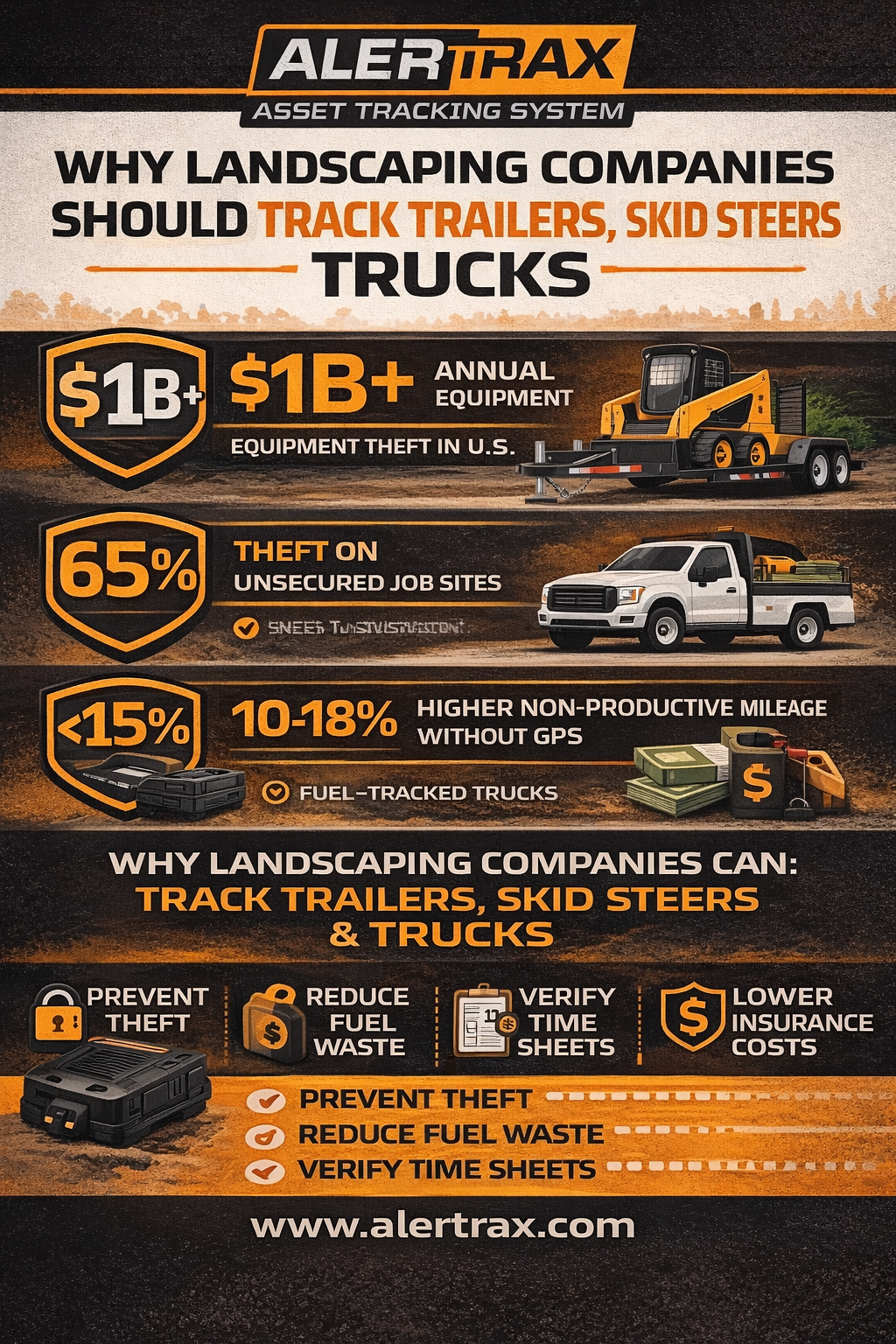
The National Equipment Register (NER) estimates U.S. equipment theft losses land between $300 million and $1 billion per year. Landscaping assets are frequent targets because they are mobile and easy to move quickly.
Trailers are especially vulnerable. If it can be hitched, it can be gone in minutes.
Recovery depends on time, not hope
In theft, the first hours matter most. Once an asset has time to cross jurisdictions, get parked in storage, or get stripped, recovery becomes dramatically harder.
That is why tracking is less about maps and more about speed. Alerts turn a theft into an active event, not a next-day surprise.
Trailers are often noticed missing too late
Insurance and law enforcement reporting consistently points to delayed reporting as a major driver of non-recovery. Overnight thefts get discovered the next workday. Weekend thefts get discovered Monday morning.
If your process depends on someone physically returning to the yard or the job site to notice something moved, you are giving thieves their biggest advantage: time.
Skid steers are fewer incidents, bigger hits
Skid steers are not stolen as often as trailers, but the financial hit is larger. A compact skid steer with attachments commonly represents $45,000 to $75,000 in replacement exposure.
Most thefts happen when equipment is left on an inactive job site. Friday night to Monday morning is a common window.
Truck data reveals waste you cannot see on a timesheet
Fleet studies across mobile trades show a consistent pattern: untracked trucks tend to accumulate non-productive mileage. A common range reported in commercial fleet analytics is 10 to 18 percent more non-productive mileage when there is no GPS accountability.
Even modest route improvement can reduce fuel spend. Many fleet benchmarking reports cite 8 to 12 percent fuel savings when routes and behavior improve.
For a landscaping company running multiple trucks, that becomes real money fast.
Payroll leakage is a bigger problem than most owners admit
In mobile service businesses, workforce research often finds 5 to 10 percent of paid time is unproductive or inaccurately logged when there is no objective verification.
Tracking does not replace trust. It replaces guessing. It turns conversations into facts.
What tracking should do for a landscaping company
- Instant movement alerts when a trailer or skid steer moves after hours.
- Geofence alerts when equipment leaves a yard or a job site.
- Location history to verify routes and reduce disputes.
- Higher operational visibility across trucks, trailers, and equipment without adding workload.
Sources
- National Equipment Register (NER) annual equipment theft loss estimates.
- National Insurance Crime Bureau (NICB) commercial theft patterns and reporting guidance.
- FBI Uniform Crime Reporting (UCR) property crime and recovery reporting.
- Commercial fleet benchmarking reports on route efficiency and fuel savings ranges.
Turn guessing into visibility
If your business depends on trailers, skid steers, and trucks, the data says the same thing every time: speed wins.
AlerTrax helps you know when an asset moves, where it goes, and how long it has been there. That is the difference between filing a claim and making a recovery.
If it moves, track it.