It is 3:15 on the Thursday before the Fourth of July. Half the notifications on your phone are guys asking if they can cut out early. The heat index is brutal, the holiday starts tomorrow, and nobody on your crews is thinking about anything except the cooler waiting at home. Trucks are rolling back in. Trailers are getting dropped. And somewhere in the shuffle, a skid steer stays parked at the Miller hardscape job, because dragging it all the way back on a Thursday afternoon just was not worth it.
By Friday evening, your entire operation is at rest. One trailer is at the yard. Another is in a foreman's driveway across town. Two zero-turns are still strapped down behind the shop. The skid steer is at the Miller job, where it will sit, alone, next to a half-finished patio, until Tuesday morning. That is roughly ninety-six hours of your most expensive assets sitting completely still, in five different places, while you are standing over a grill.
So here is the uncomfortable question. Right now, before you close up for the weekend, could you write down the exact location of every trailer, every mower, and every piece of equipment you own? Most owners can nail about eighty percent of that list from memory and then start guessing on the rest. The guessing is the part that costs you, because thieves already know something you might not: the long holiday weekend is the best window they get all year.
Ninety-Six Hours Is a Long Time for Nobody to Be Watching
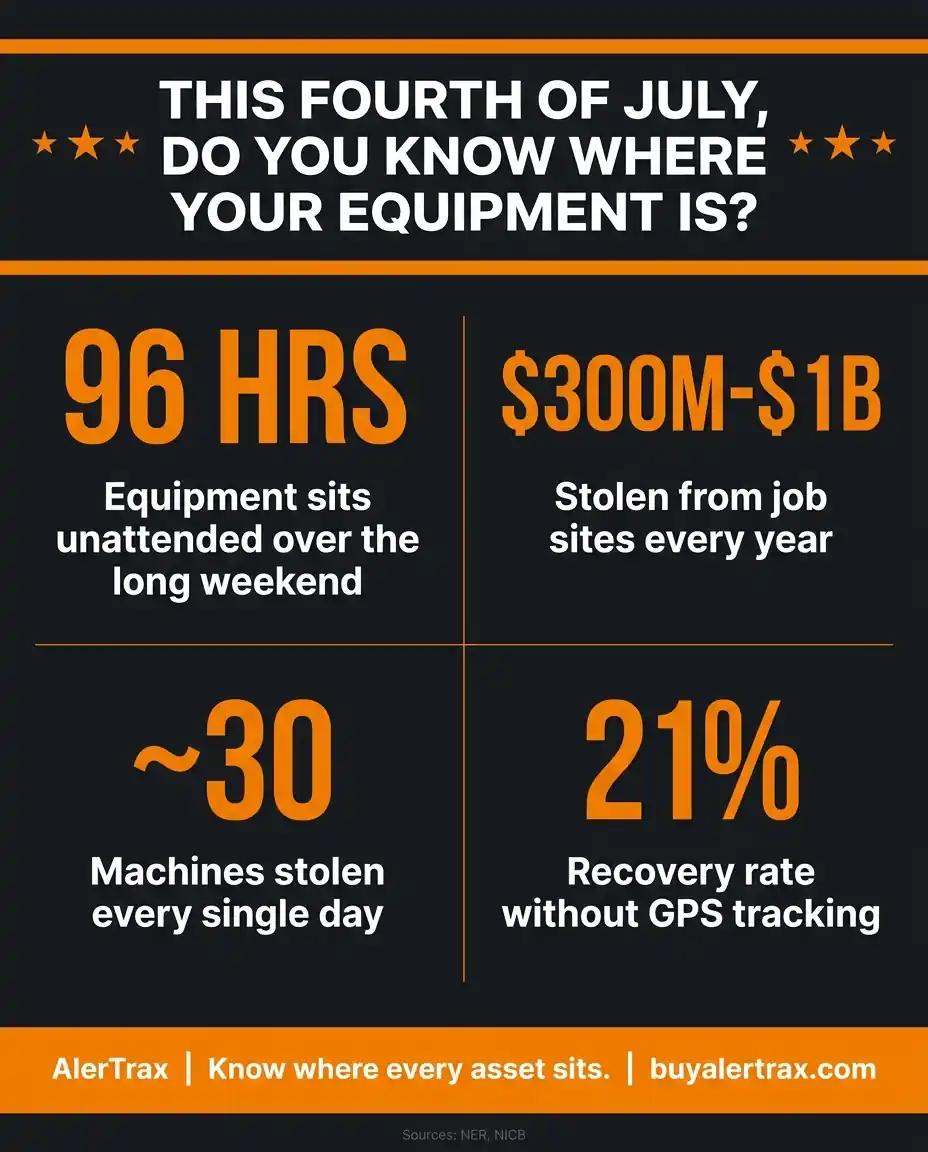
The reason a holiday weekend feels different is because it is different. On a normal night, your equipment sits unattended for maybe twelve hours between the end of one workday and the start of the next. Over a three or four day holiday, that window stretches to seventy-two hours, ninety-six hours, sometimes more. The National Equipment Register, the theft database used by insurers and law enforcement across the country, has documented recurring theft spikes around exactly these windows, with Memorial Day, the Fourth of July, Labor Day, and Thanksgiving all flagged as periods when sites sit unattended for multiple consecutive days and losses pile up fast (NER).
It is not random. It is timing. The majority of equipment theft happens after hours, in the quiet stretch between roughly 5 p.m. and 7 a.m. when nobody is around to notice (NER / NICB). A long weekend is simply that quiet stretch multiplied by three or four. Add in the fact that local law enforcement is stretched thin over a holiday, and you have the single lowest-risk window of the year for someone to back a truck up to your trailer and drive off.
The Numbers Are Worse Than Most Owners Think
Equipment theft is not a rare event you read about happening to somebody else. Across the country, direct losses from construction and equipment theft run between $300 million and $1 billion every year (NER / NICB). That works out to roughly 11,000 to 12,000 reported incidents annually, about 1,000 pieces of equipment every month, or right around thirty machines stolen every single day (NER, CONEXPO-CON/AGG). And those are only the reported ones. A large share of smaller tool and equipment thefts never get filed at all, because they fall below the insurance deductible.
When something does walk off, it is expensive. The National Equipment Register pegs the average loss from a single equipment theft at about $30,000 once you count the machine, the rental to replace it, and the downtime (NER). For trucks specifically, federal crime data puts the average even higher, north of $40,000 per incident (FBI NIBRS). The equipment rental industry alone loses an estimated $100 million a year to theft, with more than 360 pieces disappearing every month (American Rental Association). Copper stripped from job sites adds another billion dollars a year on top of all of it (U.S. Department of Energy).
Then comes the part that really stings. You are probably not getting it back. Fewer than one in four stolen machines is ever recovered, and without a tracker on it, the recovery rate sits around 21 percent (NICB). For hand tools and small equipment it collapses to under 7 percent (NICB). In plain terms, if a thief takes one mower or one trailer off your job site over the weekend, there is better than a 75 percent chance you never see it again.
Landscaping gear sits squarely in the crosshairs. John Deere equipment alone accounts for about 26 percent of reported equipment thefts, with Kubota close behind (NER). And smaller operators feel it hardest. The National Association of Home Builders has noted that smaller contractors are the most vulnerable to theft losses, simply because they have the least cushion to absorb a $30,000 hit in the middle of the season (NAHB).
Why Your Trailer Is Easier to Steal Than You Think
None of this is because thieves are geniuses. It is because landscaping equipment is close to a perfect target, and the reasons are structural. Your assets are mobile, they are valuable, and they spend their nights sitting in open lots, in driveways, and on job sites with no fence and no lights.
A few things make it worse. Many zero-turn mowers and skid steers ship with universal keys, so one common key starts thousands of identical machines (NER advisories). A full trailer is the biggest prize of all, because a single hookup takes everything at once, and stolen trailers frequently resell online within hours of being taken. Crews also tend to follow predictable schedules, so the same trailer parks in the same spot night after night, which is all the pattern a scout needs.
The kicker is that your insurance may not have your back the way you assume. Standard general liability policies often exclude tools in transit or carry sub-limits well below what you are actually hauling, which is why so many owners discover the gap only after the trailer is already gone.
The Real Problem Is Not Security. It Is Not Knowing Where Anything Is.
Here is where most of this circles back to something more basic than theft. Before you can protect your equipment over a holiday weekend, you have to know where it actually is. And for most companies, that knowledge lives in exactly one place: the owner's head, backed up by a group text.
Think about how your gear actually gets distributed on the Thursday before a holiday. One crew swings by a second job to grab a blower and leaves the trailer at the site. A foreman takes a truck home because it is closer to the fireworks. A skid steer stays put because moving it was not worth the trip. By the time everyone clocks out, your equipment is scattered across the county, and the only record of where it all landed is whatever people happen to remember to mention.
That is a crew visibility problem, not a security problem, and it is the one GPS quietly solves first. With a tracker on every asset, the fleet map becomes a live location audit. On Thursday afternoon you open your phone and see exactly where every trailer, mower, and skid steer came to rest before the long weekend started. Not where it was supposed to end up. Where it actually is. You know your real exposure before the first firework goes off, and you know it without calling a single crew member or making anyone feel like they are being checked up on.
This is the same visibility that makes GPS worth having the other fifty weeks of the year: knowing where your crews are, when they arrived, and how long they stayed. The holiday weekend just makes the value impossible to ignore.
What the Tracker Does While You Are at the Cookout
Knowing where everything sits is step one. Getting told the instant something moves is step two, and it is the part that actually protects you over a long weekend.
Draw a geofence around your yard, and if a trailer crosses that line after hours, you get a notification on your phone within minutes. Geofence the Miller job site where you left the skid steer, and the same thing happens the moment it moves. Your mower trailer has no business rolling at 2 a.m. on the fifth of July. If it does, you find out right then, while there is still a chance to act, instead of walking up to an empty spot on Tuesday morning.
And if the worst happens, a live tracking link changes the recovery math entirely. Instead of handing police a serial number and hoping, you send them a link that shows the asset moving live. Given that untracked recovery sits near 21 percent (NICB), a device that puts a live location directly in law enforcement's hands is the single biggest thing you can do to flip those odds.
One honest note on all of this. AlerTrax tracks your trucks, trailers, and equipment. It is an asset tracker, not an employee monitor. What it tells you is where your gear is and when it moves, which is exactly what you need to know heading into a weekend when nobody is on site.
Why AlerTrax Fits How Landscapers Actually Work
Most GPS systems were built for over-the-road trucking fleets with constant power and hardwired installs. Your operation does not look like that. You have trucks, trailers, mowers, and skid steers that move in and out of crews and job sites every day, and much of it has no power to wire into at all. AlerTrax was built for that reality.
- No Wiring, Over a Year of Battery Life: Runs on two AA batteries for more than a year, so there is nothing to splice, no OBD port, and no installer to schedule. Put it on and it works, including on a trailer or mower that has no power of its own.
- Covert Magnetic Mount: Mounts magnetically to any steel surface and tucks out of sight under a frame rail or inside a housing, so a thief does not know it is there.
- 100% Waterproof, Ruggedized Housing: IP67 rated to survive rain, mud, and pressure washing, the everyday abuse of landscaping work.
- Geofence, After-Hours and Tamper Alerts: Draw boundaries around your yard, your job sites, or a customer's property, and get an instant notification when an asset enters, exits, or moves when it should not.
- One Fleet Map for Everything: Every tracked truck, trailer, and machine on a single live map, from the Fleet Portal or your phone.
- Automatic Time-on-Site Logging: Arrival and departure timestamps recorded on every stop, for job costing, billing, and proof of service.
- iOS and Android App: Check any asset's location, and share a live tracking link, from anywhere.
Pricing That Costs Less Than One Stolen Trailer
You can put AlerTrax on your entire fleet for a low monthly rate, with no long-term contracts and no hidden fees.
(Prefer to own it outright? We offer a $599 Lifetime option for permanent, subscription-free tracking.)
Run that against the downside. The average equipment theft costs around $30,000 (NER), and better than three out of four stolen machines never come back (NICB). A tracker on the assets you are about to leave sitting for ninety-six hours is not really an expense. It is the cheapest insurance policy you will buy all year, and unlike your deductible, it works every single night, not just the holiday.
The Best Part Is What It Does the Other 361 Days
Here is the thing worth remembering once the holiday passes. The device you bought to stop worrying over a long weekend does not go back to sleep on Tuesday. The same tracker that guarded your skid steer over the Fourth is the one showing you which crew is at which job, who arrived when, and how long they stayed, every day of the season.
That is where the real money is. Theft protection is the reason a lot of owners buy in, and it is a real one. But the crew visibility, the time-on-site data, and the job costing you can finally trust are what pay for the system month after month, long after the fireworks are over. The long weekend is just the moment the value becomes impossible to miss.
This Fourth of July, Know Where Everything Is
Every landscaping owner is going to spend part of this weekend thinking about the gear sitting out there. You can spend it wondering, or you can spend it knowing, with a live map in your pocket and an alert ready to fire the second anything moves.
Visit www.buyalertrax.com and put a tracker on every truck, trailer, and machine before you close up for the holiday.
Sources
National Equipment Register (NER) / National Insurance Crime Bureau (NICB) : Annual construction and equipment theft losses ($300 million to $1 billion); $30,000 average loss per incident; recovery rate near 21% without tracking, under 25% overall, under 7% for tools and small equipment; John Deere ~26% of reported thefts; after-hours theft concentration; documented theft spikes around Memorial Day, the Fourth of July, Labor Day, and Thanksgiving.
NICB / National Crime Information Center (NCIC) : 8,068 vehicle thefts recorded on the Fourth of July holiday (2014-2017 stolen vehicle file); 659,880 vehicles stolen nationwide in 2025, down 23% year over year.
CONEXPO-CON/AGG : Approximately 1,000 pieces of construction equipment stolen per month.
FBI National Incident-Based Reporting System (NIBRS) : Average truck theft loss over $40,000 per incident.
American Rental Association (ARA) : Equipment theft costs the rental industry an estimated $100 million per year, with more than 360 pieces stolen each month.
U.S. Department of Energy : Approximately $1 billion in copper theft annually across industries, with construction and job sites among the primary targets.
National Association of Home Builders (NAHB) : Smaller contractors are disproportionately vulnerable to theft-related losses.