In most parts of the country, growing a landscaping company means hustling for every new account. You chase the work, you fight for the bid, you sweat the slow months. In Houston, the problem is the opposite. The work keeps finding you. A new subdivision opens in Fort Bend and needs maintenance contracts. A commercial pad goes up off the Grand Parkway. The phone rings with more business than you can comfortably handle, and you face the question every growing Houston owner eventually hits: do you turn it down, or do you add another crew?
So you add the crew. Then another. And somewhere between three crews and six, something shifts. When you ran two crews, you could practically see both job sites from your truck. Now you have crews scattered from Katy to Conroe to Pearland, and you genuinely do not know, hour to hour, where they are, whether they are on schedule, or whether the quality that built your reputation is holding on every site. You are busier than ever, your revenue is up, and your margins are somehow getting thinner.
That is the Houston paradox. In the fastest-growing metro in America, finding the work is the easy part. Scaling without losing control of it is where most companies break. And the thing that breaks first is almost always visibility.
Houston Is the Growth Capital of the Country
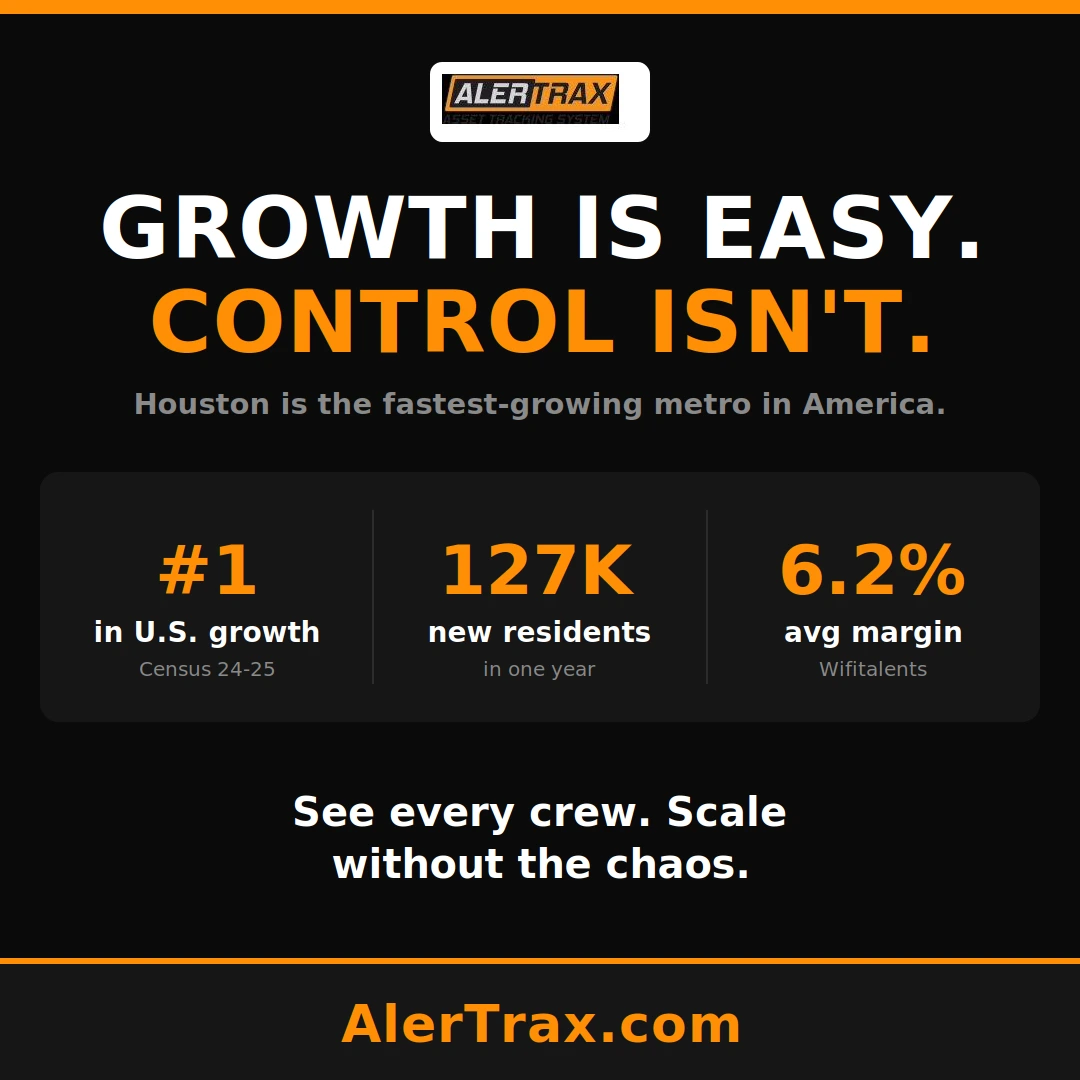
The scale of Houston's growth is hard to overstate. According to the U.S. Census Bureau, the Houston metro ranked first in the entire nation for population growth from 2024 to 2025, adding nearly 127,000 residents and pushing the region to roughly 7.9 million people. The year before that, it added almost 200,000 in a single year, its largest increase on record, which the Greater Houston Partnership calculated works out to a new resident every 2.7 minutes.
That growth is not concentrated downtown. It is spilling out into the suburbs that make up your service area. Harris County led every county in the country in numeric growth, and the surrounding counties are exploding right alongside it, Fort Bend, Montgomery with Conroe and The Woodlands, and fast-growing cities like Fulshear, which the Census Bureau ranked as the second-fastest-growing city in the United States (U.S. Census Bureau). Over the past two decades, the region's population has grown by nearly 40 percent.
For a landscaping company, every one of those new residents is a new lawn, every new subdivision is a stack of potential maintenance contracts, and every new commercial development is an account waiting to be won. The demand is extraordinary, and it is not slowing in a way that changes the basic picture. The opportunity in front of a Houston landscaping owner is as big as it gets in this industry. The only question is whether your operation can absorb it.
Fast Growth Is How Good Companies Break
Here is the uncomfortable truth about rapid growth: it kills more landscaping companies than slow markets do. When work is scarce, you stay lean and careful. When work is pouring in, you add crews and trucks faster than you add the systems to manage them, and the cracks do not show up until they are expensive.
The failure data tells the story. According to the U.S. Bureau of Labor Statistics, 20.4 percent of businesses fail in their first year, 48.4 percent fail by year five, and 65.1 percent are gone by year ten (LendingTree / BLS). A large share of those are not companies that could not find work. They are companies that grew faster than they could control, took on more than they could see, and watched quality and margin erode until the business was no longer worth running.
The industry knows this gap intimately. The 2026 Aspire Commercial Landscape Industry Report found that 79 percent of landscaping companies are focused on growing revenue, but only 41 percent are optimizing their processes to support sustainable growth. In most markets, an owner can hide behind the first number, "I'm focused on growth," and never confront the second. In Houston, the booming demand strips away that excuse. The market hands you the growth. Whether you have the systems to survive it is suddenly the only thing that matters.
Every New Crew Multiplies What You Can't See
The reason scaling erodes margin comes down to a simple problem: the owner who personally watched two crews cannot personally watch six. And in landscaping, what you cannot watch, you cannot control.
Labor is the largest cost in the business, running 30 to 50 percent of total revenue (Aspire), and every crew you add multiplies it. Once you add labor burden, a crew member you pay $20 an hour actually costs you $24 to $27 an hour (Service Autopilot, 2026). New crews are also your least proven: with industry turnover running around 42 percent a year (Wifitalents), the crew you added last month is often made up of people you barely know, working sites you cannot see, at the exact moment you are stretched too thin to check.
That is how a growing company quietly becomes less profitable. The average landscaping margin is already just 6.2 percent (Wifitalents), and analysis from Duranta finds 1 in 5 jobs is unprofitable, usually because real labor hours outran the estimate and nobody caught it. Now run that across six crews you cannot see instead of two you could. The unprofitable jobs multiply, the quality slips on the sites you never get to, and you, the owner, become the bottleneck, the only set of eyes the operation has, trying to be everywhere in a 10-county metro at once. Growth that should have made you money makes you exhausted instead.
Crew Visibility Is the System That Lets You Scale
You cannot add eyes to your operation by working more hours. You add them with data. Crew visibility is what replaces the owner standing on every job site, and it is the single thing that lets you grow the number of crews without growing the chaos.
- A live fleet map. Every crew, truck, and trailer on one screen, live. You see all six crews at a glance from your phone, instead of driving across the metro to spot-check them one at a time. Your span of control stops being limited by how far you can drive in a day.
- Automatic time-on-site logging. Arrival and departure timestamps at every stop, for every crew, with no input required. This is how you verify that a brand-new crew is actually hitting the job times you bid, before a mispriced pattern repeats all season.
- Complete route history. As you add crews across a sprawling metro, route history shows you which ones are running efficiently and which are wandering, so you can keep new crews tight instead of letting drive time eat the margin on every new account.
- Exportable trip reports. The data to manage by the numbers instead of by being there. You review the week's reports from your office and know exactly which crews, which routes, and which jobs need attention, without having visited a single site.
This is what breaks the owner-as-bottleneck trap. With visibility, you are no longer the only oversight your company has. The system watches every crew at once, which means you can finally add the seventh crew without it being the one that tips your operation into chaos.
New Crews Won't Fight It. It Helps Them Succeed.
Owners worry that tracking will sour new hires. The research says the opposite. Surveys from TSheets and HR C-Suite found 95 percent of employees rate GPS tracking positive or neutral, 75 percent say it helps track their time accurately, and 50 percent say it actually builds trust with their employer.
For a fast-growing company, that matters even more, because clear data sets expectations for new crews from day one. A new foreman who knows job times are tracked simply runs the route the right way from the start, instead of developing bad habits on sites nobody is watching. When you cannot personally train and shadow every new hire because you are adding them too fast, verified data becomes the consistent standard that keeps quality from drifting crew to crew. It protects your reputation precisely when growth is putting it most at risk.
Introduce it honestly as a tool for routing, fair billing, and keeping the whole team on the same standard, and resistance drops to nearly zero.
Why Alertrax Is Built to Scale With You
Most GPS systems were designed for long-haul logistics: hardwired installs, constant vehicle power, dedicated drivers. That is the last thing a fast-growing landscaping company needs. When you are adding trucks and equipment every few weeks, you cannot wait on installation appointments to bring a new crew online.
Alertrax was engineered to grow as fast as you do.
- One-Year Battery Life, No Wiring Required: Runs over a year on two AA batteries. No splicing, no OBD-II port, no install appointment. When you add a truck, you have it tracked in under a minute.
- Track Anything That Moves: Trucks, trailers, mowers, skid steers, and equipment, one platform that covers every new asset you add as you grow.
- Live Fleet Map: Every crew on one live map from the Fleet Portal or the iOS and Android app, so your visibility scales with your crew count instead of breaking under it.
- Automatic Time-on-Site Logging: Arrival and departure timestamps at every stop, the data that keeps job costing honest as you take on more accounts.
- Complete Trip Reports: Address, arrival, departure, duration, and mileage for every vehicle, every day, exportable to PDF or CSV.
- Geofence and After-Hours Alerts: Boundaries around the yard, job sites, and customer properties, with instant notifications on arrivals, departures, and movement that should not be happening.
- 100% Waterproof, Ruggedized Housing: IP67 rated, covert magnetic mounting, built to take Houston rain, mud, and the daily abuse of commercial work.
Pricing That Scales One Truck at a Time
You can equip your entire fleet for a low monthly rate, with no long-term contracts and no hidden fees, and add a device for each new truck or piece of equipment as you grow.
(Want to own it outright? We offer a $599 Lifetime option for permanent, subscription-free tracking.)
The math gets better the more you scale. If visibility helps each crew recover even a fraction of its wasted labor and keeps your job costing honest as you add accounts, the system pays for itself several times over per crew, and that return compounds with every truck you add. In a market handing you this much growth, the cost of tracking is trivial next to the cost of growing blind and watching your margins disappear into crews you cannot see.
And Yes, It Protects Your Equipment Too
As your fleet grows, so does the value of what is sitting in your yard overnight. Equipment theft costs the industry an estimated $400 million annually, and 40 percent of stolen landscaping equipment is never recovered (AMAROK / NER), with a single truck out of service costing up to $4,000 a day in lost revenue (AMAROK). With after-hours movement alerts, you know within minutes if a trailer leaves the yard overnight, and you have a live location to hand to law enforcement. It is not the reason to put GPS on your fleet. It is the bonus that comes with it.
In a Boom, Control Is the Competitive Edge
Houston is going to keep growing, and the work is going to keep coming. That is the easy part, and it is a gift most landscaping owners in the country would trade anything for. But a boom does not reward whoever grabs the most accounts. It rewards whoever can grow into them without the wheels coming off, holding quality and margin steady while the company gets bigger. That is a control problem, and you cannot solve a control problem by working more hours.
You solve it with visibility: the ability to see every crew, every job, and every route at once, so the company can grow past the limits of what one owner can personally watch. It does not require new habits from your crews or new software for anyone to learn. It takes one device per asset, mounted in under a minute, added one truck at a time as you scale.
Visit www.buyalertrax.com today and build the visibility to grow with the fastest market in the country.
Sources
U.S. Census Bureau, "Houston metro ranked #1 in the U.S. for numeric population growth 2024-2025 (~127,000 added; ~7.9M total); largest single-year increase on record ~198,000 in 2024; Harris County led all U.S. counties in numeric growth; Fulshear 2nd-fastest-growing U.S. city; region grew ~40% over two decades"
Greater Houston Partnership, "Houston added a new resident roughly every 2.7 minutes in 2024"
Aspire Commercial Landscape Industry Report (2026), "79% focused on growing revenue; only 41% optimizing processes for sustainable growth"
Aspire (2025), "Labor = 30-50% of total revenue"
Service Autopilot (2026), "Labor burden adds 20-35% on top of base wages; a $20/hr employee costs $24-$27/hr"
Wifitalents, "6.2% average profit margin; 42% annual employee turnover"
Duranta, "1 in 5 landscaping jobs is unprofitable"
BLS / LendingTree, "20.4% of businesses fail in year 1; 48.4% by year 5; 65.1% by year 10"
TSheets / HR C-Suite, "95% of employees rate GPS tracking positive or neutral; 75% say it tracks time accurately; 50% say it builds trust"
AMAROK / NER, "$400M annual equipment theft losses; 40% never recovered; up to $4,000/day lost revenue per truck"