Landscaping Is Half the Program
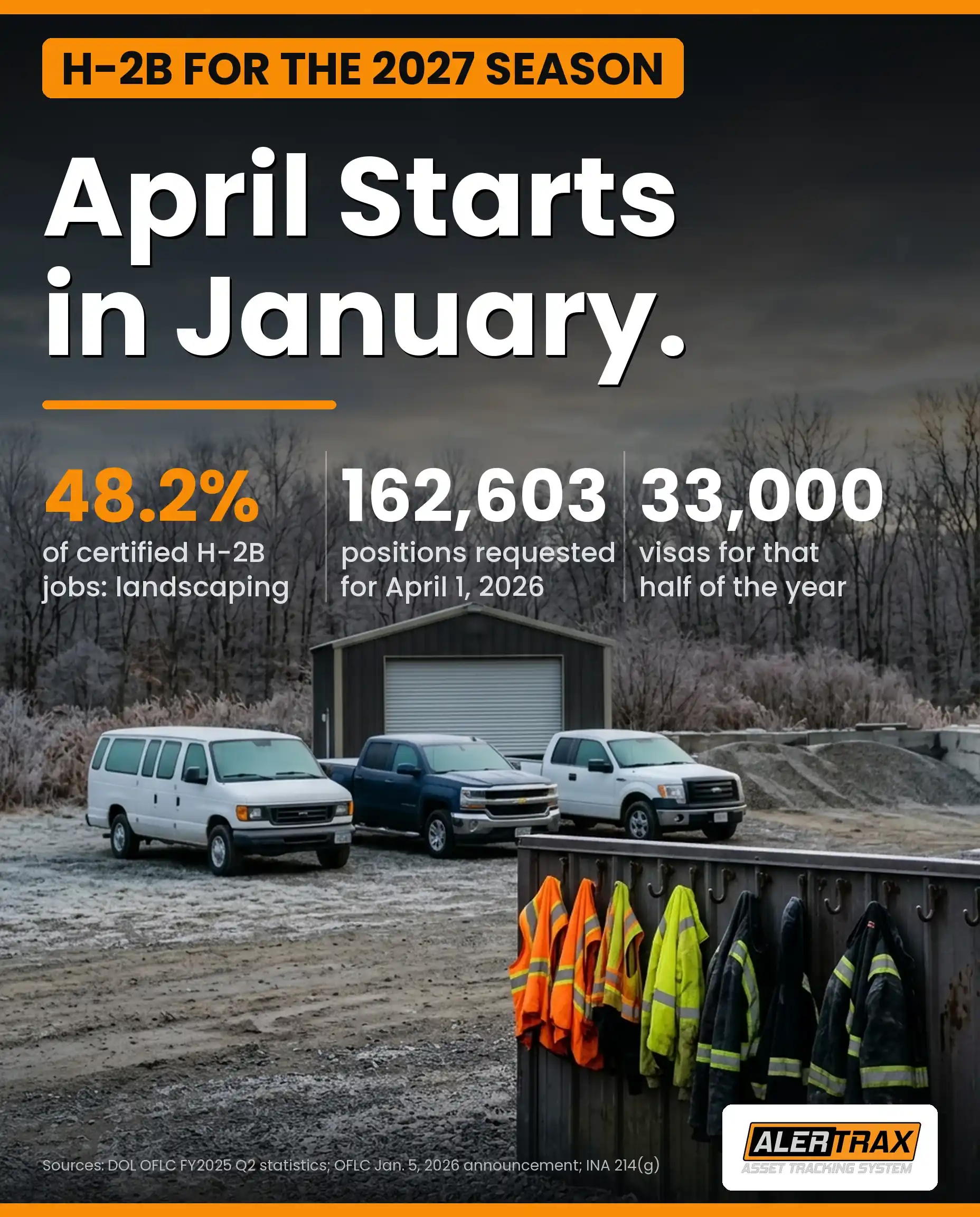
The Department of Labor's Office of Foreign Labor Certification (OFLC) publishes quarterly statistics on the H-2B program. For the first half of fiscal year 2025, October 2024 through March 2025, OFLC certified 135,678 H-2B positions. 65,397 of them, 48.2 percent, were for landscaping and groundskeeping workers. The next largest occupation, maids and housekeeping cleaners, was 6.8 percent (DOL OFLC, H-2B Selected Statistics, FY 2025 Q2).
Nearly one of every two certified H-2B positions in that period was a landscaping job.
33,000 Visas, 162,603 Positions Requested
H-2B visas are capped by law at 66,000 per fiscal year, split into two halves of 33,000. The second half covers jobs starting April 1 or later, which is when most landscaping seasons begin.
For April 1, 2026 start dates, OFLC's filing window opened on January 1, 2026 at 12:00 a.m. Eastern Time. On January 5, OFLC announced it had randomized 10,062 applications covering 162,603 worker positions with an April 1 start date, and that the first assignment group contained enough positions "to reach the H-2B semi-annual visa allotment of 33,000" (DOL OFLC announcements, December 29, 2025 and January 5, 2026).
In other words, employers requested close to five positions for every visa available for that half of the year. For October 1, 2026 start dates, OFLC's window ran from July 3 to July 5, 2026, and it randomized 2,625 applications covering 51,158 positions (DOL OFLC announcements, June 26 and July 8, 2026).
The government has at times released supplemental visas above the cap, but the amounts and timing change from year to year. Plan as if they will not come.
The Timeline Works Backward From April 1
Under 20 CFR 655.15(b), an H-2B application "must be filed no more than 90 calendar days and no less than 75 calendar days before the employer's date of need." For a date of need of April 1, 2027, that is a window from January 1, 2027 to January 16, 2027.
Before you can file, you need a prevailing wage determination. Under 20 CFR 655.15, employers that do not submit one "will not be eligible to file," and under 20 CFR 655.10, the job must be advertised at a wage at least equal to the prevailing wage or the applicable minimum wage, whichever is highest. Without a collective bargaining agreement or an approved survey, the prevailing wage is "the arithmetic mean of the wages of workers similarly employed in the area of intended employment" from the BLS occupational wage survey. For what landscaping workers earn in your state, see What a Landscaper Earns in Your State.
Working backward, late October and November is when most employers and their agents start on the prevailing wage request, so that it comes back in time to file in January.
What You Promise: The Three-Fourths Guarantee
Getting the workers is only half of it. An H-2B employer makes promises about hours, and the regulations require proof.
Under 20 CFR 655.20(f), the employer "must guarantee to offer the worker employment for a total number of work hours equal to at least three-fourths of the workdays in each 12-week period," or each 6-week period if the job order covers less than 120 days. A slow, rainy stretch in May does not erase the guarantee. It just makes it harder to meet.
Here is an example, not a legal calculation: a job order lists a 40 hour workweek. Over a 12-week period, that is 480 hours, so the employer must offer at least 360 hours to each H-2B worker in that period.
The Records You Have to Keep
Under 20 CFR 655.20(i), the employer "must keep accurate and adequate records" that include "the nature, amount and location(s) of the work performed," "the number of hours of work offered each day," "the hours actually worked each day by the worker," the reasons a worker did not work hours that were offered, and "the time the worker began and ended each workday."
Those records have to be kept for 3 years from the date of certification (20 CFR 655.56). Each payday, workers must also get a written statement showing, among other things, hours offered and hours actually worked for each workweek.
Location of the work performed, start and end time each day, hours worked: that is a daily log for every crew, every day, all season. Most landscaping companies already have most of that information on their trucks. The question is whether anyone is writing it down.
What to Do Before Thanksgiving
1. Decide your date of need and headcount. The date of need sets the filing window. Look at when last season really started, not when you wished it did.
2. Talk to your agent or immigration attorney now. The prevailing wage request, the job order, and domestic recruitment all have to happen in order. None of it should start in late December.
3. Plan for the lottery. With applications far above the cap, have a plan for the season if your workers are not approved, or arrive late.
4. Set up your hours records before the workers arrive. Daily start and end times, hours offered, hours worked, and where the work happened, for every H-2B worker.
5. Check the guarantee every 12 weeks. Do not wait until the end of the season to find out you are short.
Where Alertrax Fits
Alertrax does not replace a timekeeping system or your payroll records. It gives you an independent, automatic log of when each truck left the yard, which properties it visited, and how long it was there, which is the backbone of the "location(s) of the work performed" and the start and end of each day. Alertrax records it without asking the crew to do anything.
- Automatic Time-on-Site Logging: Every arrival and departure at every property is timestamped, for every tracked truck and trailer.
- Trip Reports You Can Export: Pull a date range by vehicle, with start time, stop time, addresses visited, duration, and distance, to check against timesheets.
- AddressFence: Set the yard as an address and see exactly when each crew rolled out and came back.
- Complete Route History: A full breadcrumb trail of each day, kept for later review.
- One-Year Battery, No Wiring Required: Alertrax runs on two AA cells, with nothing to wire in and nothing to charge.
- iOS and Android App: Check the map and the day's history from your phone.
Pricing
You can equip your fleet with Alertrax for a low monthly rate, no long-term contracts, no hidden fees.
(Want to own it outright? We offer a $599 Lifetime option for permanent, subscription-free tracking.)
Sources
U.S. Department of Labor, Office of Foreign Labor Certification (OFLC), "H-2B Temporary Non-Agricultural Program, Selected Statistics, Fiscal Year (FY) 2025 Q2," data as of March 31, 2025, retrieved October 2026: 135,678 positions certified in FY 2025 Q1 and Q2; landscaping and groundskeeping workers 65,397 certified positions (48.2 percent of total certified); maids and housekeeping cleaners 6.8 percent
DOL OFLC, announcements of December 29, 2025 and January 5, 2026, retrieved October 2026: filing window for April 1, 2026 start dates opened January 1, 2026 at 12:00 a.m. Eastern Time; randomization of 10,062 applications covering 162,603 worker positions; Group A sufficient to reach the semi-annual allotment of 33,000
DOL OFLC, announcements of June 26 and July 8, 2026, retrieved October 2026: filing window for October 1, 2026 start dates from July 3 to July 5, 2026; randomization of 2,625 applications covering 51,158 worker positions
Immigration and Nationality Act, section 214(g), H-2B numerical limitations of 66,000 per fiscal year, with no more than 33,000 in the first half of the fiscal year
Electronic Code of Federal Regulations (eCFR), 20 CFR 655.10, "Determination of prevailing wage for temporary labor certification purposes," retrieved October 2026
eCFR, 20 CFR 655.15, "Application filing requirements," retrieved October 2026: filing no more than 90 and no less than 75 calendar days before the date of need
eCFR, 20 CFR 655.20(f) and (i), "Assurances and obligations of H-2B employers," retrieved October 2026: three-fourths guarantee; earnings and hours records
eCFR, 20 CFR 655.56, "Document retention requirements of H-2B employers," retrieved October 2026: 3 year retention
This article is provided for general informational purposes and is not legal or immigration advice. H-2B rules, filing procedures, caps, and supplemental visa allocations change, and this summary does not cover every requirement, including domestic recruitment, job order, transportation, and housing obligations. Work with a qualified immigration attorney or agent on any H-2B application. AlerTrax is a GPS tracking company and does not provide payroll or immigration compliance services. The hours example above is an illustration, not a legal calculation.
April Starts in January
For H-2B employers, the 2027 season does not start when the grass does. It starts with a filing window on New Year's Day, and a paperwork trail that has to begin this fall.
Visit www.buyalertrax.com today and have every crew day logged automatically before next season starts.