1. What cellular network does it use?
A tracker reports its location over a cell network. When that network shuts down, the tracker stops reporting, no matter how good the hardware is.
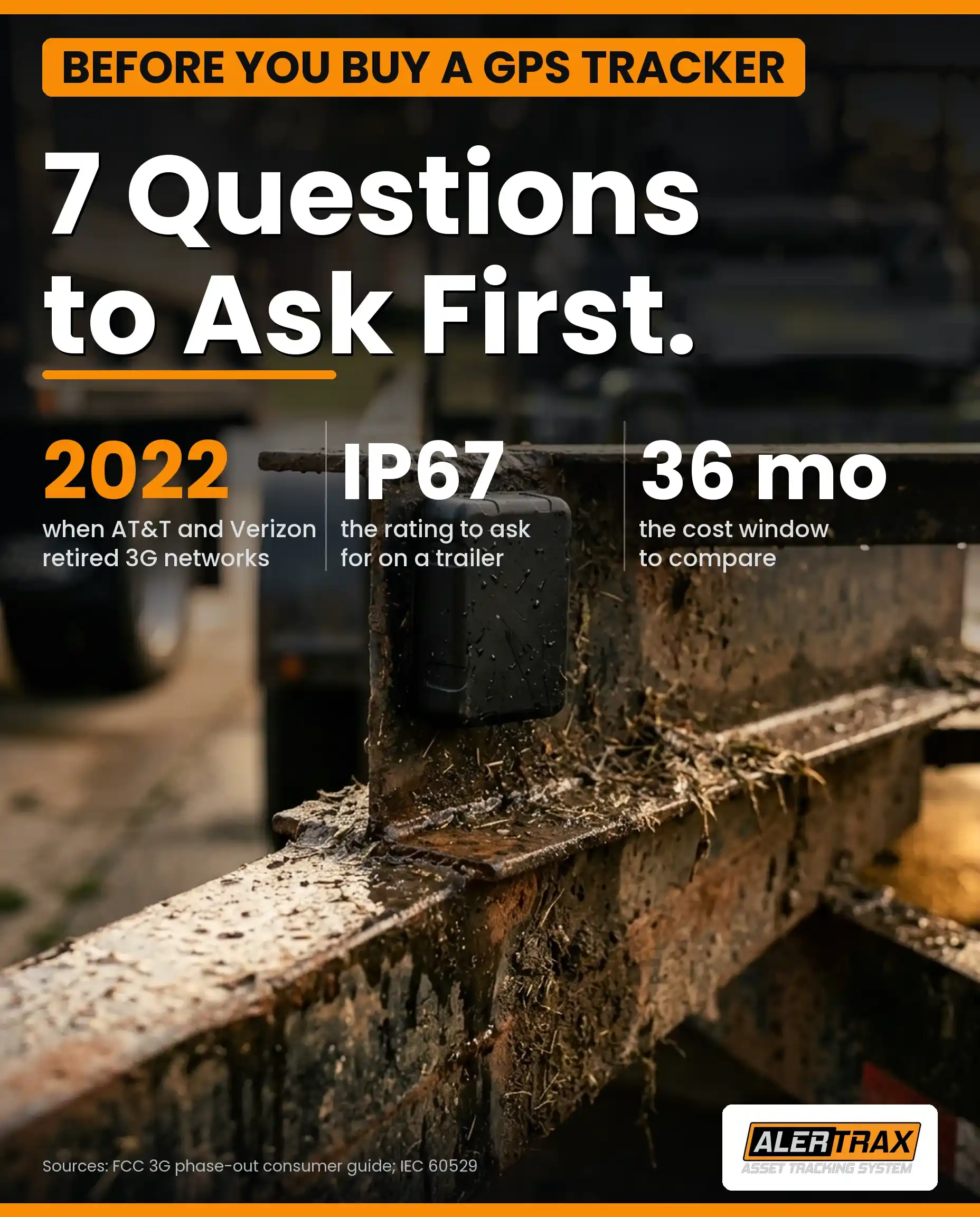
This has already happened once. The FCC warned consumers that carriers were shutting down their 3G networks, with AT&T announcing it would finish by February 2022 and Verizon by December 31, 2022. The FCC noted that the shutdowns would affect more than phones, including "vehicle SOS services, home security systems, and other connected products" (FCC, Plan Ahead for Phase Out of 3G Cellular Networks and Service). A tracker built only for a network that is being retired is one of those connected products.
Ask what network technology the device uses and which carriers it runs on. Low-power LTE technologies built for devices like trackers, such as LTE-M, are the current standard.
Our answer: Alertrax uses LTE CAT-M1 (LTE-M) on Verizon, AT&T, and T-Mobile in the U.S.
2. What is the battery life claim based on?
Every battery life number assumes something: how often the device reports, how much the asset moves, and how cold it gets. A tracker that checks in once a day can last a long time. The same tracker reporting every two minutes on a truck that runs all day will not.
Ask for the battery life on a trailer that sits most of the week, and on a truck that runs every day, and what update rate each number assumes.
Our answer: two AA batteries. 1+ year on low-movement assets like trailers and yard equipment, and 4 to 6 months on a truck running Monday to Friday, based on 10 minute updates and a 24 hour check-in. The batteries are standard AA cells you can replace yourself.
3. How often does it update, and how accurate is it?
"Live tracking" can mean every few seconds or every few hours. For theft, the update rate while the asset is moving decides how fast you find out. For crew reports, it decides how precise your arrival and departure times are.
Ask how often it updates while moving and while parked, what happens when there is no cell signal, and how accurate it is with GPS, and without it, such as inside a steel building.
Our answer: as often as every 2 minutes while moving, less often when parked to save battery. With no signal, it stores movement data and uploads it when it is back in range. Accuracy is about 30 feet with satellite positioning, about 90 feet with WiFi and LTE, and 2,000+ feet with LTE alone.
4. Does it need wiring or power?
Hardwired trackers work well on trucks. They do not work on a trailer, a mower, a skid steer with a disconnected battery, or a generator, because there is nothing to wire them into. For most landscaping companies, the unpowered equipment is where the theft risk is.
Ask whether one device can go on everything you own, and how long installation takes.
Our answer: no wiring. It mounts in minutes with a magnet, zip ties, or screws, on a truck, trailer, mower, or machine.
5. Will it survive a landscaping trailer?
Rain, mud, grass clippings, road salt, and the pressure washer. Ask for an ingress protection (IP) rating, not just "weatherproof." Under the IP rating system, a second digit of 7 means the device is protected against temporary immersion in water.
Our answer: IP67 rated and salt water protected.
6. What alerts and reports do you actually get?
A dot on a map is nice. What you will use every week is alerts and reports. Ask whether it can alert you when an asset moves after hours, crosses a boundary, or exceeds a speed you set. Ask whether it produces a report of every arrival and departure by address that you can export and put next to a timesheet or an invoice.
Our answer: alerts for movement, speed, and geofence or address entry and exit, plus trip reports showing arrival time, departure time, and time on site for every stop, exportable from the Alertrax Fleet Portal. For what that report looks like in practice, see our post on crew time on site.
7. What does it cost over three years?
Compare total cost, not the hardware price. Add up the device, any activation fee, the monthly or annual service fee for 36 months, and replacement batteries. Ask whether there is a contract, what happens if you cancel, and whether the price goes up after the first year.
Our answer: you can equip your fleet with Alertrax for a low monthly rate, no long-term contracts, no hidden fees. Or, if you would rather own it outright, a $599 Lifetime option covers permanent, subscription-free tracking.
Bring This List to Every Demo
Copy this into a note before your next sales call:
GPS TRACKER QUESTIONS Company: ____________
[ ] 1. Network technology and carriers: ____________
[ ] 2. Battery life on a trailer / on a truck, and at what update rate: ________
[ ] 3. Update rate moving / parked; offline storage; accuracy: ________
[ ] 4. Wiring required? Works on trailers and mowers? ________
[ ] 5. IP rating: ______
[ ] 6. After-hours, geofence, and speed alerts? Exportable arrival and departure report? ______
[ ] 7. Total 3 year cost, contract, cancellation: ________
Pricing
You can equip your fleet with Alertrax for a low monthly rate, no long-term contracts, no hidden fees.
(Want to own it outright? We offer a $599 Lifetime option for permanent, subscription-free tracking.)
Sources
Federal Communications Commission (FCC), Consumer and Governmental Affairs Bureau, "Plan Ahead for Phase Out of 3G Cellular Networks and Service," consumer guide, retrieved October 2026: AT&T announced it would finish shutting down its 3G network by February 2022; Verizon announced it would finish by December 31, 2022; T-Mobile announced shutdowns of Sprint's 3G and LTE networks in 2022; other connected devices, including vehicle SOS services and home security systems, may be affected
International Electrotechnical Commission (IEC), IEC 60529, "Degrees of protection provided by enclosures (IP Code)": second characteristic numeral 7 indicates protection against the effects of temporary immersion in water
AlerTrax, product specifications and FAQ, buyalertrax.com, October 2026: LTE CAT-M1 on Verizon, AT&T, and T-Mobile; two AA batteries; battery life of 1+ year on low movement assets and 4 to 6 months on high movement assets, based on 10 minute updates and a 24 hour check-in; accuracy of about 30 feet (GNSS), 90 feet (WiFi/LTE), and 2,000+ feet (LTE only); IP67
This article is provided for general informational purposes. It does not evaluate or name any other company's products. Battery life, update rates, and accuracy vary with movement, temperature, signal, and settings; the AlerTrax figures above are our published specifications, not guarantees of performance in every condition.
Ask Us First
Run us through the same seven questions. Call 800-240-6533 or email sales@buyalertrax.com, and we will walk you through every one of them.
Visit www.buyalertrax.com today and see the specs for yourself.