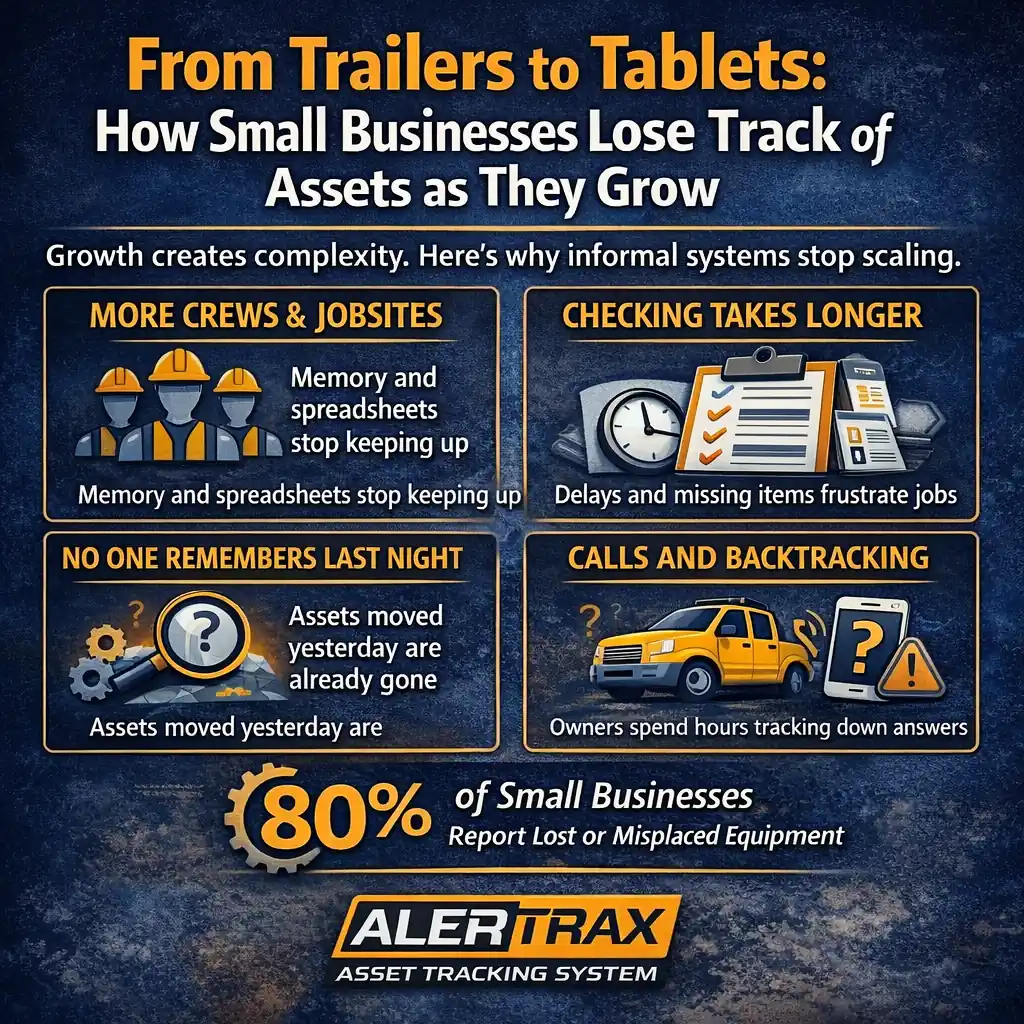
Most small businesses do not lose equipment because they are careless.
They lose it because they grow.
In the early days, everything feels simple. There are only a few assets. Everyone knows where the trailer is. Tools live in the same place. Vehicles go to the same jobs.
Then the business starts winning more work.
More crews.
More jobsites.
More moving pieces.
And somewhere along the way, visibility starts to slip.
The Early Stage: When Memory Works
In small operations, asset tracking is informal by design.
The owner knows who took the trailer.
The crew knows where the tools are.
The truck is always parked in the same spot.
This works because the system relies on proximity and repetition. The same people touch the same equipment every day. Nothing moves without someone noticing.
At this stage, formal tracking feels unnecessary. It would even feel like overkill.
That is why most businesses delay it.
The Growth Tipping Point No One Plans For
Growth changes the equation quietly.
A second crew is added.
Jobs start overlapping.
Assets rotate between sites.
Research across construction, service, and logistics industries shows that once a business exceeds five mobile assets or multiple simultaneous jobsites, loss and misplacement rates rise sharply.
Not because theft increases immediately, but because awareness drops.
People assume someone else knows.
Why Asset Loss Increases with Scale
As businesses grow, assets move more often and are handled by more people. Each handoff introduces friction.
Common failure points include:
- Equipment moved between jobs without documentation
- Trailers parked temporarily and forgotten
- Tools borrowed across crews without clear ownership
- Vehicles used after hours without visibility
FBI and industry theft data show that temporary locations and transitional moments are when most theft and loss occur. The risk is not the jobsite itself. It is the in-between.
Growth creates more in-between moments.
Spreadsheets and Memory Stop Scaling
Most businesses respond to early confusion by adding documentation.
Spreadsheets.
Whiteboards.
Shared notes.
These tools help briefly. Then they create their own problems.
Spreadsheets are only accurate if they are updated live. In the field, updates are delayed or skipped entirely. Information becomes stale before it is reviewed.
Studies on operational errors consistently show that delayed data leads to bad decisions. By the time someone checks the spreadsheet, the asset has already moved again.
The system does not fail dramatically. It fails quietly.
The Cost of Not Knowing Where Things Are
Lost assets are only part of the problem.
Not knowing where equipment is creates secondary costs that compound quickly.
- Crews waste time searching instead of working
- Duplicate equipment gets purchased unnecessarily
- Jobs are delayed because the right tools are unavailable
- Owners spend hours tracking down answers
Industry research shows that businesses with poor asset visibility experience higher operating costs even without theft. Time spent searching and reallocating equipment adds friction to every job.
That friction eats margin.
Why Theft Becomes More Likely as Complexity Increases
As visibility decreases, theft becomes easier.
Law enforcement data consistently shows that unattended assets and unmonitored locations are primary theft targets. Thieves look for opportunity, not specific brands.
When no one notices movement, no one reacts.
Many businesses assume theft happens because of bad luck. In reality, theft is often a symptom of lost visibility. The longer it takes to notice something is gone, the lower the chance of recovery.
Most stolen equipment is not recovered because discovery happens too late.
The Businesses That Avoid This Trap Do One Thing Differently
Businesses that scale without losing control do not rely on better memory or stricter rules.
They design systems that assume growth.
Instead of asking, Who knows where this is, they ask, How do we know where this is.
That shift changes behavior.
Assets stop being invisible. Movement becomes intentional. Accountability improves without confrontation.
Research comparing tracked and untracked equipment shows dramatically higher recovery rates and lower downtime for businesses that maintain live awareness.
The difference is not technology. It is response time.
Asset Tracking as a Growth Tool, Not a Security Tool
Many small businesses view tracking as a theft prevention expense.
In reality, it is a growth tool.
Tracking supports:
- Faster job starts
- Better scheduling decisions
- Reduced duplicate purchases
- Clearer accountability across crews
When assets are visible, decisions become easier. Growth feels less chaotic. Owners spend less time putting out fires and more time planning.
That shift often happens before theft ever occurs.
Why Waiting for a Loss Is the Expensive Path
Data on tracking adoption shows a clear pattern.
Most businesses adopt tracking after their first major loss.
They lose a trailer.
They miss a deadline.
They spend weeks recovering.
Then they install systems they wish they had earlier.
The businesses that adopt before the wake-up call spend less, recover faster, and scale with less stress.
The difference is not budget. It is timing.
Rethinking Asset Management as the Business Grows
Growth is not just more work. It is more complexity.
The systems that support a five-person business rarely support a fifteen-person one. Asset visibility breaks long before revenue does.
Small businesses that recognize this early avoid painful lessons later.
You do not lose control because you stop caring. You lose control because informal systems stop working.
The smartest businesses do not wait for proof. They plan for scale before it shows up on the balance sheet.