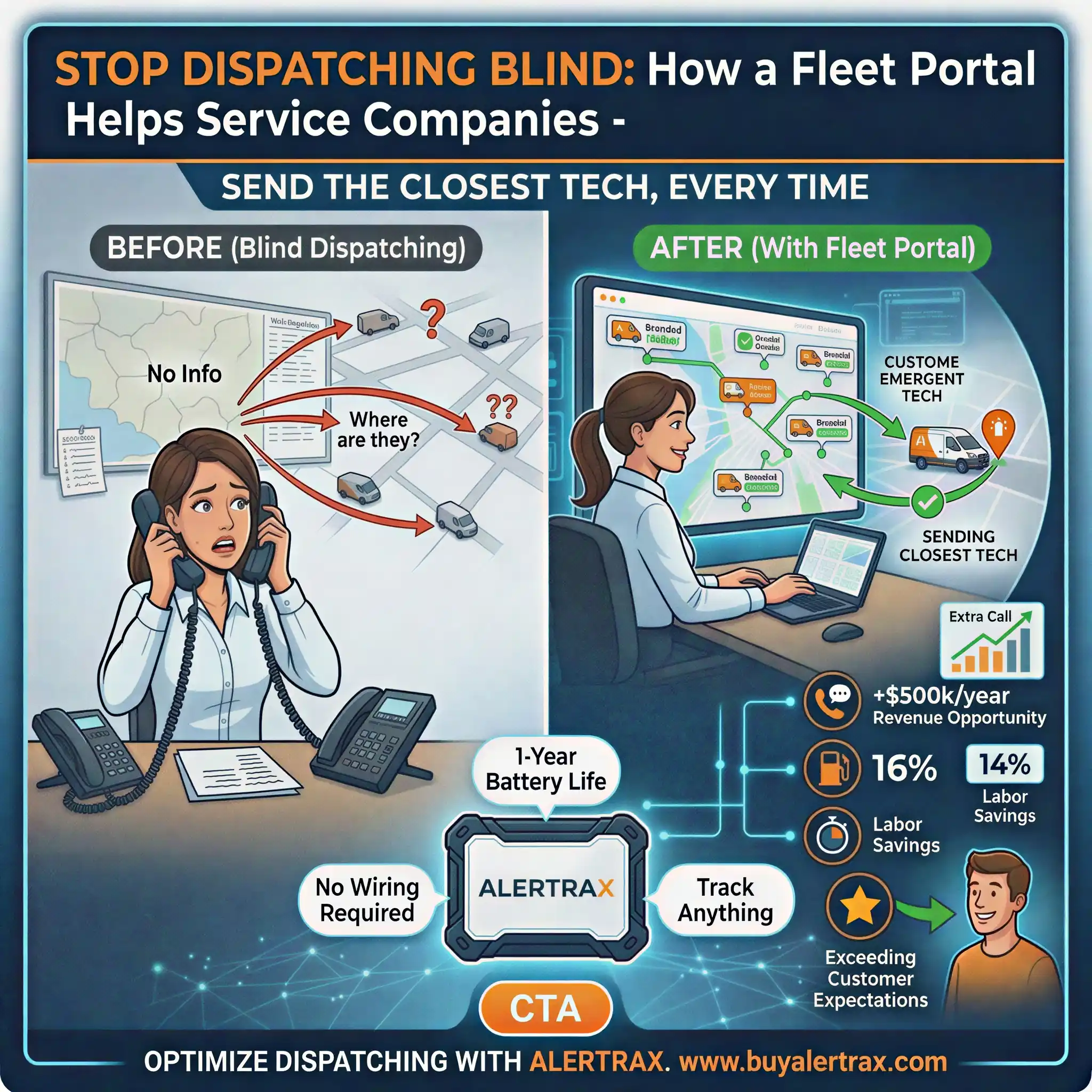
The phone rings at 2:15 PM. A commercial property manager has a busted water heater flooding a mechanical room. He needs someone there now, not in two hours, not tomorrow morning, now.
Your dispatcher picks up the phone and starts calling techs. Mike does not answer. Jason says he is wrapping up a job on the other side of town and can be there in about 45 minutes. Your dispatcher sends Jason.
What your dispatcher did not know, because she had no way of knowing, is that Dave was finishing an install eight minutes from that property manager's building. Dave could have been on-site before Jason even got in his van. Instead, the customer waited 50 minutes, and Dave drove right past the address on his way to his next scheduled call.
This is not a rare scenario. For most service companies dispatching by phone, text, and gut instinct, this is every single day. And the data says it is costing you far more than you think.
Speed Is No Longer a Bonus. It Is the Baseline
Customer expectations around response time have shifted dramatically, and the research from the last two years paints a picture that should concern every service company owner.
According to a 2025 study by Salesforce, 80 percent of customers now say the experience a company provides is as important as its products and services. It is not enough to do great work anymore. If the experience of getting to that great work, the wait, the communication, the responsiveness, falls short, customers will leave.
And leave they do. A Hiver survey found that 72 percent of customers will switch companies after a single negative experience. Not two bad experiences. Not a pattern. One. A separate study found that 45 percent of customers will end a business relationship the same day they experience poor service. In home services, where most of your revenue comes from repeat customers and referrals, losing a customer over a slow response is not just losing one job. It is losing years of future revenue.
How fast do customers expect you to respond? According to HubSpot's State of Service Report, 90 percent of consumers rate an immediate response as important when they have a service question, and 60 percent define "immediate" as 10 minutes or less. For field service companies specifically, industry benchmarks put urgent repair response at a few hours at most, and the companies winning the most business are the ones consistently beating that window (ServiceTitan, 2026).
The research from Liveforce puts an even sharper point on it: every extra hour a customer waits can reduce conversions by up to 80 percent. In a service business, that means every hour between the call and the truck in the driveway is an hour where the customer is more likely to call your competitor instead.
The Dispatching Problem Hiding in Plain Sight
Here is the reality most service companies live with every day: your dispatcher is the most important person in your company, and she is operating with almost no information.
She knows which techs are on the schedule. She might know which jobs they were assigned this morning. But she does not know where any of them actually are right now. She does not know if Mike finished his 10:00 AM call early and has been sitting in a parking lot for 20 minutes. She does not know if Jason is stuck in traffic on the highway or already back in the service area. She does not know that Dave just pulled out of a neighborhood three blocks from the emergency call.
So she does what every dispatcher without a fleet map does: she starts calling. She texts. She waits for callbacks. She makes a decision based on whoever answers first, or whoever says "I think I can be there by…", and hopes it works out.
According to the 2025 Fleet Technology Trends Report (an independent survey conducted by Bobit Business Media), 52 percent of all fleets using GPS tracking report improved productivity as the number one benefit. The reason is simple: when your dispatcher can see every truck on a live map, she does not need to call anyone. She looks at the screen, identifies the closest available tech, and dispatches. The guessing is gone. The phone tag is gone. The 20 minutes of figuring out who is where is gone.
That same survey found that 69 percent of fleets across all industries now use GPS tracking, and 72 percent rate it as extremely or very beneficial. The field service management market is projected to grow from $5.64 billion in 2025 to $9.68 billion by 2030 (MarketsandMarkets), driven almost entirely by companies realizing that dispatching without live visibility is like navigating without a map.
What "Nearest Tech" Actually Means for Your Revenue
Let us put real numbers to this.
Say your average service call generates $200 in revenue. Your average tech runs 4 calls per day. If GPS-based dispatching allows each tech to squeeze in just one additional call per day, because they are spending less time driving between jobs and more time turning wrenches, here is what that looks like for a 10-van fleet:
1 extra call × $200 × 10 techs × 250 working days = $500,000 per year in additional revenue.
That is not a fantasy number. The 2025 Fleet Technology Trends Report found that fleets using GPS tracking reported average labor cost savings of 14 percent and fuel savings of 16 percent, and those fuel savings have nearly doubled since 2021, when the same survey measured them at 8 percent. The technology is getting better, and so are the results.
The Aberdeen Group found that companies using fleet monitoring systems saw a 20 percent reduction in equipment downtime and a 30 percent increase in service profitability. In practical terms, that means techs spend more time at job sites generating revenue and less time sitting idle, driving inefficient routes, or waiting for dispatch instructions.
And consider the insurance angle. The same Bobit survey reported average fleet insurance savings of 11 percent, with accident-related cost savings jumping from 11 percent to 22 percent between 2021 and 2025 among fleets using GPS. An independent study by Cambridge Mobile Telematics found that telematics adoption correlated with 38 percent fewer accidents. When your drivers know their speed and braking are being monitored, they drive better, and your premiums reflect it.
The Customer Experience Gap Your Competitors Are Closing
Here is the competitive reality: your customers are comparing your responsiveness not just to other plumbers or HVAC companies, but to every service experience they have ever had. They are used to tracking their pizza delivery live. They expect an Uber in four minutes. And then they call your company, and the best you can offer is "someone will be there between 1:00 and 5:00."
According to Salesforce, 74 percent of mobile field workers say customer expectations are higher than they used to be, and 73 percent say customers now expect a more personal touch. A Qualtrics XM Institute study found that companies with significantly above-average customer experiences perform better financially than their competitors, 89 percent of them.
This is where a fleet portal changes the game. When a customer calls with an urgent issue, your dispatcher does not say "let me check and call you back." She pulls up the fleet map, sees that your nearest tech is 12 minutes away, and says: "I've got someone who can be there in about 15 minutes. Does that work?"
That is not just good service. That is a competitive weapon. According to HubSpot Research, 93 percent of customers are likely to make repeat purchases with companies that offer excellent customer service. And Khoros reports that 83 percent of customers feel more loyal to brands that respond to and resolve their complaints quickly. In the home services world, where your next five years of revenue from a customer depends on whether they call you back or Google someone else, response speed is the single most controllable factor in your growth.
Research from Bain & Company backs this up at the top line: businesses that prioritize better customer service experiences grow revenues 4 to 8 percent above their market average.
What a Fleet Portal Actually Shows You
If you have never used a fleet portal, here is what it looks like in practice. You open a browser or an app and see a live map with every one of your company vehicles represented as a pin. Each pin shows you:
- Current location, exactly where the truck is right now, updated live
- Movement status, whether the vehicle is parked at a job site, driving, or sitting idle
- Last known speed and direction, so you can tell if a tech is headed toward or away from a potential dispatch
- Time on site, how long the tech has been at their current location, so you know who is wrapping up and who just started
- Complete route history, a breadcrumb trail showing everywhere the vehicle has been that day, with timestamps
When a service call comes in, your dispatcher glances at the map and can instantly answer three questions: Who is closest? Who is available? And how fast can they get there?
No phone calls. No texting and waiting for a reply. No guessing. The answer is on the screen.
This is what the Alertrax Fleet Portal was built to do. Every vehicle with an Alertrax tracker shows up on a single, live map, accessible from any browser on your office computer, your dispatcher's tablet, or your phone while you are out in the field yourself.
Beyond Dispatch: The Data That Runs Your Business
Faster dispatching is the most immediate benefit of a fleet portal, but it is not the only one. The same GPS data that shows you where your trucks are right now also builds a history that helps you run a smarter operation over time.
Route efficiency. Over weeks and months, route history data reveals patterns. You will see which techs are taking efficient routes and which ones are zigzagging across the service area. You will see which neighborhoods cluster together well and which jobs should be rescheduled to a different day for geographic efficiency. According to the American Transportation Research Institute (ATRI), every hour of vehicle idling costs up to $2.50 in fuel alone. When you can see idle time and inefficient routing on a map, you can fix it.
Proof of service. Every arrival and departure is logged with a timestamp. When a customer disputes whether your tech showed up, or a property manager asks for documentation of your service visits, you do not need to dig through paper logs or rely on your tech's memory. You pull up the trip report and show them the data. The 2025 Fleet Technology Trends Report found that 47 percent of fleets achieve a positive return on investment from GPS tracking in under 12 months, and dispute resolution is one of the reasons that payback comes so quickly.
Accountability without micromanaging. Nobody likes being watched. But according to a TSheets (Intuit QuickBooks) survey, 95 percent of employees rate GPS tracking as positive or neutral, and 50 percent say it actually builds trust with their employer. Good techs welcome the data because it proves the work they are doing. It eliminates suspicion, reduces awkward conversations, and replaces "I think he left early" with "the data says he was on-site from 9:07 to 11:42."
Time theft prevention. The American Payroll Association and Workpuls estimate that businesses lose 5 to 10 percent of payroll to time theft annually. For a service company with $1 million in annual labor costs, that is $50,000 to $100,000 per year in wages paid for time not worked. GPS-verified arrival and departure times close that gap without a single confrontation.
Why Alertrax Is Built for Service Fleets
Most GPS tracking systems require hardwired installation into a vehicle's OBD-II port or electrical system. That works fine for a truck that never leaves your fleet, but it does not work for trailers, equipment, or any asset that does not have a 12-volt power source.
Alertrax is different. It was engineered for the real-world conditions that service companies operate in.
- One-Year Battery Life, No Wiring Required: Alertrax runs on a self-contained battery that lasts a full year. No splicing into your van's electrical system, no OBD-II ports, no installation appointments. You mount it and it works.
- Track More Than Just Trucks: Because there are no wires, you can put Alertrax on anything, service vans, work trucks, equipment trailers, tool trailers, generators, compressors, and any towable asset your crews take into the field. One fleet portal, every asset, one screen.
- 100% Waterproof, Ruggedized Housing: Service vehicles live outside. They get rained on, pressure-washed, and covered in mud. Alertrax is built to survive all of it without skipping a beat.
- Covert Magnetic Mounting: Alertrax mounts magnetically to any steel surface. Tuck it under a bumper, inside a frame rail, or behind a panel. No visible antennas, no wires to trace. It stays hidden.
- Live Fleet Portal: The Alertrax Fleet Portal shows every tracked asset on a single live map. Your dispatcher sees who is closest to the next call. You see how your fleet is performing across the entire service area. It is accessible from any browser, desktop, tablet, or phone.
- Geofence and After-Hours Alerts: Set virtual boundaries around your shop, your storage yard, or a customer's property. If a tracked vehicle or trailer moves outside that boundary after hours, you get an instant alert. Dispatch intelligence during the day, theft protection at night.
- Automatic Time-on-Site Logging: Every arrival and departure is recorded with a timestamp. Use it for dispatching, for proof of service, for payroll verification, and for job costing. No manual entry required.
- iOS and Android App: See your fleet map from anywhere, in the office, on the road, or at home. The same data, the same map, the same alerts, right on your phone.
Pricing That Works for Service Companies
You can equip your entire fleet with Alertrax for a low monthly rate, no long-term contracts, no hidden fees.
(Want to own it outright? We offer a $599 Lifetime option for permanent, subscription-free tracking.)
Think about the math. If one faster dispatch per day generates one additional service call worth $200, that is $50,000 per year, per tech. The cost of tracking an entire fleet with Alertrax is a fraction of the revenue you recover from faster dispatching alone, before you even count the fuel savings, the insurance reduction, the time theft prevention, and the customer retention.
According to the 2025 Fleet Technology Trends Report, 47 percent of fleets see a full return on their GPS investment in under 12 months. With Alertrax's pricing, most service companies see it in weeks.
And Yes. It Prevents Theft Too
We have spent this entire article talking about dispatching, response time, and customer experience, because those are the benefits that impact your revenue every single day. But there is another benefit that matters when the worst happens.
Service companies run expensive assets. Fully loaded work vans. Specialty tool trailers. Diagnostic equipment worth thousands. And those assets are parked in driveways, on curbs, and at jobsites across your service area every night.
With Alertrax, if a van or trailer moves after hours, you know instantly. You can track its exact location live and direct law enforcement to the thief before your tools end up on Facebook Marketplace.
Smart dispatching by day. Theft protection by night. One device. One portal. One investment.
Your Customers Are Calling. Can You Get There First?
Every service call is a race, even if your customer does not tell you that. They called you, but they are also thinking about calling someone else. The company that gets a tech on-site fastest wins the job, wins the relationship, and wins every future call from that customer for years to come.
You cannot win that race if your dispatcher is playing phone tag to figure out where your trucks are. You win it with a fleet portal, a live map, and the ability to say: "We've got someone 12 minutes away. He's on his way."
Visit www.buyalertrax.com today and put every vehicle in your fleet on one screen.
Sources
Salesforce, "80% of customers say experience is as important as products"; "74% of mobile workers say expectations are higher"; "73% expect a more personal touch"
Hiver, "72% of customers switch companies after a single negative experience"; "45% end a relationship the same day"
HubSpot State of Service Report, "90% rate immediate response as important; 60% define immediate as 10 minutes or less"
HubSpot Research, "93% likely to make repeat purchases with excellent service"
Liveforce, "Every extra hour of wait time can reduce conversions by up to 80%"
Khoros, "83% feel more loyal to brands that respond and resolve quickly"
Bain & Company, "Companies prioritizing service grow revenues 4-8% above market"
Qualtrics XM Institute, "89% of companies with above-average CX outperform financially"
2025 Fleet Technology Trends Report (Bobit Business Media), Fleet GPS adoption, ROI, fuel/labor/insurance savings data
MarketsandMarkets, Field service management market projections ($5.64B to $9.68B by 2030)
Aberdeen Group, 20% downtime reduction, 30% service profitability increase with fleet monitoring
Cambridge Mobile Telematics, 38% accident reduction with telematics
American Transportation Research Institute (ATRI), Idling cost data ($2.50/hour)
TSheets (Intuit QuickBooks) / HR C-Suite, Employee GPS tracking perception (95% positive/neutral, 50% builds trust)
Workpuls / American Payroll Association, 5-10% of payroll lost to time theft annually