The Two-Hour Extension Has a Condition
If your plow trucks are commercial motor vehicles, which under federal rules generally means a gross vehicle or combination weight rating of 10,001 pounds or more used in interstate commerce (49 CFR 390.5), your drivers are covered by the federal hours of service rules in 49 CFR Part 395.
Many owners have heard that bad weather buys a driver extra time. That rule exists. Under 49 CFR 395.1(b)(1), a driver who "encounters adverse driving conditions" and cannot safely finish the run within the normal limits may drive "for not more than two additional hours" to complete the run or reach a safe place.
The catch is in the definition. Under 49 CFR 395.2, adverse driving conditions means snow, ice, sleet, fog, or other adverse weather "that were not known, or could not reasonably be known, to a driver immediately prior to beginning the duty day ... or to a motor carrier immediately prior to dispatching the driver."
A storm that has been in the forecast since Tuesday, that you are dispatching drivers into on purpose, is known. The extension is for a driver who gets caught by weather. It is not for planning a long snow shift.
The Limits Still Apply in a Storm
Most local snow contractors use the short-haul exception, which removes the logbook requirement for drivers who stay within 150 air-miles of their normal work reporting location and are released within 14 consecutive hours (49 CFR 395.1(e)(1)). It removes the logbook. It does not remove the clock. Property-carrying drivers using it still need at least 10 consecutive hours off duty separating each 14 hours on duty, and the employer still has to keep time records for 6 months.
For drivers of property-carrying vehicles that do not require a CDL, a separate exception applies: they may not drive after the 14th hour after coming on duty on 5 days of any 7 consecutive days, or after the 16th hour on 2 days of any 7 consecutive days (49 CFR 395.1(e)(2)).
Apply that to the 2:10 AM call. A driver who came on duty at 7 AM yesterday for leaf cleanup and went home at 6 PM had 11 hours on duty and only 8 hours off before a 2 AM start. Whether that driver can legally take a CMV out depends on which rules apply to your operation, and it is worth knowing before the storm instead of during it. For more on the time records the exception requires, see No Logbook Does Not Mean No Records.
Why the Rules Take Snow Seriously
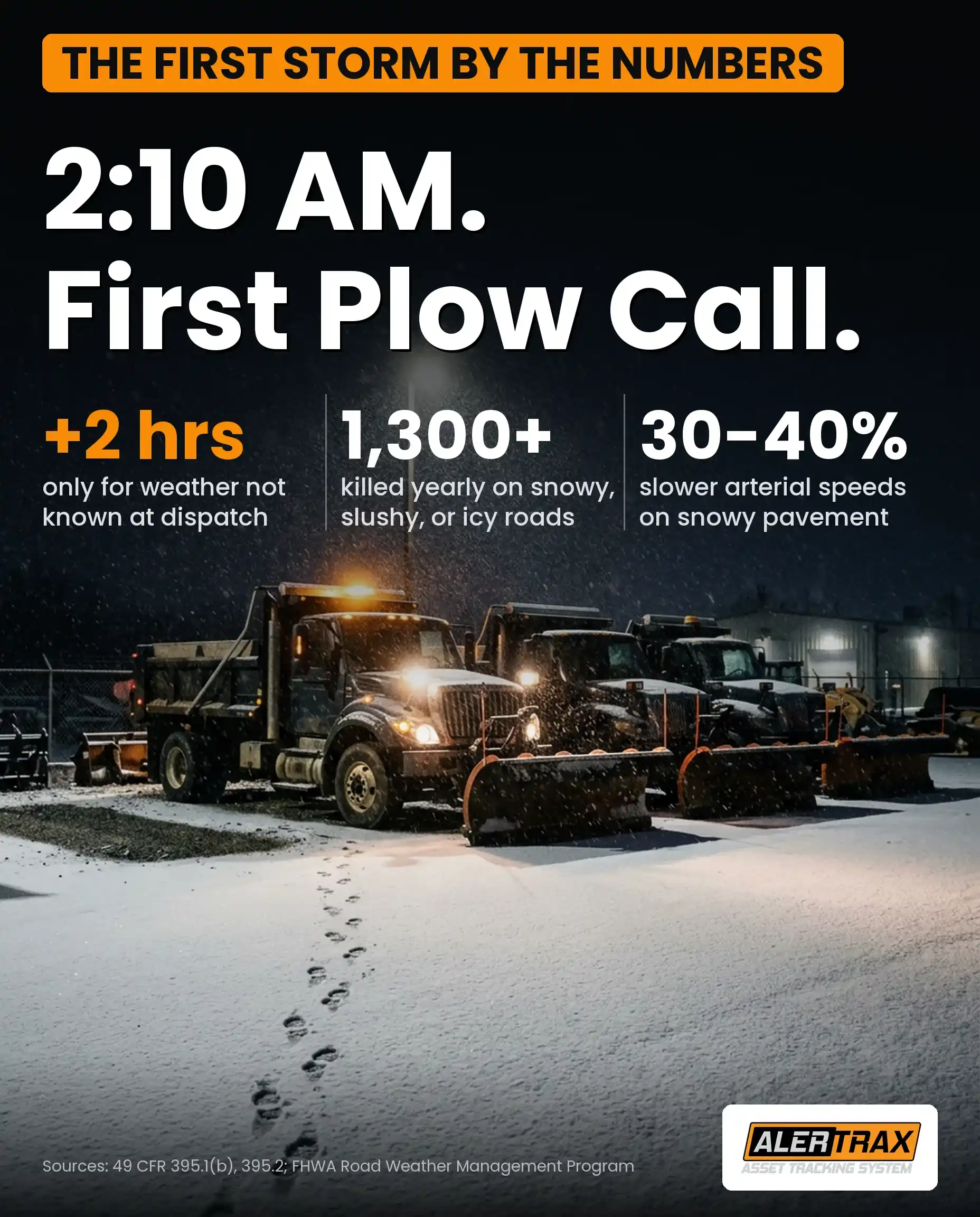
According to the Federal Highway Administration's Road Weather Management Program, each year over 1,300 people are killed and more than 116,800 injured in vehicle crashes on snowy, slushy, or icy pavement. Nearly 900 people are killed and nearly 76,000 injured in crashes during snowfall or sleet (FHWA, Snow and Ice).
The federal driving rule for those conditions is direct. Under 49 CFR 392.14, "extreme caution" is required when snow, ice, or sleet affect visibility or traction, "speed shall be reduced," and if conditions become sufficiently dangerous, operation "shall be discontinued" until it can be done safely.
Fatigue makes all of that worse. A driver who slept four hours is the one most likely to push it.
Snow Also Stretches the Route
The same FHWA program reports that average arterial speeds decline by 30 to 40 percent on snowy or slushy pavement. Freeway speeds fall 3 to 13 percent in light snow and 5 to 40 percent in heavy snow.
Here is an example, not survey data: if a plow route's driving between lots takes 90 minutes on dry roads, a 35 percent drop in speed stretches that to about 2 hours and 18 minutes, before a single lot is pushed. Across four trucks, that is more than three hours of extra driving in one night. If your 6 AM deadline was built on dry road times, it was built wrong.
Six Questions to Answer Before the First Storm
1. Who is rested? Decide now who sits out leaf cleanup the day before a forecast storm, so you have legal, rested drivers at 2 AM.
2. Where are the trucks? Know whether every plow truck is at the yard or at a driver's home before you start calling people.
3. Which lots go first? Put the 6 AM openers, hospitals, and anything with a contractual deadline at the top of the list, and route from the closest truck.
4. How long will the route really take? Build snow-speed route times, not dry ones.
5. Is standby paid? If drivers are told to wait at the shop for the storm, that time may be work time. See Paid to Wait? Snow Crews on Standby.
6. Is every driver file complete? Seasonal plow drivers in CMVs need a qualification file before the first event. See Your Snow Drivers Need a File Before They Need a Plow.
Where Alertrax Fits
At 2:10 AM, "where are the trucks" should take ten seconds, not ten phone calls. Alertrax puts every plow truck, trailer, and staged machine on one map, and keeps a record of the whole night.
- Live Fleet Map: See every tracked plow truck, trailer, and skid steer on one map in the Alertrax Fleet Portal or the iOS and Android app, with location updates every 2 minutes, and send the closest truck first.
- Automatic Time-on-Site Logging: Every arrival and departure at every lot is timestamped, which doubles as proof of service when a property manager asks when you were there.
- Trip Reports You Can Export: Start time, stop time, addresses visited, duration, and distance for every truck, to check against driver time records and to learn what a storm really takes.
- AddressFence: Get departure and arrival alerts for the yard and key lots, so you know when each truck rolled out.
- One-Year Battery, No Wiring Required: Alertrax runs on two AA cells, so it works on a skid steer staged at a lot all winter, with nothing to wire in.
- 100% Waterproof, Covert Magnetic Mounting: Mounts to a steel frame in seconds and keeps working through slush, salt, and cold.
Pricing
You can equip your fleet with Alertrax for a low monthly rate, no long-term contracts, no hidden fees.
(Want to own it outright? We offer a $599 Lifetime option for permanent, subscription-free tracking.)
Sources
Electronic Code of Federal Regulations (eCFR), 49 CFR 395.1(b)(1), "Adverse driving conditions," retrieved October 2026: up to two additional hours of driving to complete a run or reach a safe place
eCFR, 49 CFR 395.2, definition of "adverse driving conditions," retrieved October 2026: conditions that were not known, or could not reasonably be known, to a driver immediately prior to beginning the duty day or to a motor carrier immediately prior to dispatching the driver
eCFR, 49 CFR 395.1(e)(1) and (e)(2), "Short-haul operations," retrieved October 2026: 150 air-mile radius; release within 14 consecutive hours; 10 consecutive hours off duty separating each 14 hours on duty for property-carrying drivers; 6 month time records; for non-CDL property-carrying drivers, no driving after the 14th hour on duty on 5 days, or after the 16th hour on 2 days, of any 7 consecutive days
eCFR, 49 CFR 395.3(a), maximum driving time for property-carrying vehicles, retrieved October 2026
eCFR, 49 CFR 390.5, definition of "commercial motor vehicle," retrieved October 2026
eCFR, 49 CFR 392.14, "Hazardous conditions; extreme caution," retrieved October 2026
Federal Highway Administration (FHWA), Road Weather Management Program, "Snow and Ice," retrieved October 2026: over 1,300 people killed and more than 116,800 injured each year in vehicle crashes on snowy, slushy, or icy pavement; nearly 900 killed and nearly 76,000 injured each year in crashes during snowfall or sleet; arterial speeds decline 30 to 40 percent on snowy or slushy pavement; freeway speeds reduced 3 to 13 percent in light snow and 5 to 40 percent in heavy snow. The page does not state the data years
This article is provided for general informational purposes and is not legal or compliance advice. It summarizes selected federal regulations only and does not cover every requirement or exception. Whether the hours of service rules apply to your drivers depends on your vehicles, your operations, and whether you operate in interstate commerce; state rules for intrastate carriers vary. The storm night and route figures above are illustrations, not survey data. Confirm your obligations with FMCSA, your state's motor carrier enforcement agency, or a qualified transportation compliance professional.
Make the 2 AM Decisions Now
The first storm is the wrong time to find out who is rested, where the trucks are, and how long a route takes in snow. Answer those questions this week, while it is still dry.
Visit www.buyalertrax.com today and see every plow truck on one map before the first call.