It is 2:15 on a Thursday afternoon in July. The heat index outside is 99 degrees. Your phone rings, and it is a number you do not recognize. The voice on the other end tells you one of your guys is down at a job site, sitting in the shade, confused and not making much sense, and they are not sure what to do.
Your first question is the one you cannot answer fast enough: which crew, and where exactly are they right now?
You think they are at the Brookfield property. Or maybe they wrapped that one this morning and moved to the church off Route 9. Your foreman is not picking up. You are scrolling back through this morning's group text trying to reconstruct the schedule while a worker sits in the heat and the clock runs.
Now run the same afternoon a different way. The call comes in, you open the fleet map on your phone, and within five seconds you see the exact truck, the exact address, and that it has been parked there since 11:40. You give the caller the address, you send the nearest crew, and you stay on the line. The difference between those two versions of that afternoon is not luck. It is visibility.
Most owners think of GPS tracking as an efficiency tool, a way to tighten routes and verify job times. It is that. But the first job of knowing where your crews are has nothing to do with billing. It is knowing where to send help when a crew cannot help themselves.
The Most Dangerous Part of This Work Is Not the Equipment
Landscaping looks like one of the safer trades from the outside. The numbers say otherwise.
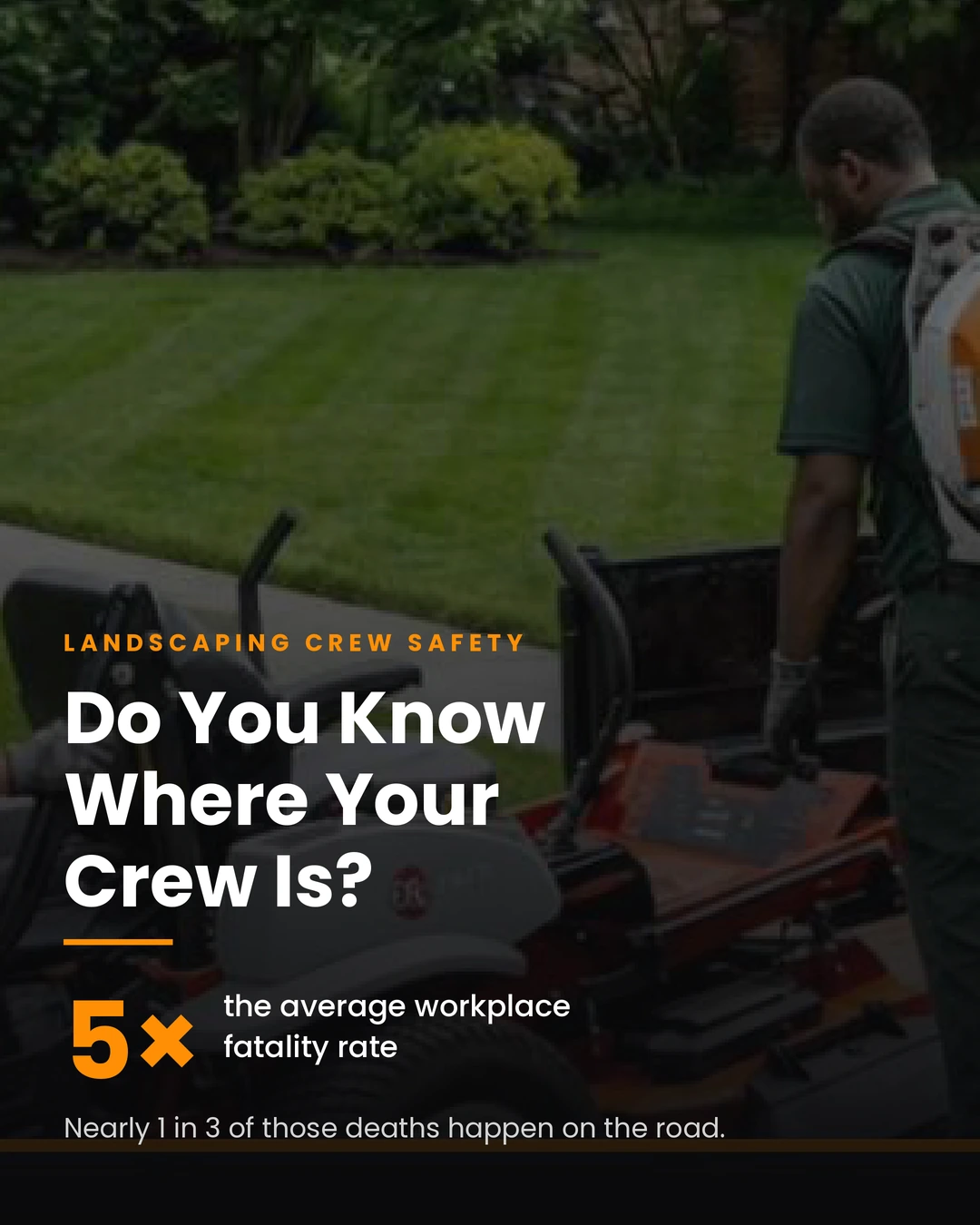
According to the U.S. Bureau of Labor Statistics, grounds maintenance workers died on the job at a rate of 19.1 per 100,000 full-time workers, compared to 3.8 per 100,000 across all private industry (BLS, 2021). That is roughly five times the average American workplace, which puts this work in the same risk tier as agriculture and mining.
This is not a small problem, and it is not improving on its own. BLS recorded 102 deaths among landscaping and groundskeeping workers in 2023, and fatalities across the broader building and grounds cleaning and maintenance category rose to 356 in 2024, up from 337 the year before (BLS Census of Fatal Occupational Injuries).
Here is the part that should change how you run your operation. The single largest cause of these deaths is not mowers, not chainsaws, not falling limbs. It is the road. Nearly one third of grounds maintenance worker fatalities are transportation related (BLS CFOI), which means the most dangerous part of your crew's day is often the part you have the least visibility into: the time they spend driving between the yard and the job, and between jobs.
That is the gap. The moment a truck pulls out of your lot, you lose your picture of where it is and how it is moving, right at the point when your people are most exposed.
In an Emergency, "I Think They're at the Smith Job" Is Not an Answer
When a crew member goes down from the heat, a truck rolls on the highway, a chainsaw kicks back, or a piece of equipment pins someone, the response starts with a single question: where are they? If your answer is a guess, you have already lost time you cannot get back.
The cruel math of an emergency is that the people most likely to need help are the ones least able to tell you where they are. A worker in heat stroke is confused or unconscious (those are the defining symptoms, according to OSHA). A driver in an accident may not be in a position to read you a street address. A foreman whose phone is sitting in the truck cab while he is up in a bucket is not answering your call.
This is the hidden cost of running blind that never shows up on a profit and loss statement. It is not labor leakage or wasted fuel. It is the forty minutes you spend reconstructing a schedule while someone needs an ambulance.
Knowing, live, which truck is at which address turns those forty minutes into forty seconds. You are not promising your crews that you can prevent every accident. You are promising them that if one happens, you will know exactly where to send help.
Heat Is the Hazard Getting Regulated Right Now
Of all the hazards your crews face, heat is the one regulators are moving on hardest. OSHA reports that heat related illness is the leading cause of weather related death in the United States, and outdoor crews doing heavy physical work through the summer are squarely in the highest risk group (OSHA).
The enforcement side just got more serious. OSHA's original heat National Emphasis Program expired in April 2026 and was immediately replaced by an expanded program that runs through April 2031. Under it, heat related inspections have climbed from roughly 200 a year to around 2,400 a year (OSHA). A federal heat standard has been proposed but not yet finalized, so the formal rules are still being written. The inspections, however, are already happening.
One detail from the proposed federal rule is worth flagging for anyone with trucks: it treats vehicles operated outdoors as outdoor work areas (OSHA proposed rule). In plain terms, the cab of a work truck on a hot day is exactly the kind of environment the agency is looking at.
And here is the statistic that should change how you handle your newest hires: OSHA's findings indicate that a majority of heat deaths occur within a worker's first three days on the job, before their bodies have had a chance to acclimatize (OSHA). Those first few days are precisely when you most need to know where a new crew member is and whether the truck they are riding in is where it is supposed to be.
You cannot control the weather. You can control whether you know where your people are when the heat index spikes, so you can move start times earlier, pull a crew when conditions turn dangerous, and confirm the truck actually left the job when you told it to.
Visibility Is the Foundation Everything Else Sits On
Let me be straight about what a GPS tracker is and is not. Alertrax tracks your trucks, trailers, and equipment. It is not a wearable that monitors a worker's heart rate or detects a fall. If you want a dedicated man down device, that is a different product.
What asset tracking gives you is the layer underneath all of it: a continuously updated answer to "where is that crew right now," because the truck and the crew are in the same place. That is the foundation of any emergency response, and it does a few other things that matter for keeping people safe and keeping yourself protected.
You see when a truck stops moving and stays stopped when it should be working. You get alerted when an asset moves after hours, when nobody should be on it. And because every arrival and departure is timestamped automatically, you build a record of where your crews were and when, the kind of documentation that matters when an incident happens and someone asks what time the crew arrived, how long they were on site, and whether they were where they were supposed to be.
In an enforcement climate where inspections are climbing, having a clean, automatic record of your operation is not paranoia. It is just good business.
Why Alertrax Fits How Crews Actually Work
Most GPS systems were built for over the road logistics fleets, long haul trucks with constant power and a single dedicated driver. Your operation does not look like that. You have work trucks, trailers, mowers, and skid steers moving between crews and job sites every day, much of it with no power to wire into.
Alertrax was engineered for that reality.
- One-Year Battery Life, No Wiring Required: Alertrax runs on a self-contained battery that lasts a full year in normal use. No splicing into a vehicle's electrical system, no OBD-II ports, no installation appointments. Mount it and it works.
- Track Anything That Moves: Because there are no wires, you can put Alertrax on work trucks, trailers, mowers, skid steers, and any equipment that leaves the yard. Every asset visible, every crew accounted for.
- Live Fleet Map: The Alertrax Fleet Portal shows every tracked truck and piece of equipment on a single live map, from your phone or your desk. The five-second answer to "where is everyone right now."
- Automatic Time-on-Site Logging: Every arrival and departure is recorded with a timestamp, with no check-in apps and no crew input. Your record of who was where, and when.
- Geofence and After-Hours Alerts: Draw virtual boundaries around the yard, job sites, or supply stops. Get an instant notification when an asset arrives, departs, or moves when it should not.
- Tamper Notification: Get alerted the moment a tracked device is removed or disturbed, not the next morning.
- 100% Waterproof, Ruggedized Housing: IP67 rated and built to survive mud, rain, and the day-to-day abuse of field work.
- Covert Magnetic Mounting: Mounts magnetically to any steel surface. Tuck it under a bumper, inside a frame rail, behind a panel, with no visible antennas and no wires to trace.
- iOS and Android App: Check any asset's location from anywhere, the moment you need it.
Pricing That Costs Less Than One Bad Afternoon
You can equip your entire fleet with Alertrax for a low monthly rate, with no long-term contracts and no hidden fees.
(Want to own it outright? We offer a $599 Lifetime option for permanent, subscription-free tracking.)
Put the cost in context. A single heat-related OSHA citation, a single workers comp claim from an incident that took too long to respond to, or a single day spent not knowing where a truck and crew actually were, any one of those dwarfs what it costs to put a tracker on every asset you own. The system pays for itself the first time it answers "where are they?" when it actually counts.
And Yes, It Protects Your Equipment Too
This post is about your crews, but the same device pulls double duty. If a truck, trailer, or piece of equipment ever walks off, you have its live location to hand straight to law enforcement, and the after-hours movement alerts mean you find out the night it happens, not when you pull up to an empty yard the next morning.
One device, one platform. The tool that helps you keep your people safe also helps you keep your equipment where it belongs.
Know Where Your Crew Is, Before You Need To
The owners who sleep well are not the ones who never have an emergency. They are the ones who know that when something goes wrong, they can answer the only question that matters in the first sixty seconds: where is my crew, right now?
You do not need to overhaul anything to get there. You need a live map that tells you where every truck, trailer, and piece of equipment is, the moment you open your phone.
Visit www.buyalertrax.com today and put Alertrax on every truck, trailer, and piece of equipment in your fleet.
Sources
U.S. Bureau of Labor Statistics (2021): Grounds maintenance worker fatality rate of 19.1 per 100,000 full-time workers vs. 3.8 per 100,000 across all private industry
BLS Census of Fatal Occupational Injuries: 102 deaths among landscaping and groundskeeping workers (2023); 356 deaths among building and grounds cleaning and maintenance workers (2024), up from 337 in 2023
BLS Census of Fatal Occupational Injuries: Transportation incidents as the leading cause of grounds maintenance worker fatalities (nearly one third of deaths)
OSHA: Heat-related illness as the leading cause of weather-related death in the United States
OSHA: Expanded heat-related National Emphasis Program (effective through April 2031) and increase in heat-related inspections from roughly 200 to approximately 2,400 per year
OSHA: Heat stroke symptoms (confusion, unconsciousness); majority of heat-related deaths occurring within a worker's first three days on the job
OSHA Proposed Heat Injury and Illness Prevention Rule: Vehicles operated outdoors treated as outdoor work areas