You are sitting in front of an HOA board, and the contract you have held for three years is up for renewal. The work has been good. Then a board member leans forward and says, "I drove through the community last Saturday and the entrance islands hadn't been touched. Honestly, some weeks I'm not sure your crew even shows up. Are we getting what we pay for?"
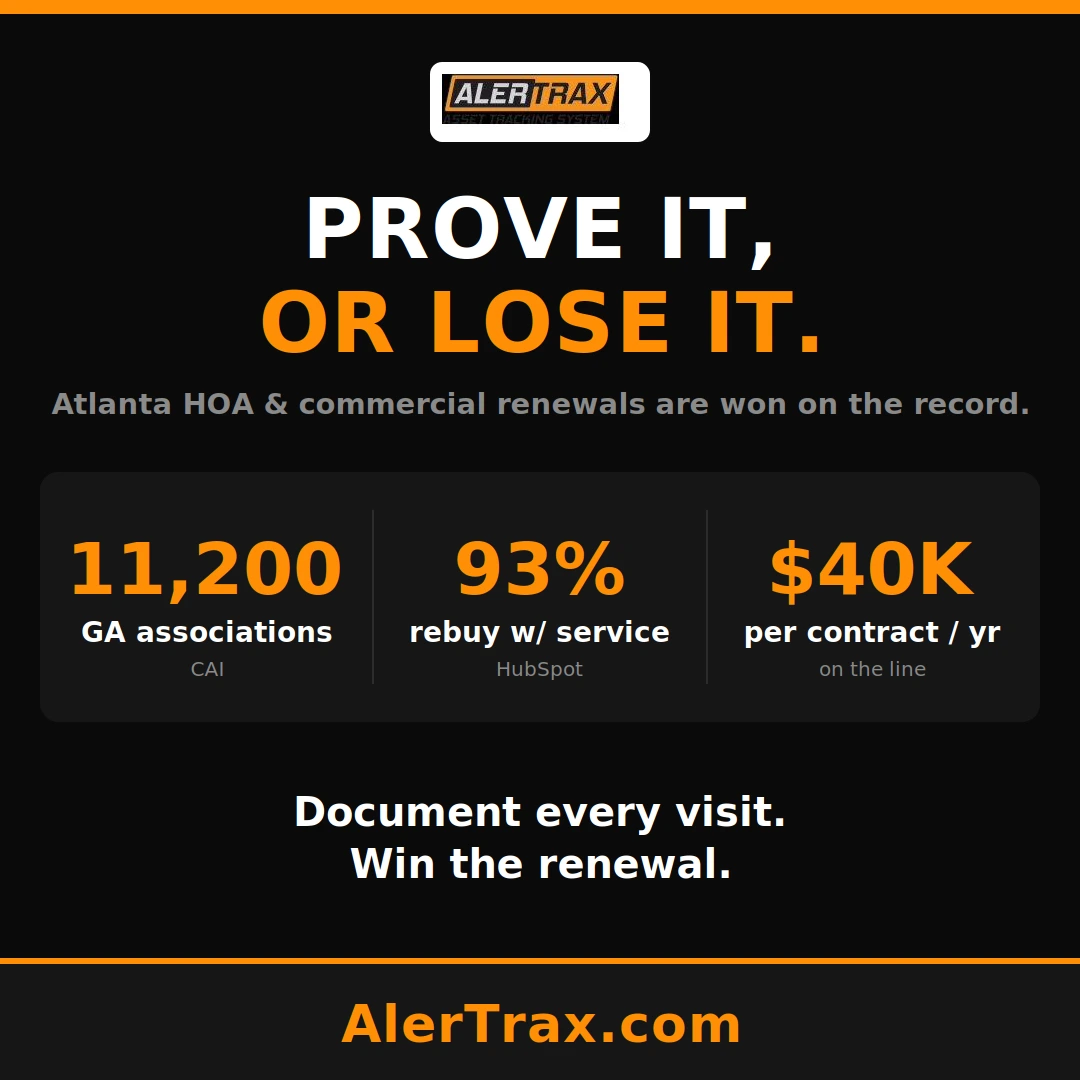
Everyone at the table turns to you. And all you have is your word. "We were absolutely there Thursday like always." Maybe you were. You probably were. But you cannot prove it, and now a $40,000-a-year contract is hanging on whether five volunteers believe you over one neighbor's Saturday drive-by.
This is the moment that decides commercial and HOA work in metro Atlanta. Not the quality of the cut. The quality of the proof. The companies that keep these accounts year after year are not necessarily the best landscapers in town. They are the ones who can show, on demand, exactly when their crew arrived, how long they stayed, and that every scheduled visit happened, without a single "trust me" in the conversation.
Metro Atlanta Runs on Recurring Contracts
In a lot of landscaping markets, the bread and butter is one-off residential work. Metro Atlanta is different. It is one of the densest community-association and commercial-property markets in the country, and that is where the real recurring money is.
Georgia is home to roughly 11,200 community associations covering about 2.3 million residents and 874,000 homes (Community Associations Institute), and the vast majority of that is concentrated in metro Atlanta's master-planned communities, townhome developments, and condo associations. Nationally, the Foundation for Community Association Research notes that the assessments these associations collect fund a specific short list of essential services, and landscaping and common-area maintenance sit right at the top of it. In other words, in HOA country, landscaping is not a nice-to-have. It is one of the core line items every board is watching.
Layer the commercial side on top of that. Metro Atlanta has one of the largest corporate footprints in the nation, with one of the country's heaviest concentrations of Fortune 500 headquarters and corporate campuses. Office parks, retail centers, and corporate properties all run on recurring maintenance contracts managed by professionals who answer to owners and tenants. Between the HOAs and the commercial accounts, a huge share of an Atlanta landscaping company's revenue is not one-time jobs. It is annual contracts that renew, or do not, every single year.
A Renewal Isn't Won on Quality. It's Won on Trust.
Here is what makes recurring contracts so different from one-off work. With a one-time job, you do the work, you get paid, the relationship is over. With an HOA or commercial contract, you are asking a board or a property manager to bet on you again, every year, often in front of other people who second-guess the decision. That bet is built on trust, and trust is built on whether they ever have to wonder if you showed up.
The economics make this enormous. A single HOA or commercial maintenance contract can be worth tens of thousands of dollars a year, and a property management company often controls a whole portfolio of them. When you lose one account over a "we're not sure you're really servicing us" doubt, you are rarely losing one contract. You are losing your standing with the manager or board that controls the next five.
The customer-experience research is blunt about how much responsiveness and reliability drive renewals. HubSpot Research found that 93 percent of customers are likely to buy again from companies that deliver excellent service. Khoros reports that 83 percent of customers feel more loyal to brands that respond and resolve issues quickly. And Bain & Company found that businesses that prioritize the customer experience grow revenues 4 to 8 percent above their market average. For a landscaping company living on annual renewals, that is not soft stuff. That is the difference between a shrinking route and a growing one.
"Did Your Crew Actually Come?" Should Never Be a Debate
The single most damaging conversation in contract landscaping is some version of "we don't think your crew was here." On a recurring property nobody is standing there watching, so the customer's impression is formed by a drive-by, a glance out an office window, or a single resident's complaint. If your only answer is your crew's memory, you are defending a five-figure contract with a he-said-she-said.
It gets worse in Georgia specifically, where HOA oversight is tightening. The state recently passed new community-association legislation (SB 406) that phases in stricter record-keeping and formal homeowner-complaint procedures for associations. Boards are under more pressure than ever to document that the money they collect is being spent on services actually delivered. A vendor who can hand them clean records of every visit is not just easier to trust. They make the board's own compliance easier, which makes you the contractor they want to keep.
The fix is simple, and it is entirely within your control: stop relying on memory and start relying on records. When every visit is automatically documented with a timestamp, "did your crew come?" stops being a debate and becomes a report you pull up on your phone.
What Crew Visibility Gives You as Proof of Service
Crew visibility is not just knowing where your trucks are today. For contract work, it is an automatic, timestamped record of every service visit you have ever made, building itself in the background while your crews work.
- Geofence every HOA and commercial property. Draw a virtual boundary around each account, and the system automatically logs the moment a crew arrives and the moment it leaves, with zero input from the crew. Every property builds its own attendance record, week after week.
- Automatic time-on-site logging. You do not just prove the crew showed up, you prove how long they stayed. When a board questions whether a property is getting enough attention, you show them the actual minutes on site, visit after visit.
- Exportable trip reports. Pull a clean report by property and date range, dates, arrival times, departure times, and durations, and attach it to an invoice or hand it to a property manager. It is the receipt for the entire contract, ready before anyone asks.
- A live fleet map. When a manager asks whether you are servicing them this week, you answer in five seconds instead of "let me check with the crew."
Walk into a renewal meeting with a quarter's worth of documented visits and the conversation changes completely. There is nothing for the board to doubt, because you are not asking them to take your word. You are showing them the record.
Your Crews Won't Fight It. It Protects Them.
Owners worry crews will see tracking as a lack of trust. The research says the opposite. Surveys from TSheets and HR C-Suite found 95 percent of employees rate GPS tracking positive or neutral, 75 percent say it helps track their time accurately, and 50 percent say it actually builds trust with their employer.
On contract work, the data is squarely on the crew's side. When a resident files a "nobody came" complaint and your foreman knows for a fact his guys were there Thursday morning, the timestamped record clears them instantly, instead of leaving a hardworking crew under a cloud of suspicion they cannot disprove. Good crews want the receipts. The record only threatens the ones who were cutting corners on the properties no one was watching.
Introduce it honestly as a tool for proving your work and protecting the crew, and resistance drops to nearly zero.
Why Alertrax Is Built for Contract Landscaping
Most GPS systems were designed for long-haul logistics: hardwired installs, constant vehicle power, dedicated drivers. A landscaping operation servicing dozens of HOA and commercial properties is different. Your trucks, trailers, mowers, and skid steers move between crews and accounts every day, and you do not have time for installation appointments.
Alertrax was engineered for the way contract landscaping fleets actually run.
- Geofence and Visit Logging: Set boundaries around every customer property and automatically capture arrivals, departures, and after-hours movement, your proof of service builds itself.
- Automatic Time-on-Site Logging: Every arrival and departure timestamped, so you can prove not just that you came, but exactly how long you serviced each account.
- Exportable Trip Reports: Address, arrival, departure, duration, and mileage for every vehicle, every day, in PDF or CSV, ready to attach to an invoice or hand to a board.
- Live Fleet Map: Every asset on one live map from the Fleet Portal or the iOS and Android app.
- One-Year Battery Life, No Wiring Required: Runs over a year on two AA batteries. No splicing, no OBD-II port, no install appointment. Mount it and it works.
- Track Anything That Moves: Trucks, trailers, mowers, skid steers, and equipment, one platform across every account in your portfolio.
- 100% Waterproof, Ruggedized Housing: IP67 rated, covert magnetic mounting, built to survive rain, mud, and pressure washing.
Pricing That Pays for Itself on a Single Saved Contract
You can equip your entire fleet for a low monthly rate, with no long-term contracts and no hidden fees.
(Want to own it outright? We offer a $599 Lifetime option for permanent, subscription-free tracking.)
Do the math on a single account. If documented proof of service saves just one HOA or commercial contract worth $40,000 a year that you would otherwise have lost to a "we're not sure you're showing up" doubt, the entire tracking system has paid for itself many times over, from one renewal. In a metro built on recurring contracts, the ability to prove your work is not an expense. It is account-retention insurance, and the cheapest you will ever buy.
And Yes, It Protects Your Equipment Too
The same device documenting your visits is watching your equipment around the clock. Equipment theft costs the industry an estimated $400 million annually, and 40 percent of stolen landscaping equipment is never recovered (AMAROK / NER), with a single truck out of service costing up to $4,000 a day in lost revenue (AMAROK). With after-hours movement alerts, you know within minutes if a trailer leaves the yard overnight, and you have a live location to hand to law enforcement. It is not the reason to put GPS on your fleet. It is the bonus that comes with it.
Be the Vendor They Never Have to Wonder About
Every Atlanta landscaping company chasing HOA and commercial work is competing for the same renewals in front of the same boards and property managers. The ones who keep those accounts year after year are not winning on the quality of the cut alone. They are winning because their customers never have to wonder whether the work got done. The record answers the question before it is even asked.
That kind of proof does not require new habits from your crews or new software for anyone to learn. It takes one device per asset, mounted in under a minute, quietly documenting every visit so that when the renewal conversation comes, you are holding the receipts.
Visit www.buyalertrax.com today and turn every service visit into proof you can put on the table.
Sources
Community Associations Institute (CAI), "Georgia: ~11,200 community associations, ~2.3 million residents, ~874,000 homes"
Foundation for Community Association Research, "Association assessments fund essential services including landscaping and common-area maintenance"
State of Georgia, "SB 406 phases in stricter HOA record-keeping and homeowner-complaint requirements"
HubSpot Research, "93% of customers likely to repeat purchase with excellent service"
Khoros, "83% feel more loyal to brands that respond and resolve quickly"
Bain & Company, "Companies prioritizing customer experience grow revenues 4-8% above market"
TSheets / HR C-Suite, "95% of employees rate GPS tracking positive or neutral; 75% say it tracks time accurately; 50% say it builds trust"
AMAROK / NER, "$400M annual equipment theft losses; 40% never recovered; up to $4,000/day lost revenue per truck"