It is 6:10 on a Tuesday morning. Your install crew is standing in the yard with coffee going cold, and the aerator is not on the trailer. Nobody remembers loading it Friday. Somebody thinks it went out with the Timonium crew. Somebody else thinks it is still sitting behind the shed at the Crofton property because the customer asked them to leave it overnight.
So you start making calls. Twenty minutes later you find it. It is at the Crofton property. The crew that needs it is forty minutes the other direction. Two guys drive out to get it, and now a five hour install job is a six and a half hour install job that you quoted at five.
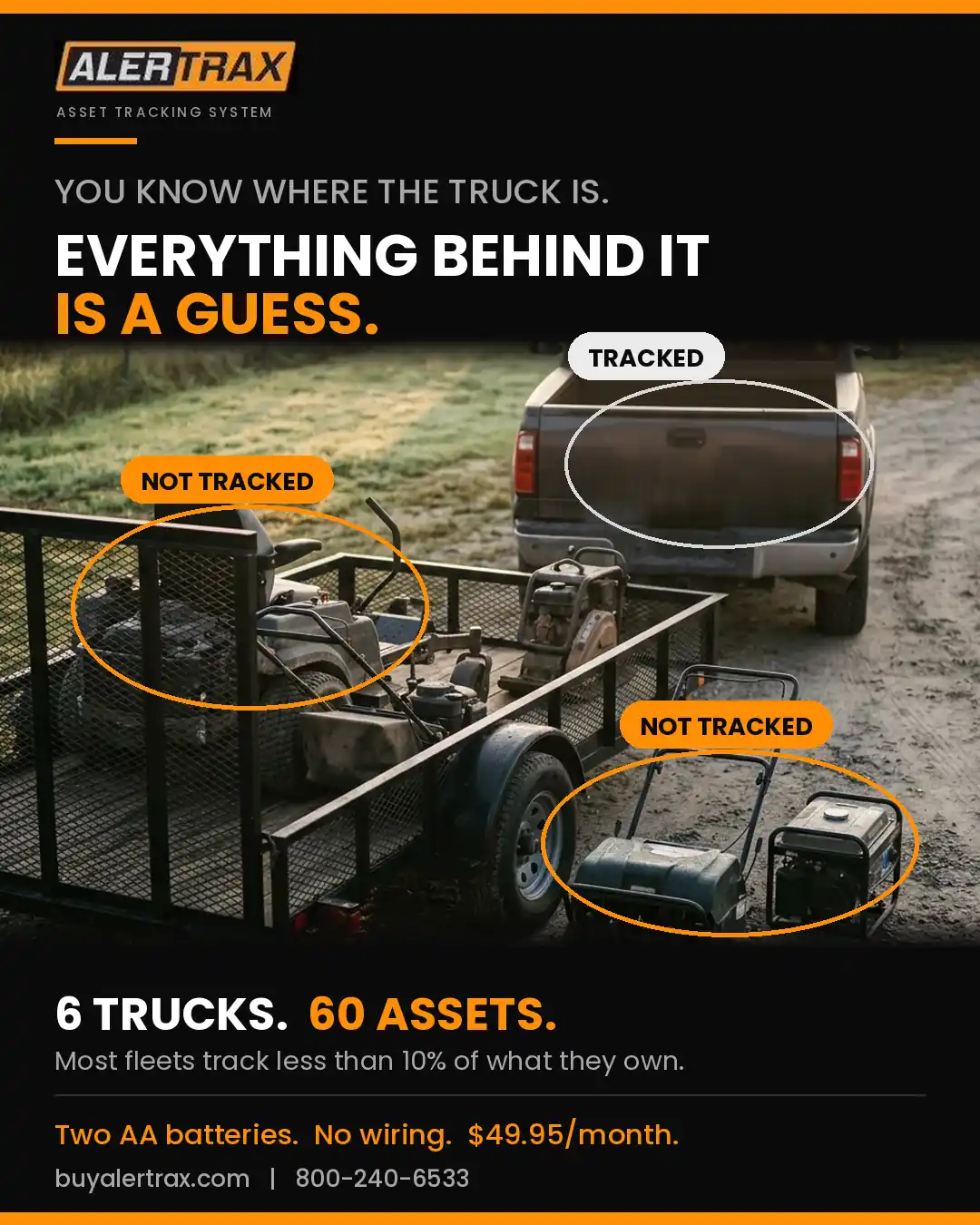
Here is what makes that morning worth thinking about. You almost certainly know where your trucks were. Most owners with four or more trucks have some kind of vehicle tracking by now. What you do not know is where the aerator was, or the plate compactor, or the dump trailer, or the walk behind. And in a landscaping or hardscaping operation, that unpowered equipment is where the actual work gets done.
The trucks are not the blind spot. Everything behind them is.
Your Fleet Is Much Bigger Than Your Truck Count
Ask an owner how big their fleet is and you will hear a truck number. Six trucks. Eleven trucks. That number is how the industry talks about itself, and it badly understates the actual asset count.
Walk the yard of a company with six trucks and count what is actually there. Six trucks, sure. Then eight to twelve trailers, because most crews run a dedicated trailer and you keep spares for material hauling and equipment moves. Then the mowers, six to fifteen of them across zero turns, stand ons, and walk behinds. Then the aerators, dethatchers, sod cutters, plate compactors, walk behind saws, generators, pressure washers, mini skids, and the stump grinder you bought last spring.
A six truck company is routinely a sixty asset company. The trucks are less than ten percent of what you own and less than ten percent of what you need to find on any given morning.
The scale of the workforce operating that equipment is documented. The U.S. Bureau of Labor Statistics reported in its May 2023 Occupational Employment and Wage Statistics data that 703,880 building and grounds cleaning and maintenance workers were employed within the landscaping services industry (NAICS 561730), at a mean hourly wage of $20.82, with first line supervisors of landscaping and groundskeeping workers averaging $27.36 per hour (U.S. Bureau of Labor Statistics, May 2023). Every one of those workers arrives at a yard or a job site in the morning and needs a specific piece of equipment to be in a specific place.
And the asset count is growing in a direction that makes tracking harder, not easier. The American Rental Association reported on May 19, 2026 that the combined U.S. construction and industrial equipment and general tool rental industry is projected to reach $83.5 billion in 2026, up 3.6 percent, and specifically noted that the trend toward renting rather than owning continues (American Rental Association, May 19, 2026). More rented equipment on your job sites means more assets moving through your operation that you did not buy, cannot easily identify, and are paying a day rate on until they go back.
Why the Blind Spot Exists, and It Is Not Your Fault
There is a structural reason your equipment is untracked while your trucks are not, and it has nothing to do with how well you run your business.
Almost the entire fleet tracking category was designed around vehicles with 12 volt electrical systems. The hardware plugs into an OBD-II port or gets hardwired to a battery. That design assumption works fine for a truck and it makes the device permanently dependent on something your equipment does not have.
A dump trailer has no battery. A walk behind mower has a battery that sits dead all winter. A plate compactor has no electrical system worth speaking of. A generator has power only when it is running, which is exactly the fraction of time you least need to locate it. So the category simply skipped these assets, and the industry built a habit of calling the tracked vehicles "the fleet" and treating everything else as inventory you keep track of in your head.
The result is that the most stolen, most misplaced, most utilization sensitive assets you own are the ones nobody built tracking hardware for. That gap is not a small feature difference. It is the difference between tracking ten percent of your fleet and tracking all of it.
What the Blind Spot Actually Costs
The cost of not knowing where equipment is does not arrive as a line item. It arrives as a slightly longer morning, a slightly late arrival, a slightly padded estimate, repeated across every crew and every week of a season.
The construction sector has measured this more rigorously than the green industry has, and the findings transfer directly. FMI Corporation's 2023 Labor Productivity Study found that an estimated $30 billion to $40 billion is lost annually across the industry to poor labor productivity, and that 60 percent of survey respondents reported 11 percent or more of their field labor costs are wasted (FMI Corporation, 2023 Labor Productivity Study). The study identified planning, communication, and collaboration as three of the top four internal factors driving those losses. Not knowing where a piece of equipment is sitting at 6 AM is a planning and communication failure in its purest form.
Apply that 11 percent figure to your own payroll and the number stops being abstract. On $600,000 in annual field labor, 11 percent is $66,000. Not all of that is equipment location. But equipment location is one of the few causes on that list you can fix with a device rather than a culture change.
The Morning Scramble Has a Number
Here is the arithmetic on a single recurring problem. The inputs below are illustrative placeholders, not survey findings. Substitute your own crew size and wage and the shape of the result holds.
Say a four person crew loses 20 minutes twice a week to locating equipment, waiting on a piece that is somewhere else, or driving to retrieve it. That is 40 minutes of crew time per week, multiplied by four people, which is 2.7 crew hours weekly. At the BLS mean landscaping wage of $20.82 per hour, before any labor burden, that is about $56 a week. Across a 40 week season, one crew loses roughly $2,240 in wages to equipment location alone.
Run four crews and you are near $9,000 a season. And that figure counts only the wages. It does not count the fuel on the retrieval trip, the job that started 40 minutes late and pushed the next job, the customer who noticed, or the estimate you now have to pad next year because your actual hours keep running over.
Once the number exists, it is hard to unsee. A device that costs $49.95 a month does not have to eliminate the problem to pay for itself. It has to eliminate about a quarter of it.
The Equipment You Buy Twice
There is a quieter version of this cost that shows up on your balance sheet instead of your payroll.
When you cannot verify where a piece of equipment is or how often it actually gets used, the safe decision is always to buy another one. A second aerator so the north crew and the south crew both have one. A third plate compactor because the hardscape crews keep colliding over the two you have. A spare trailer because loading and unloading between crews is a hassle.
Sometimes that is the right call. Often it is capital spent to solve a visibility problem. If you could see that the aerator sat unused nineteen days out of twenty two last month, the answer was never a second aerator. The answer was scheduling.
Utilization data is the argument you cannot make without location history. Once every asset logs where it is and how long it sits, "should we buy another one" becomes a question with an answer instead of a hunch. For a company running on the kind of margins typical in this industry, avoiding one unnecessary $6,000 equipment purchase per year is a meaningful line on the P&L.
Rented Equipment Raises the Stakes
The ARA data on the ownership to rental shift matters here for a specific operational reason. Rented equipment carries a running meter.
When you own a mini skid and it sits at a job site an extra four days because nobody remembered it was there, you lose utilization. When you rent one and it sits an extra four days, you lose actual dollars at a daily rate, plus the argument with the rental yard about who is responsible for the overage.
The same applies in reverse. Rental yards increasingly want to know their equipment is where the contract says it is. A contractor who can produce location history for a rented machine is a contractor who gets better terms and fewer disputes. As rental penetration keeps climbing, being the company that can document where the rented gear went stops being a nice touch and starts being a competitive position.
What Tracking an Unpowered Asset Actually Requires
Tracking a truck and tracking a trailer are different engineering problems. A truck tracker can draw all the power it wants. An equipment tracker has to survive on its own for a season, mount to something that was never designed to hold electronics, and take weather, mud, and pressure washing without complaint.
AlerTrax was built for the second problem.
- Runs on two AA batteries: Over one year of battery life in low movement use, four to six months under heavy daily movement. No wiring, no OBD-II port, no vehicle power, no installation appointment.
- Mounts to anything: An 8 lb magnet, screw mounts, or zip ties. Put it on a trailer tongue, a mower deck, a generator frame, a compactor housing, or the underside of a skid steer.
- IP67 waterproof and salt water protected: A ruggedized housing at 3.2 by 1.8 by 1.6 inches and 5.3 ounces, built to survive being hosed down along with the equipment it is attached to.
- Live location on one map: Every truck, trailer, mower, and machine on a single view in the AlerTrax fleet portal or the mobile app, with location updates as often as every 2 minutes when an asset is moving.
- GNSS, WiFi, and LTE positioning: GPS, GLONASS, GALILEO, and BEIDOU for 30 foot accuracy outdoors, with WiFi and LTE fallback so an asset parked inside a shop or a shipping container still reports in.
- Automatic time on site logging: Arrival and departure timestamps recorded for every asset at every stop, with no crew input required. This is your utilization data and your job costing data in the same feed.
- Geofence and after hours movement alerts: Draw a boundary around the yard, a customer property, or a storage lot. Get notified when an asset crosses it, including at 2 AM when nothing should be moving.
- Tamper notification: If the device is removed from the asset it is mounted to, you find out within minutes.
- AddressFence: Upload your customer address list and receive arrival and departure alerts for those properties automatically, without drawing each boundary by hand.
- TeamTrax: A free companion app that puts crew phones on the same map as the equipment, so you can see people and machines together instead of in two systems.
Pricing
AlerTrax is $49.95 per month per device, with no long term contract and no hidden fees. (A $599 Lifetime option is available if you would rather own the tracking outright with no subscription.)
Most owners do not start by tagging all sixty assets. They start with the five or six pieces that cause the most trouble: the dump trailer, the two aerators, the mini skid, the generator. Those are the ones that go missing, get left behind, and hold up mornings. If those five stop causing problems, the case for the rest makes itself.
And Yes, It Helps When Something Gets Stolen
This post is about knowing where your equipment is on a normal Tuesday. But the same gap that makes equipment hard to find makes it easy to steal.
The National Equipment Register and the National Insurance Crime Bureau estimate annual U.S. losses from construction and farm equipment theft at $300 million to $1 billion, a range that reflects how much theft never gets reported because owners absorb smaller losses rather than trigger a claim. Among portable equipment, generators and light towers are frequent targets, and recovery for tools and small equipment falls below 7 percent (National Equipment Register and National Insurance Crime Bureau). CONEXPO-CON/AGG reported in March 2023 that roughly 1,000 pieces of construction equipment are stolen per month in the United States (CONEXPO-CON/AGG, March 2023).
The pattern holds across every unpowered asset category. NICB published an analysis on August 3, 2026 of 2025 recreational vehicle thefts and found that of 58,957 units reported stolen, about 63 percent were never recovered, with ATVs the worst at a 23 percent recovery rate (National Insurance Crime Bureau, August 3, 2026). NICB noted that recovery odds track how quickly the theft is discovered and reported.
That last point is the whole argument. A stolen trailer discovered Monday morning is already gone. A stolen trailer that triggers an after hours movement alert at 1:40 AM is a phone call to police with a live location attached. The device does not prevent the theft. It compresses the window between the theft and the report, and that window is what determines whether you see the equipment again.
Start With the Five That Cause the Most Trouble
You do not have a truck tracking problem. You solved that one. You have an everything else problem, and it exists because the tracking industry spent twenty years building hardware that needs a battery your equipment does not have.
Pick the five assets that have cost you the most mornings this season. Put a tracker on each one. Give it a month and look at the location history. You will either find out the problem was smaller than you thought, or you will find out exactly where your season has been going.
Visit www.buyalertrax.com to get started, or call 800-240-6533 and we will talk through which assets to tag first. Questions can also go to sales@buyalertrax.com.
Paul
NautAlert, LLC
Sources
U.S. Bureau of Labor Statistics, Occupational Employment and Wage Statistics, May 2023, NAICS 561730 Landscaping Services. Employment of 703,880 in building and grounds cleaning and maintenance occupations; mean hourly wage $20.82; first line supervisors of landscaping, lawn service, and groundskeeping workers mean hourly wage $27.36.
American Rental Association, updated North American equipment and event economic forecast, published May 19, 2026. Combined U.S. construction and industrial equipment and general tool rental industry projected at $83.5 billion in 2026, up 3.6 percent; continued shift toward renting over ownership.
FMI Corporation, 2023 Labor Productivity Study. Estimated $30 billion to $40 billion lost annually to poor productivity industry wide; 60 percent of respondents reported 11 percent or more of field labor costs wasted; planning, communication, and collaboration identified among the top four internal factors affecting productivity.
National Equipment Register and National Insurance Crime Bureau, annual equipment theft reporting. Estimated $300 million to $1 billion in annual U.S. construction and farm equipment theft losses; generators and light towers cited as frequent portable equipment targets; recovery rate for tools and small equipment below 7 percent.
CONEXPO-CON/AGG, industry briefing, March 28, 2023. Approximately 1,000 pieces of construction equipment stolen per month in the United States.
National Insurance Crime Bureau, recreational vehicle theft analysis published August 3, 2026, covering calendar year 2025. 58,957 recreational vehicles reported stolen, a 20 percent decline from 2024; approximately 63 percent never recovered; ATV recovery rate of 23 percent on 11,050 units reported stolen.
Note on illustrative arithmetic: The crew time calculation in "The Morning Scramble Has a Number" uses placeholder inputs (four person crew, 20 minutes lost twice weekly, 40 week season) applied to the BLS mean hourly wage. These inputs are illustrative examples chosen to demonstrate the calculation method. They are not survey data and are not drawn from any published study of equipment location time loss.