You didn't start a landscaping company because you wanted to spend your day making phone calls to find out if people are doing their jobs.
You started it because you're good at the work. You understand properties, you know how to build and maintain beautiful outdoor spaces, and you saw an opportunity to build something of your own. The plan was always to hire good people, put them in trucks, and trust them to deliver.
But somewhere between three crews and eight, trust alone stopped being enough.
Not because your people are bad. Most of them are doing exactly what they're supposed to do. But when you can't physically be on every job site, you start relying on phone calls, text check-ins, and end-of-day recaps that may or may not be accurate. You're not managing — you're guessing. And the bigger you get, the more that guessing costs you.
In an industry where labor consumes 30% to 50% of total revenue (Aspire, 2025) and the annual employee turnover rate runs around 42% (Wifitalents, 2023), the challenge isn't just finding good people. It's building a system that keeps operations tight without requiring you to hover over every crew, every day.
GPS tracking solves this — not as a surveillance tool, but as a management layer that gives everyone clarity, eliminates guesswork, and actually makes crews' lives easier in the process.
The Micromanagement Trap
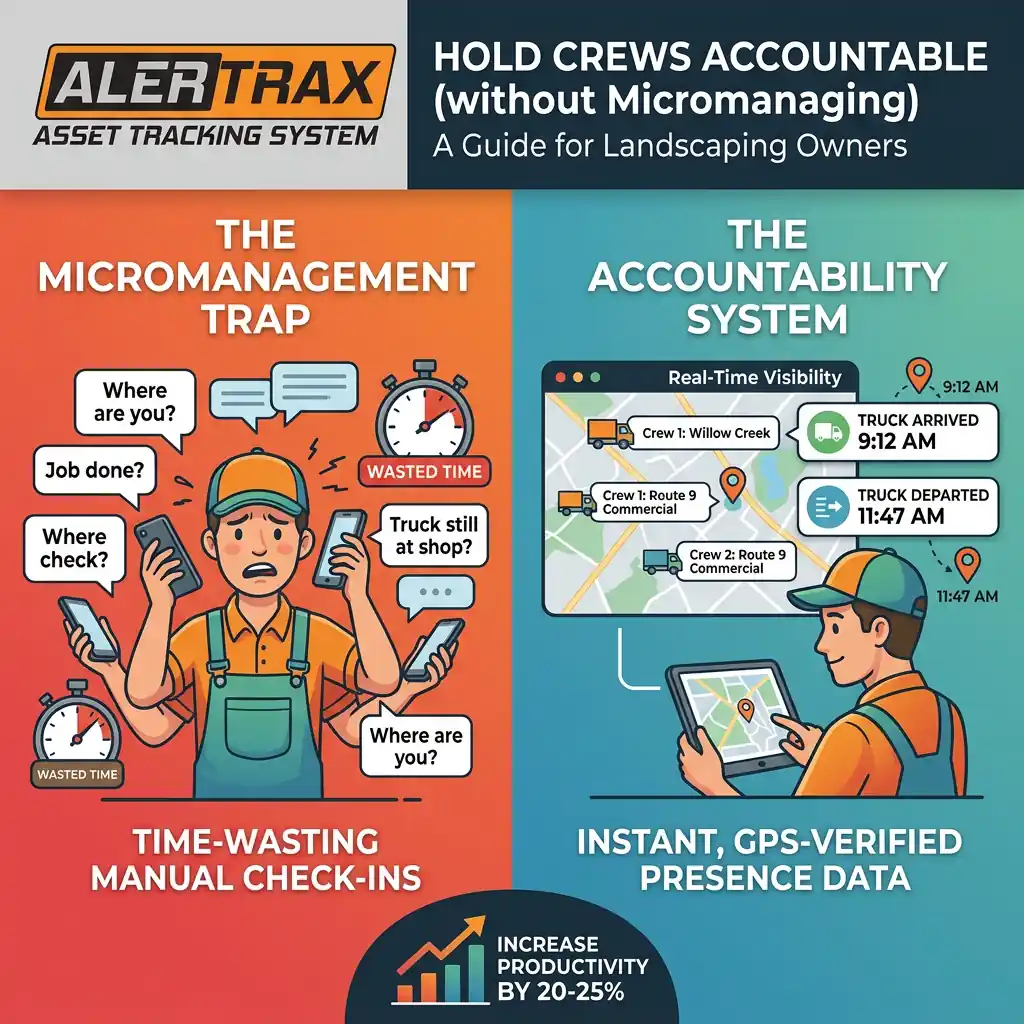
There's a pattern that plays out in almost every growing landscaping company. At three crews, the owner knows where everyone is because they're still in the field themselves. At five or six crews, the phone starts ringing constantly. "Where's Crew 3?" "Did anyone go to the Willow Creek property today?" "Why is the truck still at the shop at 8:30?"
The natural response is to check in more. More calls. More texts. More morning meetings that eat into production time. Some owners start driving between job sites just to see what's happening. This is micromanaging, and it's a trap — because it eats the owner's time, frustrates the crews, and still doesn't give you reliable information.
The core problem isn't effort. It's visibility. You're working hard to stay informed, but the information you're getting is fragmented, delayed, and filtered through whoever happens to answer the phone. What you need isn't more check-ins. You need a system that gives you the full picture without requiring anyone to stop what they're doing.
What Accountability Actually Looks Like
True accountability in a field operation isn't about catching people doing something wrong. It's about creating an environment where expectations are clear, performance is measurable, and everyone — owner, crew lead, and crew member — is working from the same set of facts.
GPS tracking provides exactly that. The device logs when each truck arrives at a property and when it departs. No manual entry. No crew check-ins. No paperwork. Just timestamped, location-verified records of where every vehicle was throughout the day.
This changes the entire dynamic. Instead of asking "did you go to the Henderson property?" and getting a defensive answer, you already know. The truck arrived at 9:12 AM and departed at 11:47 AM. The conversation shifts from interrogation to coaching: "I noticed Ridgewood is consistently taking 40 minutes longer than we estimated — what's happening on that property that we should account for?"
That's not micromanaging. That's managing.
The Data That Replaces the Phone Calls
Consider how much time the average landscaping company owner spends each day just figuring out where people are. Calls to crew leads. Texts that don't get answered because the mower is running. Driving across town to check on a job that should've been finished an hour ago.
GPS fleet tracking data from operators across industries shows 30 to 60 minutes of unproductive time per vehicle per day before tracking is implemented (Spytec GPS, 2026). But there's a mirror image to that number: the owner and office staff are also losing 30 to 60 minutes per day chasing down information that a single screen would provide instantly.
Open the fleet tracking app and every truck is on the map. Crew 1 is on site at Maple Ridge — been there since 7:45. Crew 2 is in transit between jobs, should arrive in eight minutes. Crew 3 is at the commercial property on Route 9. Crew 4 hasn't left the shop yet. That last one is the only one that needs a phone call — and you spotted it in five seconds instead of forty-five minutes.
This is what GPS tracking replaces: not trust, but the inefficient, time-consuming, frustrating process of trying to maintain visibility without a system. Companies using GPS fleet management report productivity increases of 20% to 25% through streamlined operations and reduced coordination time (US Fleet Tracking).
Why Crews Actually Prefer It
Here's the part that surprises most owners: the crews usually end up liking GPS tracking more than management does.
According to one independent survey, 95% of employees who had experience with GPS tracking at work described their experience as positive or neutral (TSheets / HR C-Suite). Only 5% responded negatively. Three out of four employees said they believed GPS tracking would help them more accurately track mileage and travel time, ensure paycheck accuracy, and keep them safer on the job. Another 50% said they believed it would help them work more efficiently and build trust with their employer.
The reason is straightforward: good employees are already doing their jobs. GPS data proves it. When a client calls and claims the crew didn't show up on Thursday, the data shows they were on site from 8:30 to 11:15. When the owner wonders why the Tuesday route ran late, the GPS shows a 40-minute traffic delay on the highway — not a lazy crew. When payroll questions come up, the arrival and departure records provide objective documentation that protects the crew member as much as it protects the company.
The employees who resist GPS tracking are almost always the ones who have something to hide. And in an industry with 42% annual turnover (Wifitalents, 2023) where 72% of owners cite labor as their biggest barrier to growth (Aspire, 2025), identifying and addressing accountability issues early is worth far more than the cost of the tracker.
Setting Expectations the Right Way
The difference between GPS tracking that builds trust and GPS tracking that destroys it comes down to how you introduce it. The technology is the same either way — the rollout makes all the difference.
The companies that get the most out of GPS tracking are transparent about it from day one. They explain what the tracker does: it logs vehicle location during work hours. They explain what it doesn't do: it doesn't listen to conversations, it doesn't track personal vehicles, and it doesn't monitor anyone off the clock.
Most importantly, they frame it as a tool that benefits the crew. Accurate time records mean accurate paychecks. Proof of service protects them from false client complaints. Route data helps the company schedule more efficiently, which means less wasted windshield time and more reasonable workdays. And if a vehicle or trailer gets stolen, the tracker helps get it back.
When the message is "this helps all of us do our jobs better," buy-in follows. When the message is "I'm watching you," resistance follows. The technology is identical. The framing is everything.
From Reactive to Proactive Management
Without GPS data, landscaping management is almost entirely reactive. You find out about problems after they've already cost you money. The crew was late to a job — and you hear about it from an angry client. A property was skipped — and you don't know until the invoice is disputed. A truck took a 45-minute detour — and you only notice it in the fuel bill at the end of the month.
GPS tracking flips this to proactive management. You can see a crew running behind schedule at 10 AM and adjust the afternoon accordingly. You can identify a property that's consistently running over estimate and reprice it before it drains margin for another season. You can spot a route inefficiency and fix it the same week, instead of absorbing the wasted fuel and labor for months.
This shift from reactive to proactive is where the real ROI lives. Fleet tracking systems typically deliver 200% to 400% annual ROI (Traxelio / Spytec GPS), and seventy percent of fleets using GPS tracking report significant operational benefits (Heavy Duty Journal, 2026). Those numbers aren't just about fuel savings or theft prevention. They're about the compound effect of making better, faster decisions with better information — every single day.
The Accountability Flywheel
Something interesting happens when GPS tracking has been in place for a few months. The accountability problems that prompted you to consider tracking in the first place start to fade. Not because you're catching people and disciplining them, but because the system itself creates a culture of accountability.
Crews know the data exists, so they show up on time. They know idle time is visible, so they keep the truck moving between jobs. They know arrival and departure times are logged, so the temptation to shave thirty minutes off the end of the day disappears. It's not that people become robots. It's that the small, invisible slippage that costs landscaping companies thousands of dollars per year simply stops happening.
Studies estimate that businesses lose 5% to 10% of payroll costs annually to time theft — extended breaks, early clock-outs, and inflated hours. For a landscaping company with $400,000 in annual payroll, that's $20,000 to $40,000 per year in losses that GPS tracking virtually eliminates, often within the first few weeks of implementation (ShadowGPS / Spytec GPS).
Meanwhile, the crews that were already performing well get recognized for it. Their data is clean, their time-on-site records are solid, and they become the benchmark for the rest of the operation. Accountability, done right, rewards good work as much as it corrects bad habits.
And It Protects Your Assets While You Sleep
While GPS tracking is running your daily accountability system, it's also standing guard over your equipment after hours. The landscaping industry loses an estimated $400 million annually to equipment theft, and 40% of stolen equipment is never recovered (AMAROK). A single stolen truck can cost up to $4,000 per day in lost revenue.
Geofence alerts notify you instantly if a vehicle or trailer moves outside a designated boundary during off-hours. Live location data lets you guide law enforcement directly to the asset. The same device that tells you Crew 2 arrived at Maple Ridge at 7:45 AM alerts you at 2:00 AM if that truck leaves your yard without authorization.
It's 24/7 protection that runs silently in the background — no extra hardware, no extra cost, no extra effort. Just one more layer of value from a tool that's already paying for itself through better daily operations.
How Alertrax Makes It Simple
This is exactly why we built Alertrax.
Alertrax gives landscaping companies the crew visibility and operational data they need to manage with confidence — without the complexity of enterprise fleet software.
- Automatic Arrival and Departure Logging: Every stop is timestamped and location-verified. No manual entry, no crew check-ins, no paperwork. Just clean, objective data you can use for management, billing, and client communication.
- Live Fleet Map: See every truck on a single screen. Know who's on site, who's in transit, and who's running behind — without making a single phone call.
- Route History: Review exactly where each vehicle went throughout the day. Identify patterns, optimize schedules, and coach crews with data instead of assumptions.
- Ruggedized for Landscaping: 100% waterproof housing built to survive rain, mud, dust, vibration, and high-pressure washdowns. This is not a consumer car tracker.
- One-Year Battery, No Wiring: A massive self-contained battery lasts a full year. Mount it on a truck, trailer, mower, or skid steer — no electrical connections required.
- Geofence and After-Hours Alerts: Draw a boundary around your shop or yard. If anything moves outside it during off-hours, you get an instant alert.
Visibility That Pays for Itself
You can equip your fleet with Alertrax today for a low monthly rate — no long-term contracts, no hidden fees.
(Prefer to own it outright? We also offer a one-and-done $599 Lifetime option for permanent, subscription-free tracking.)
Consider what you're spending right now on the phone-tag, drive-by, end-of-day-recap approach to managing crews. Now consider that GPS tracking recovers $350 to $500 per truck per month in productivity, eliminates $20,000 to $40,000 per year in time theft losses, and gives you back hours of your own time every week. The device doesn't just pay for itself — it's one of the highest-ROI investments a growing landscaping company can make.
The Bottom Line
The best landscaping companies aren't built on trust alone. They're built on trust plus visibility.
GPS tracking doesn't replace the relationship you have with your crews. It strengthens it — by removing the guesswork, eliminating the uncomfortable phone calls, and giving everyone a shared set of facts to work from.
You hired your people because they're good at what they do. GPS data lets them prove it — and lets you manage your growing operation without becoming a full-time babysitter.
Stop managing by phone. Start managing with data.
Visit www.buyalertrax.com today to give your landscaping operation the visibility it needs to grow without losing control.
Sources: Aspire 2025 Landscaping Industry Report, Service Autopilot (2026), Spytec GPS (2026), US Fleet Tracking, TSheets / HR C-Suite Independent Survey, Wifitalents (2023), Heavy Duty Journal (2026), Traxelio, ShadowGPS, NALP (2025), AMAROK.